In many industries, flares are used to burn by-products with unwanted waste gases or flammable gases released by pressure control valves during unplanned pressure release from plant equipment.
Uses include oil and gas well drilling operations, oil refineries, chemical processing plants, gas distribution infrastructure and landfills. In many cases, regulations require monitoring of the flares or pilot flame that ignites the gases to prevent the release of unburned hydrocarbons into the atmosphere.
Automation thermal imaging cameras are an ideal monitoring tool because they allow automated remote monitoring 24 hours a day, 7 days a week, whatever the weather conditions. They also avoid many of the economic and technical problems associated with other technologies, such as ultraviolet (UV) flame detectors, flame ionization spectrometers, thermocouples and pyrometers.
FLIR automation cameras
- They verify combustion and minimize unburned pollutants.
- Instant notification of loss of combustion with visual and audible alarms.
- They allow remote visual monitoring with a TV or PC screen.
- They provide quantitative temperature readings .
- They allow notifications to be sent to plant management via e-mail and intranet connections.
- They can be connected to a central control room via Ethernet.
- They operate day and night, seven days a week, whatever the weather conditions.
Combustion is a complex process
Combustion systems are often the last line of defense against dangerous hydrocarbon pollutants entering the atmosphere. One example is methane, which, in addition to being a fuel, is 23 times more potent than CO2 as a greenhouse gas.
A plant manager must know immediately if flaring stops and must relight the flame quickly to avoid a plant shutdown.
Various technologies have been tried with varying degrees of success to monitor the pilot flame that ignites the gas flow and detect the flare flame. Many of these technologies are unhelpful or poor at minimizing flare combustion smoke, which is an important indicator of burn efficiency.
One problem is that gas flare flows can range from low volumes during fuel gas purges under normal operating conditions to large volume flows during emergency relief valve discharge or during a complete plant blowdown operation. The size and brightness of the flare flame and the amount of smoke generated depend on how flammable the material being released is. Gas assistants such as air or steam can be injected into the gas stream to enhance combustion and minimize smoke.
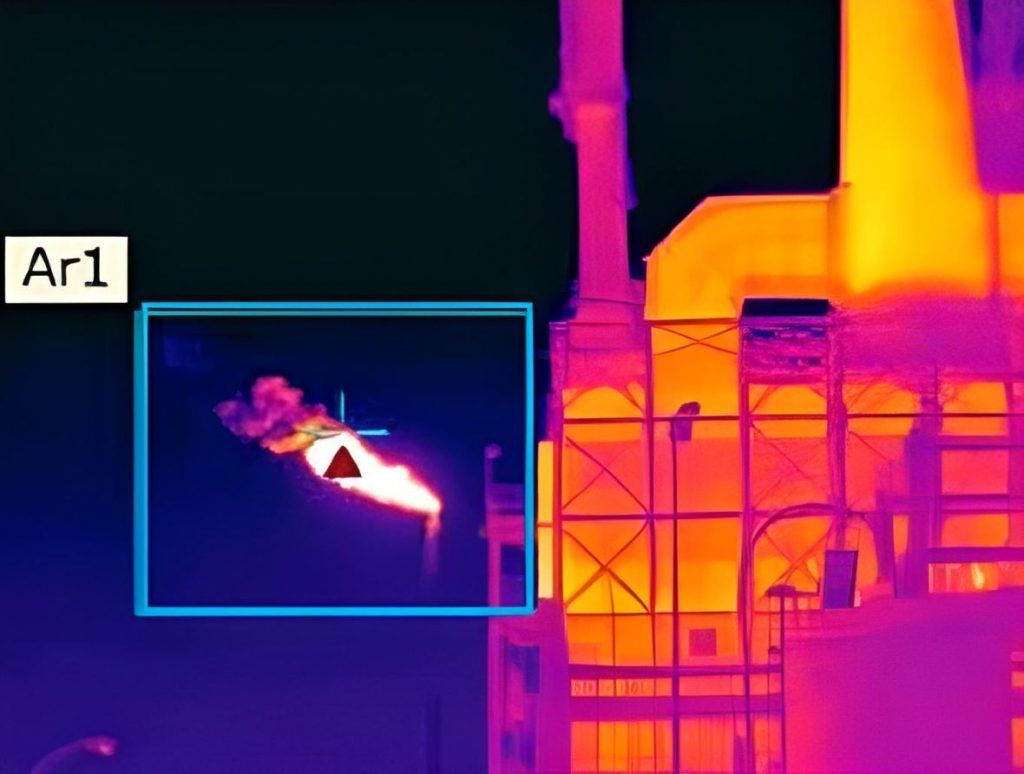
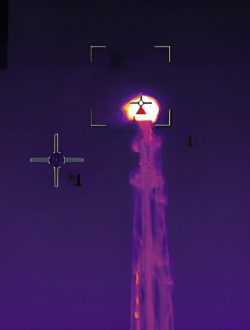
Although invisible to the naked eye, a thermal imaging camera can monitor whether a flare is burning or not. If the flare is not burning, harmful gases can enter the atmosphere. The cameras raise the alarm and allow immediate action to be taken.


FLIR thermal imaging cameras as a solution
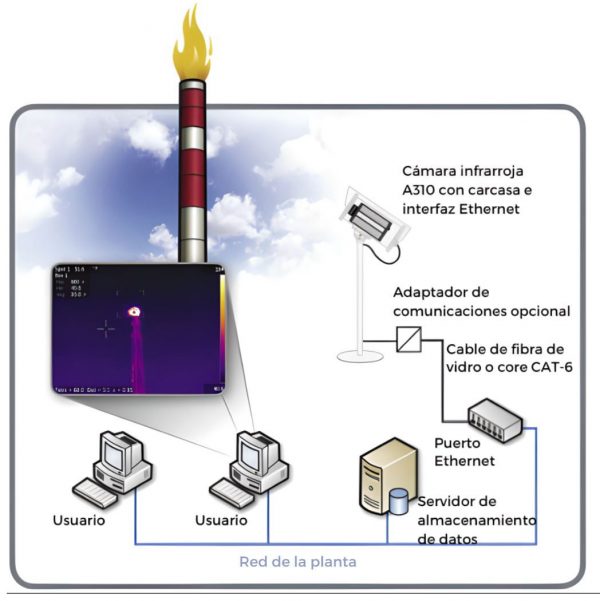
FLIR's thermographic automation cameras distinguish the difference in the heat signal of a torch flame and the surrounding background (typically the sky or clouds). In addition to detecting the flame of the torch, these automation cameras can be positioned to monitor the ignition flame. Typically, automation cameras for torch monitoring are installed on a pedestal or other rigid structure in moisture-resistant housings to protect them from adverse weather conditions.
The calibration and spectral response of the camera allows to see through the humidity in the air to obtain an optimal image and relative temperature reading of the flare or pilot flame. Images obtained with FLIR thermal imaging cameras even allow an observer to detect a flare flame that might not be visible to the human eye due to its composition or a low gas flow volume.
This solves the problem of ultraviolet flame detectors, which can be blinded by smoke. Thermal and visual images can be transmitted in real time to a central control room as analog or digitized data.
Automated control
In addition to the visual monitoring of the smoke and flame of the torches, an automatic control of the ratio between the assisting gas and the waste gas can be performed. When this ratio is properly adjusted, combustion is improved and the amount of smoke is minimized. Adverse conditions require immediate adjustment of the air or steam volume to maintain proper combustion. As an added value, automated assist gas injection control can help avoid excess steam consumption and significantly reduce costs.
FLIR' s A310 cameras incorporate several features that facilitate automatic control. As a starting point, the camera detects temperature and flame size, which is key to a control program. The calibrated data can be transmitted through the A310 camera's Ethernet port to a PLC or PC running the assistant gas control program, via a wireless access point, fiber optic cable or CAT-6 Ethernet cable.
If the data falls outside the user's predefined limits, the camera sends alarm signals to the control room via the data I/O port. In addition, A310 cameras can be configured to send numerical data and images automatically via Ethernet to a PC via email protocol (SMTP) or FTP whenever a data setpoint is reached, creating a log for later review.

Benefits of thermography in automated production and industrial maintenance systems
In modern industry, the integration of advanced technologies has become essential to maintain competitiveness and optimize each stage of production. One of the most effective tools in this area is thermography, which allows real-time, non-contact temperature monitoring, facilitating early detection of faults and improving the quality of the final product.

Maximum performance: thermography to automate ski grinding in an industry-first facility
Ski grinding RELISTE is a machine vision integrator based in Austria. For more than 50 years, it has been specialized in the sale of

Preventing factory fires and reducing downtime: how thermography protects international production lines
According to the International Energy Agency, in the race to reach ambitious global net-zero emissions targets, by 2050, additional