
Ski grinding
RELISTE is a machine vision integrator based in Austria. For more than 50 years, it has specialized in selling high-quality solutions for the automation industry.
Now, for the first time in the industry, RELISTE has integrated Teledyne FLIR thermal imaging cameras to automate the grinding process of ski boards used in winter sports, maintaining their performance and ensuring potentially life-saving maneuverability on the slopes when it is needed most.
To do this, it not only detects heat gain or loss, but also differentiates between two different materials by measuring their heat emissions to the environment.
Using two FLIR A35 infrared (IR) thermal imaging temperature sensors, the company was able to identify the exact transition point between steel and plastic on the edges and ends of the skis during the grinding process. Previously, this operation had to be performed by hand, by visual and tactile inspection.
State-of-the-art visual automation to replace labor-intensive manual inspections
With its location in the Eastern Alps, it is not surprising that skiing is one of the most popular leisure activities in Austria, but maintaining the safety and performance of the ski boards themselves has traditionally been a slow, manual job that is very labor intensive.
Over time, skis deteriorate and wear as a result of prolonged contact with the snow, which erodes a small layer of the base material. This results in a rough and uneven texture that can negatively affect performance.
Ski grinding or tuning is the process of grinding, flattening and restoring the base of the board to ensure a faster and smoother glide, as well as optimal maneuverability. It is a crucial operation for the maintenance of skis. Without it, badly worn skis can stick to the snow or ice instead of gliding, resulting in poorer performance and, in extreme circumstances, reduced overall mobility that can pose a life-threatening accident hazard.
Previously, the grinding process could only be automated for the sides of each ski. The front and rear end areas had to be ground manually, as traditional visual inspections could not differentiate the transition point between steel and plastic, which made it impossible to automate the process, or so it was believed.
Any questions?
Request information
Calculate the cost of a compressed air leak in your company.
Off-track strategy: combining IR and 3D
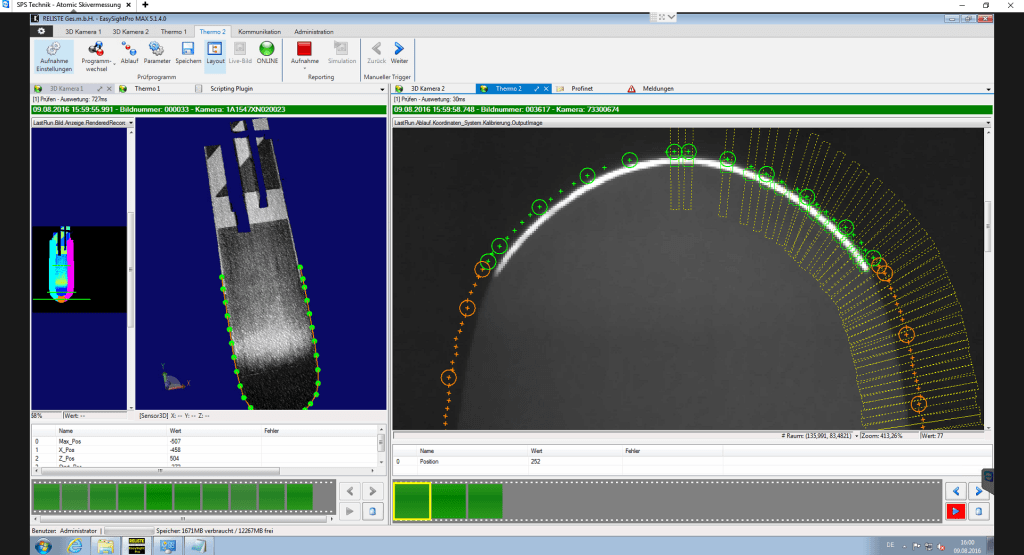
RELISTE combined two Teledyne FLIR A35 infrared thermal cameras (the predecessors of the A50/A70 with dual-spectrum inspection, which integrate thermal and visual inspection in the same camera) with a Cognex 3D laser displacement sensor. In doing so, he was able to transform this traditionally labor-intensive task into an automated maintenance line.
By using these two technologies in tandem, they were able to determine different 3D points on the ends of the skis to guide the automatic grinding robot, which avoids manual work and reduces costs. The combined information from the thermal imaging cameras and three-dimensional laser sensors provides the robotic grinding machine with precise 3D guidance. This ensures that only the steel edge is ground without damaging the more vulnerable plastic parts of the equipment.
The solution resorts to active thermography. Basically, this involves using an industrial radiator to increase the temperature of the skis and exploit the radically different ways in which plastic and metal conduct and, above all, emit heat. This information is then evaluated by FLIR Thermal Studio image processing software to determine the transition point and thus accurately rectify in a fraction of the time required by manual methods.
Advancing technology together: a long-standing partnership that shows no signs of slowing down
Ronald Fasching, business manager for Vision Systems at RELISTE, said, "When we need infrared cameras, we always use Teledyne FLIR, no other. It is our standard solution, with a large number of analysis functions and also communication with a PLC via Profinet."
"We have been a long-time partner of Teledyne FLIR and have been very satisfied with the quality of the camera. In this case, the customer was extremely satisfied with the solution we provided."
The relationship between RELISTE and Teledyne FLIR goes back years, as RELISTE exclusively uses Teledyne FLIR cameras in its industrial imaging solutions for their consistent quality and information, which makes them industry leaders.
RELISTE exclusively chooses Teledyne FLIR cameras because, with them, it can determine key properties or other minute visual variables of test objects and thus make them visible, something impossible with the limited functionality of conventional cameras.
In addition, and most notably, FLIR' s A-Series infrared thermal cameras connect to the FLIR Thermal Studio imaging infrastructure, allowing them to cross-check their findings and contrast key variables. For this application, RELISTE uses Teledyne FLIR' s A35 cameras, equipped with GigE Vision connection and FLIR's image transmission configuration protocol.
Related entries


