
According to the International Energy Agency, in the race to reach ambitious global targets for net-zero emissions, an additional 2 billion electric vehicles will need to be on the road by 2050. To power these environmentally friendly engines, lithium-ion batteries are absolutely essential.
But what happens when these batteries are defective? Even before being assembled into a running engine, traction batteries are often shipped with a small level of charge. This is because a fully discharged battery poses problems for both the manufacturer and the consumer; problems such as lower capacity, faster depletion and electrical short circuits, which can lead to fires.
Regardless of where in the supply chain it occurs, an unexpected ignition can cause catastrophic damage to human lives, vehicles and transportation infrastructure.
SICK AG, the global market leader in sensor manufacturing, has developed a risky battery detection system that helps companies prevent battery fires before they can cause serious damage.
Fighting battery fires with FLIR thermography
Having successfully developed a system that detects hot spots and potential fires in ferries and tunnels vital to transport infrastructure, such as the 17 km long Gotthard Tunnel in Switzerland, SICK AG was recently presented with an interesting opportunity in a particularly demanding time frame.
The company was approached by a German automaker to detect potential problems in electric vehicle batteries on a new assembly line. The challenge? To design, test and implement an interface to identify thermal leaks in battery production in just three months, a process that, by their own admission, would normally take more than a year to complete.
For this reason, SICK AG contacted Teledyne FLIR to provide the most suitable thermography technology for the task.
The system required a custom interface that could accurately check each battery for thermal leakage and then export and transmit the data to a server for cross-referencing and analysis when anomalies were detected.
After careful consideration of the scale of the hot spots to be detected by this state-of-the-art system, SICK AG chose to build its new hot spot detection (AHD) system around the FLIR A70.
Any questions?
Request information
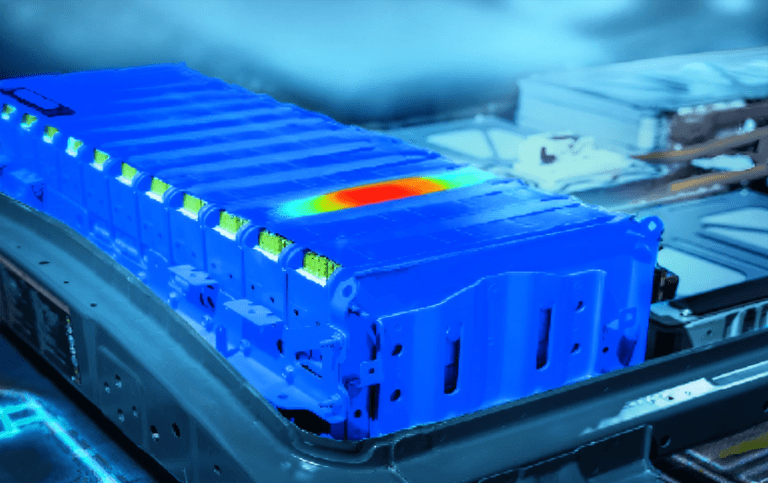
On a tightrope: a comprehensive overview of the shortcomings of Electric Vehicle batteries.
How much can a defective battery cost manufacturers?
Lukas Wallimann, Product and Project Manager at SICK AG, explains why the system is crucial for automotive manufacturing applications.
"The danger here is not simply an isolated battery, but the entire installation. A single faulty unit could cause irreparable damage to very expensive cars, writing them off before they even leave the assembly line."
"Worse still is the valuable machinery, worth millions of euros, that sits idle in a factory if a fire interrupts production. Not only could it damage the production line and the factory in general, but it would also cost thousands of euros for every hour the factory is out of service."
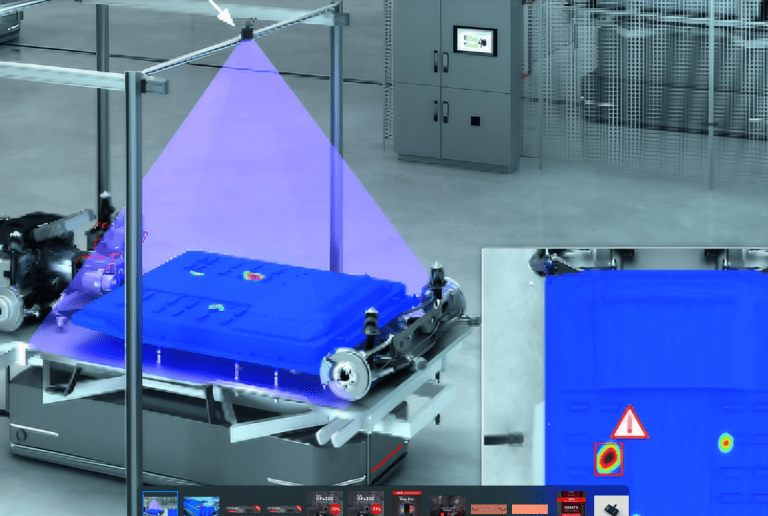
To reassure manufacturers and make the production and commissioning of batteries for electric vehicles as safe as possible, AHD goes beyond other inspection methods to accurately check each unit on the production line.
The FLIR A70 ensures that AHD has a clear view of every element of every battery through infrared imaging, unlike conventional inspections, such as laser thermography, which can only isolate and measure the temperature of battery components one at a time. This allows AHD to see in real time any areas with elevated heat readings as the batteries pass underneath the FLIR A70 thermal imaging camera. The system alerts personnel to potential problems and ensures that units measuring above the accepted temperature threshold are quickly removed from the line and neutralized, before damage occurs.
Ease of integration: superior inspection regardless of the interface
Despite the short delivery time, SICK AG has created a versatile sensor system that can be integrated with various systems to bring the functionality of the FLIR A70 to virtually any environment.
Their customer needed the system to communicate over ProfiNet (the technical standard for data communication over industrial Ethernet), and to store and share data remotely for analysis. The AHD system keeps human operators involved, giving them access to real-time information that allows them to make data-driven decisions based on the situation, as opposed to a fully automated process that could result in discarding otherwise viable stock.
The system can also be integrated into a higher-level system via the TCP/IP interface or into an older system, as the ProfiNet and I/O interfaces make it ideal for retrofitting older production lines.
High performance, higher standards: Why choose FLIR thermal imaging?
"The FLIR A70 camera is very well built, making it ideal for use in an industrial environment such as automotive manufacturing," adds Lukas Wallimann. "The housing is robust and the sensor is easy to use and intuitive. I can hold it in my hand and feel that it is a quality product."
"Apart from the hardware, the biggest advantage for us has been FLIR's assistance during the development period and application engineering. They were always on hand to help us with any technical issues or questions about integration, and made an otherwise onerous job much easier."
Related entries


