
Elevated body temperature (fever)
Thermography has proven to be a useful technique for checking body temperature and can optimize the effectiveness of more thorough medical checks to detect possible cases of people with fever.
In countries and regions previously affected by pandemics, thermal imaging cameras have been used for years in public spaces such as airports, transport stations, at high-traffic events and in companies, especially in connection with critical infrastructures.
At APLITER we offer solutions tailored to your needs with tools that have proven effectiveness in detecting elevated body temperature.
Body temperature measurement
Detection of temperature changes
Body temperature measurement
A body temperature camera requires almost no installation and once set up, the measuring equipment automatically detects people with fever. If the recommendations for use are followed, reliable, real-time body temperature measurements are possible without affecting the normal flow of people.
Steps to follow

Body temperature measurement
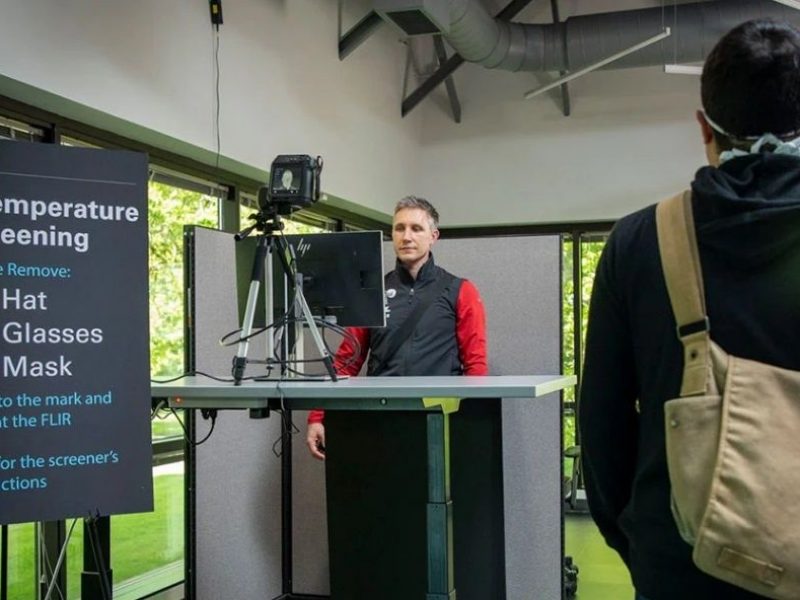
At the control point, people stand at a marked point in front of the camera to measure their body temperature. The equipment can be installed in an access control of any space with high concurrence of people (airport, station, companies, etc.).

Check if the person being scanned has fever
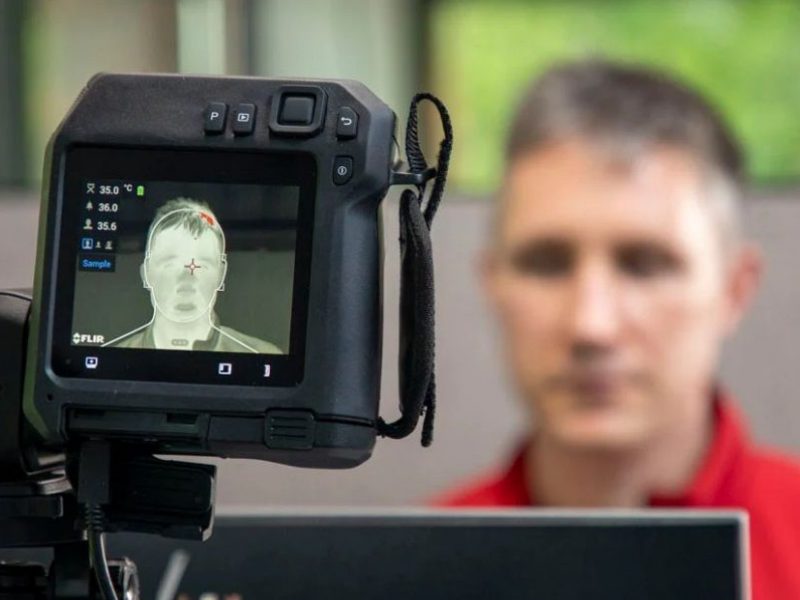
The operator observes the thermal camera image in real time and, in turn, checks the body temperature. When the camera measures a body temperature higher than the set temperature, it generates an alarm on the display and/or an audible alarm (beep).

Follow the established action protocol
Once a person with an elevated body temperature has been identified, a decision may be made to withhold entry to the facility until further medical testing for an infectious disease is conducted.
Detection of temperature changes
FLIR thermal imaging cameras ensure a real, safe, fast and accurate measurement of body temperature. That way, we can be sure whether a person is detected with fever or if he or she has no symptoms at all.
Characteristics of thermal imaging cameras

Measurement
secure
By using a thermal imaging camera, it is possible to maintain the security distance (2 meters) by the personnel in charge of access control while the body temperature measurement is being taken. For added security, the measurement can be taken from a separate control room.

Fast and automatic process
The body temperature measurement and the result are instantaneous, so it does not affect normal human traffic. The system also has an automatic alert (visual or audible) in case of detecting a person with an elevated body temperature (fever).
Easy to use and install
The installation of the temperature measuring equipment only takes a few minutes. Assembly is simple and only requires the use of a tripod and a standard PC or monitor. No other equipment or special tools are required for proper operation.

Technology
reliable
FLIR thermal cameras comply with ISO/TR 13154:2017 and UNE-EN IEC 80601-2-59:2019, concerning general guidelines and particular requirements for the deployment, implementation and operation of a sensing thermograph intended for non-invasive febrile temperature measurement.
Request more information about Elevated Body Temperature Control Projects.
Measuring equipment
FLIR is the pioneer and world's leading manufacturer of thermal imaging cameras. In terms of solutions specifically designed for fever detection, they only offer cameras with resolutions from 320×240 pixels. This minimizes the likelihood of false negatives (people with fever who are not detected). From this minimum recommended resolution, the higher the resolution, the greater the distance at which a person can be monitored.
In 2020, FLIR has implemented in its equipment the EBT (Elevated Body Temperature) function, which makes it possible to correct deviations in the apparent temperature of people caused by environmental conditions (cold/heat, sun/clouds, etc.). In addition, for some of its models, such as the A400 and A700, a continuous calibration against BlackBody can be performed.
Types of equipment

Fixed equipment
This type of equipment is designed to work in a fixed position (mounted on a tripod). They require a computer for their configuration and can be installed in a network. They have configurable digital outputs to act on other equipment, such as doors, winches, or alarms, among others. The units also have an analog video output to display images through an external monitor.

Portable equipment
Portable equipment can be used in a portable way (like a camera). In these cases it is the operator who moves around with the camera in different areas where people need to be monitored. These devices can also be used in a fixed way, installing the camera on a tripod and, optionally, connecting it to an HDMI monitor to view the image at a larger size. These mobile devices are autonomous and do not require a PC for operation.
Coronavirus COVID-19
During the year 2020 the entire planet is being affected by the COVID-19 Coronavirus pandemic, which has infected millions of people, caused thousands of deaths and forced situations of confinement and temporary closure of companies.
As had already been demonstrated in previous pandemics such as SARS-1 between 2002 and 2004 and the Ebola outbreak in 2014, thermographic cameras are an accurate and reliable solution for the detection of people with fever, one of the main symptoms of people affected by COVID-19.
Confronting Coronavirus COVID-19

COVID-19 detection
Thermal imaging cameras cannot diagnose an infection such as COVID-19 Coronavirus but they have proven to be a very effective tool for the detection of some of its most characteristic symptoms, such as fever. Once the thermal imaging camera has detected a person with an elevated body temperature they may be required to undergo a medical evaluation to confirm or rule out infection.

Operation and measurement
Thermal imaging cameras capture thermal radiation (infrared) and convert it into an image, so they can be used to measure the surface temperature of objects. In the case of body temperature measurement, this is performed in the area of the tear duct, where the skin temperature is more stable.
In the event of detecting a person with an elevated body temperature (fever) the system activates an alarm (visual or audible) to alert the operator.

Measurement accuracy
A minimum resolution of 320×240 pixels and the maximum measuring distance for the selected combination of resolution and optics are required for reliable body temperature measurement.
FLIR thermal imaging cameras specifically for body temperature measurement offer a measurement accuracy of ±0.5°C, which makes them effective for fever detection. Additional technologies, such as BlackBody, improve their accuracy to ±0.3°C.
Equipment autonomy
For the measurement of body temperature it is highly recommended to have the physical presence of an operator, both to supervise and adjust the system according to the environmental conditions, and to activate the corresponding action protocol in positive cases. Thanks to the operating system of these cameras, monitoring can be carried out in compliance with the safety distance and in a non-invasive manner, ensuring total safety for the person operating.
Not just any camera will do!
There are a multitude of thermal imaging cameras on the market, with different resolutions, optics, accuracies, sensitivities, etc., but only a few are suitable for accurate body temperature measurement and fever detection, so before purchasing a new system make sure which type of technology is the most suitable for your case.
In order to ensure correct measurement also is also adequate training in the basics is also essential to ensure correct measurement.The following are some of the basic concepts: where to place people, how to operate, set up and recognize problems in the camera, program calibration and perform periodic maintenance of the system, among others.