
Quantitative optical gas detection offers operators in the oil and gas industry a tool for improved worker safety, better environmental management and more cost-effective operation.
A relatively new technology, quantitative optical gas detection (qOGI), is quickly proving to be a viable alternative to toxic vapor analyzers and Bacharach Hi Flow® samplers as a tool for operators in the oil and natural gas industry to quantify gas leaks. This article describes qOGI, how it works, its applications, and the equipment needed to use it. The article also details how qOGI compares to alternative leak quantification technologies.
Webinar on QOGI by Steve Beynon, Sales Director of OGI at FLIR.
WHAT IS QUANTITATIVE OPTICAL GAS DETECTION?
Quantitative optical gas detection is the ability to use optical gas detection (specifically, refrigerated hydrocarbon OGI) combined with an algorithmic solution to quantify gas leaks invisible to the naked eye.
These are leaks that can usually be visualized in the OGI camera. Historically, OGI cameras have been limited to qualitative analysis, to indicate that a leak is occurring, but provide little data on the volume of the leak. Now, by combining an existing OGI camera with a qOGI solution, you can visualize and quantify such leaks in units of volumetric and mass leak rates, as well as concentration over path length (ppm-m).
QOGI COMPARED TO ALTERNATIVE TECHNOLOGIES
In terms of capability, neither a toxic vapor analyzer (TVA, commonly referred to as a "sniffer") nor a Bacharach High Flow Sampler® (BHFS) can quantify a variety of gas leaks in mass leak rate and volumetric leak rate, as well as concentration path length. A TVA provides concentration analysis, but not flow measurement. A BHFS is capable of both flow and concentration measurement.
Both TVA and BHFS devices can generate different interpretations of the same leak, depending on where and when the leak is sampled, as well as how the device is placed. This deficiency is a result of the functionality of these devices: they provide a snapshot of leakage over time, whereas a qOGI system provides a continuous average leak rate over time.
In addition, TVA and BHFS devices are limited in their ability to quantify certain gases that inspectors may encounter. A qOGI system has the ability to identify and quantify more than 400 chemical compounds. In addition, because a qOGI system analyzes information from a recorded OGI camera source, the user has visual evidence to help confirm the system's analysis. No other technology offers such assurance.
However, inspector safety may be qOGI's greatest advantage. Consider the nature of TVA and BHFS devices applied to difficult-to-monitor (DTM) devices: potential leak sources located far enough away from the meter to pose challenges to their quantification.
At best, scaffolding can be erected, hopefully not too costly or time-consuming to construct. Then, an inspector, equipped with a safety harness and all appropriate personal protective equipment, must climb dangerously close to or, in some cases, into the gas exhaust plume in an attempt to quantify the leak.
In other cases, the potential leak may be completely inaccessible to an inspector for safety reasons or lack of operating space.
Even when a leak is discovered (or suspected) in a more accessible location, a qOGI system provides superior ease of use. A TVA requires frequent calibration using a field calibration kit and works only "on the fly".
A BHFS, on the other hand, requires a lot of work for use and maintenance. Its use requires the inspector to seal the leak as best he can, with a mixture of tape and plastic, to allow the most accurate reading possible. Although these devices are capable of high accuracy, they must be calibrated weekly, as well as checked daily.
Consideration must also be given to how environmental conditions affect these devices. Although a TVA reading can be affected by humidity, temperature, and contaminants, wind can have the most dramatic effect, as the technology could miss a leak (Fig. 1); the environmental limitations of a BHFS depend on its particular sensor; readings from a qOGI system can be affected by temperature (discussed below) and wind speed, which are accounted for in the tablet's input parameters.

Figure 1: Detrimental effect of wind on toxic vapor analyzer (TVA) measurements.
HOW DOES QOGI WORK?
The ability to quantify the size of the leak without being near the gas column is the biggest differentiator between qOGI and competing technologies, as well as qOGI's biggest advantage. When using remote OGI cameras, three factors allow the camera to visualize the gas (Fig. 2).
Figure 2: Factors affecting gas imaging in an OGI chamber.
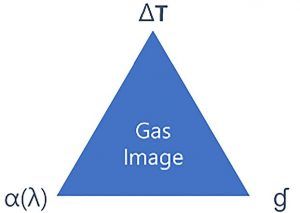
IR absorption - α(λ) - First, the gas to be detected must have an IR absorption peak that overlaps with the spectral window of the OGI camera. Response factors (RFs) have been developed for nearly 400 compounds; these RFs, indicative of the wavelengths at which different gases absorb energy, allow the user to assess whether a chemical compound can be captured by a specific IR camera. They can also be used to adjust the results of a qOGI method, allowing a single calibration with a single gas to be applied to the measurement of several gases.
The RF will also specify the sensitivity of a specific compound compared to the reference chemical. For example, the RF for propane is 1. If an RF value for another compound is 0.3, it means that the compound has 30 percent of the sensitivity of propane. If a chemical has an RF less than 0.1, it is likely that the chemical is not visible by the OGI cameras under the same conditions as the reference chemical.
Delta temperature (ΔT) There must be sufficient temperature differential between the gas column and the bottom. A higher ΔT will result in a more visible column on the OGI camera display. For qOGI, a high ΔT means a higher signal-to-noise ratio, which creates better measurement data.
QOGI users should view the leak at various angles to ensure the highest ΔT possible. At a minimum, 2 °C temperature difference is sought between the ambient air near the gas leak and the apparent temperature at the bottom of the image. Generally, ΔT should be considered the most important factor in obtaining an accurate reading.

Image of a gas leak showing the effects of Delta T as the gas passes from a hot bottom (the wall) to a bottom that is at room temperature (the fence).
Presence of gas (ɠ) There must be gas present in the image that is above the minimum detection limit of the system.
Since there must be enough gas present in a scene to take an image, the function of qOGI is to normalize the effect of the other two factors [α(λ) and ΔT] to allow quantification of the gas present. This measurement will be consistent across different measurement conditions (e.g., the same reading will produce the same result even when ΔT is different due to different measurement conditions).
QOGI can produce two types of results:
Concentration path length, expressed as ppm-m at the pixel level, and volumetric or mass leak rate (e.g., grams/h or liters/min).
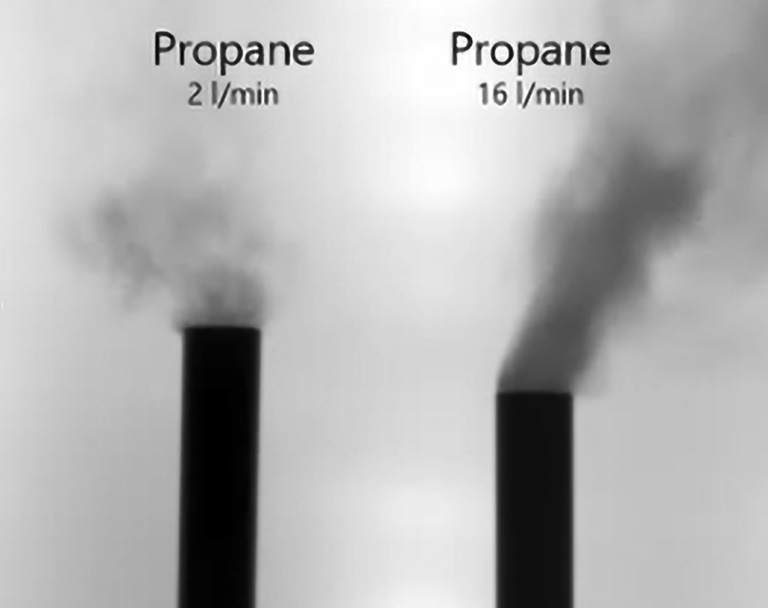
Figure 3: Examples of propane with varying concentration path lengths.
The volumetric or mass leakage rate requires an additional algorithmic process to aggregate the pixel level measurements into the overall leakage effect. The algorithm also takes into account the distance and wind condition that affect the volumetric or mass leakage rate measurement.
A qOGI solution offers two modes of operation: real-time use and Q-mode operation.
In the field (real-time use), simply plug a rugged tablet containing software that quantifies the gas being captured directly into your FLIR OGI camera(GF320, GFx320 or GF620) and it will immediately start quantifying the live view of the leak. The new FLIR G-Series incorporates in-camera QOGI quantification, making it a great advantage for all those companies that continuously perform inspections at their own or third party plants.
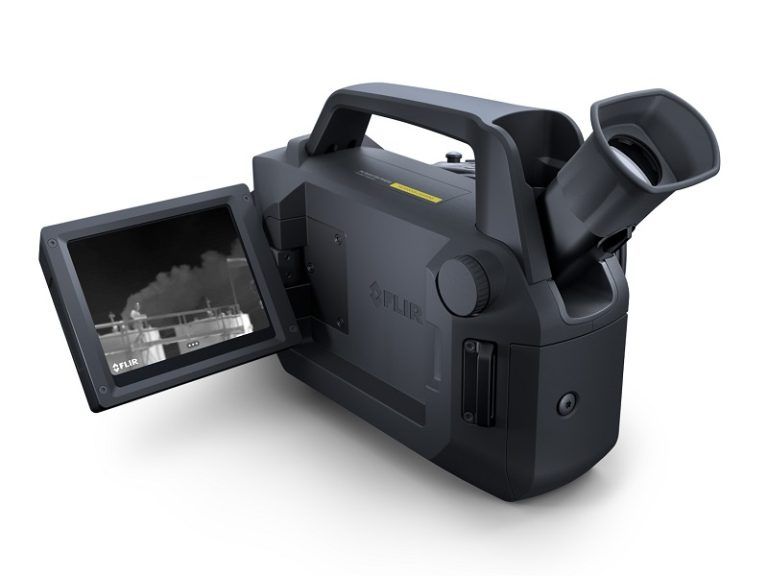
In Q mode, you can store the video in the camera for later use. You can then download the files to the tablet, allowing you to quantify the leaks after the fact.
The tablet itself includes standard technology, designed and manufactured for use with FLIR's OGI cameras (a USB cable connects the devices during field use and the camera's SD card can be removed for q-mode operation) and does not require periodic calibration. Therefore, it is easy to implement qOGI for users of existing OGI cameras.
In addition, the tablet is not subject to the same component deterioration experienced by TVA and BHFS systems regularly exposed to toxic gases. While replacement components for TVAs may be readily available, BHFS devices have not been manufactured since 2016.
Finally, note that since qOGI allows users to visualize leakage as part of the quantification process, movement can be detrimental to its performance (as with any camera). Therefore, users should stabilize the camera using a tripod.
Conclusions
The quantification of gases with QOGI, is established as one of the BAT for the new EU regulation 2019/942 and its compliance for companies in the Oil and Gas sector.
In addition to its obvious safety advantages over alternative gas quantification methods, qOGI has passed rigorous third-party testing by CONCAWE3 and has proven to be easier, faster and more accurate than technologies such as a TVA. QOGI is also cost-effective as a complement to existing OGI cameras and positions oil and gas operators to be at the forefront of environmental awareness in the communities where they operate.
Do you have any questions about how OGI cameras work?
You will find more information from Sergi Quiles, here.
Contact our technicians by e-mail or call +34 91 159 39 78 | 93 706 36 79

Top 10 questions: Quantification of gas leaks with OGI chambers
Frequently asked questions about FLIR's gas leak quantification include environmental effects on operation, regulatory issues and the

About the FLIR QL320
Quantitative optical gas detection system for GF620/GFx320/GF320 FLIR QL320 System for gas quantification The QL320 is an optical gas detection system for the quantitative detection of gases.

FLIR GF77 Gas Find IR camera increases versatility of FLIR's uncooled gas detection solutions
New lenses for the FLIR GF77, for different types of inspection and gas detection.