
Frequently asked questions about FLIR's gas leak quantification include environmental effects on performance, regulatory issues, and technology improvements on the horizon.
This article examines common questions and concerns surrounding quantitative optical gas detection (qOGI). More specifically, it answers 10 questions related to the use of FLIR's QL320 platform, which combines new technology, in the form of a rugged plug and play tablet, with FLIR's existing GF320, GFx320, and GF620 OGI cameras to quantify hydrocarbon leaks in units of mass leak rate, volumetric leak rate, or path length concentration.
1. IS QOGI CURRENTLY USED AS A COMPLIANCE TOOL?
Currently, there is no European Union regulatory factor for qOGI methods. As industry operators strive to become more responsible stewards of the environments in which they operate, qOGI technology is used to conduct field studies and determine emissions for internal purposes, so that each company is free to determine the benefits of qOGI and to implement them accordingly.
2. HAS THE QOGI METHOD BEEN VERIFIED?
QOGI is an emerging technology, under development since 2014, and has undergone extensive validation testing, including blind testing with known release rates. Some of the publicly available test results include:
- A test conducted by the EPA at Research Triangle Park, quantifying methane and propane leakage.
- A leading field test in the oil and gas industry comparing the qOGI method to the Bacharach Hi Flow® sampler (BHFS). QOGI achieved +/- 30 percent accuracy over several weeks of blind testing comprising dozens of test points in different gases (including produced gas), to cover a wide range of backgrounds and environmental conditions.
- A study conducted by a European industry group, which includes most of the oil companies operating in Europe, dedicated to investigating environmental issues relevant to the oil industry. This study concluded that qOGI significantly outperforms US EPA Method 21 in terms of accuracy of results.
NOTE: Both the oil and gas industry leader and Concawe's European studies were sponsored by the industry.
3. THE FLIR QL320 ASKS YOU TO SELECT A GAS TO QUANTIFY. WHAT HAPPENS IF THE GAS STREAM CONTAINS SEVERAL COMPOUNDS?
It is worth mentioning that the U.S. EPA-approved Method 21 shares this limitation; where qOGI excels is in how it addresses this uncertainty.
With a flame ionization detector (FID) in Method 21, the device is normally calibrated to a pure gas and then the process streams are measured. The composition of the gas can significantly change the FID response, but this error is generally accepted, although it can introduce an error of 200 percent or more in Method 21. Most facilities do not calibrate their FID for each specific process stream (a corrective action); they simply accept the concentration number (measured as pure calibration gas). Method 21 offers no recourse to retroactively adjust the result.
FLIR's QL320 makes gas mixture correction easy and adds flexibility to the task. In addition, the correction is fundamental, which means it is not instrument-specific (as with an FID and Method 21). The FLIR QL320 allows users to adjust the gas mixture after the fact, and their adjustment will be applicable to any FLIR QL320 result applied to that process stream, on any given day or ambient conditions.
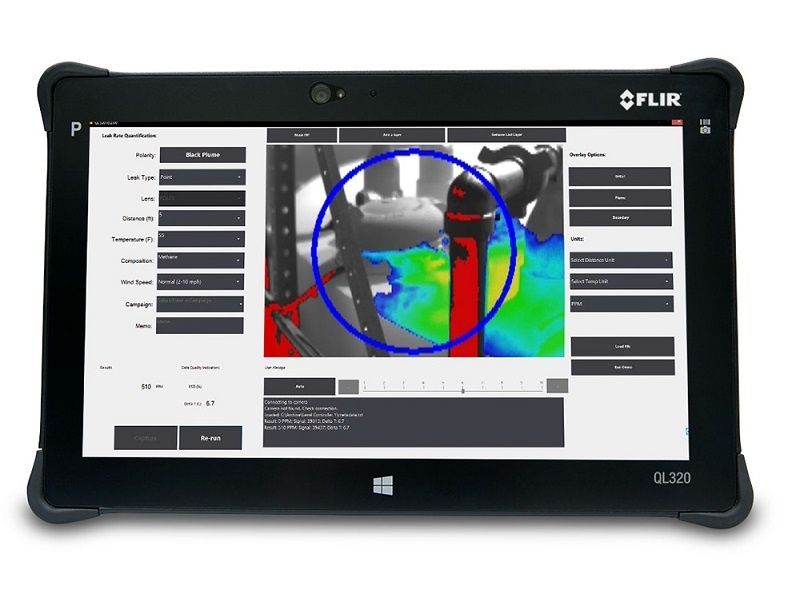
FLIR QL320
4. HOW WILL ENVIRONMENTAL FACTORS AFFECT MY MEASUREMENTS?
The delta temperature (ΔT) is the most important factor affecting accurate qOGI. There must be sufficient temperature difference between the ambient temperature adjacent to the gas column and the bottom.
When capturing video with the tripod-mounted OGI camera, QL320 users should ensure the maximum possible ΔT. As a minimum, 2 °C temperature difference is sought between the ambient air near the gas leak and the apparent background temperature in the image.
Most wind conditions will not be detrimental to qOGI accuracy. If there is no wind, gas leaks may not flow reliably in one direction, resulting in gas "pooling". Conversely, high winds (e.g., greater than approximately 24KM/H) create difficulties because the wind moves the gas away from the release point very quickly. That said, most gas leaks will be within an acceptable wind speed range or will occur in a protected or partially protected location.
Wind is fed into the FLIR QL320 at three levels (Calm, Normal and High). The result is more consistent at higher wind speeds (where no gas column buildup occurs). Accuracy is between 30 and 40 percent.
Humidity does not affect the measurement capability of the system.
5. WHAT ARE THE MINIMUM AND MAXIMUM LEAKAGE SIZES THAT CAN BE SUCCESSFULLY QUANTIFIED WITH THE FLIR QL320?
The minimum size of a leak that can be quantified is a function of the ΔT (between the ambient temperature near the gas and the background), the compound being generated, and the wind speed. FLIR's QL320 system has demonstrated the ability to quantify propane leaks up to 100 scc/min and methane leaks up to 300 scc/min with a ΔT of 5°C and moderate wind speed.
A good rule of thumb: if you can see the leak in normal mode, the system will most likely be able to quantify it. If you must use high sensitivity mode to see the leak, FLIR's QL320 may have difficulty quantifying it accurately.
For maximum leak rates, the current model is calibrated with propane from 0.1 l/min to 30 l/min. We could safely extend this to 2 or 3 times the calibrated range, or 100 cc/min up to 100 l/min (for propane). For methane, we would have correlated the limits between 300 cc/min and 300 l/min.
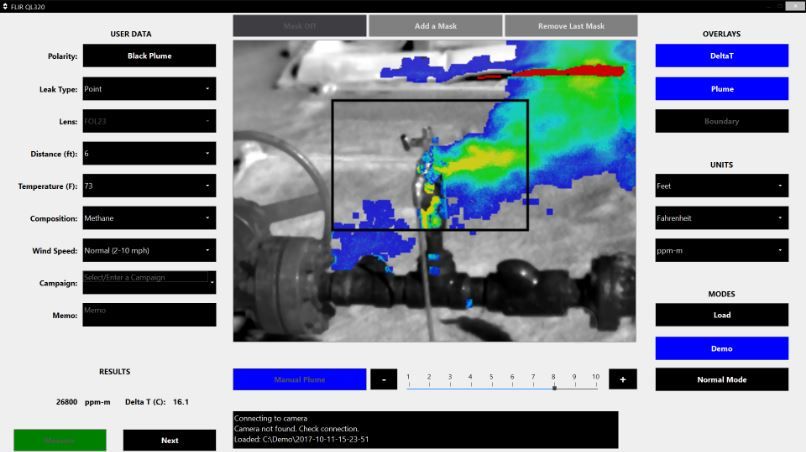
FLIR QL320 simplifies visualization and measurement of gas emissions
6. WHAT IS THE MAXIMUM DISTANCE FROM THE SOURCE OF THE LEAK THAT I CAN REPEATEDLY AND ACCURATELY USE THE QOGI METHOD?
The FLIR QL320's range and field of view (FOV) depend on the objective being used. These ranges are:
- 23 mm (24-degree FOV): from 1.5 to 16.5 meters
- 38 mm (14.5 degree FOV): from 2.5 to 27.5 meters
- 92 mm (6-degree FOV): from 6 to 64 meters
The overall distance will affect the repeatability and accuracy of the quantification results (similar to temperature measurement with a camera), as there are fewer pixels to use when calculating the concentration length of the gas leak from a greater distance. Consequently, when using the FLIR QL320 at a greater distance, you will notice that the extraction circle of the column is considerably smaller.
7. WHAT IF I AM OPERATING IN A HAZARDOUS LOCATION AND CANNOT ATTACH MY CAMERA TO THE FLIR QL320 IN THE FIELD?
A new feature available for use with FLIR's QL320 is Q-Mode. Q-Mode was originally designed for use with FLIR's GFx320, which is rated for use in hazardous locations categorized as ATEX zone 2, when not attached to FLIR's QL320. Q Mode allows video footage of leaks to be saved directly to the camera's SD card and then further processed on the FLIR QL320, away from the hazardous location.
It is still advantageous to use FLIR's QL320 in the field, directly connected to a camera, for several reasons:
- Immediately know if you have a sufficient background temperature (ΔT).
- Get real-time figures on the severity of a leak and know if immediate action is required
- Use features available on the FLIR QL320 in the field, such as manual sensitivity, notch limit and variable time interval (1 second, 5 seconds, 60 seconds), as well as real-time determination of leak rate unit options
8. WHAT ARE THE CURRENT LIMITATIONS OF THE QOGI METHOD?
The current qOGI method is designed for point releases. Large, diffuse releases, such as from a retention pond or large tank seal, may be more difficult to quantify with this method.
Very large leakage rates and very high output velocities can be underestimated. High leakage rates can cause some saturation in the image, which will tend to underestimate the leakage rate. For high exit velocities, the column may not move enough to see the background behind the column (necessary to calculate the ΔT).
9. HOW IS THE QOGI METHOD BEING IMPROVED?
The optical gas detection industry is focused on quantification, and FLIR is leading the development in this emerging field. Below are some recent enhancements and new features for FLIR's QL320:
- Colored gas column overlay.
- Ability to measure leak rate in concentration over path length (ppm-m).
- Ability to create multiple "notches" at the column extraction boundary.
- Single image snapshot with leak rate overlay.
- Leak rate (continuous average) in the video overlay.
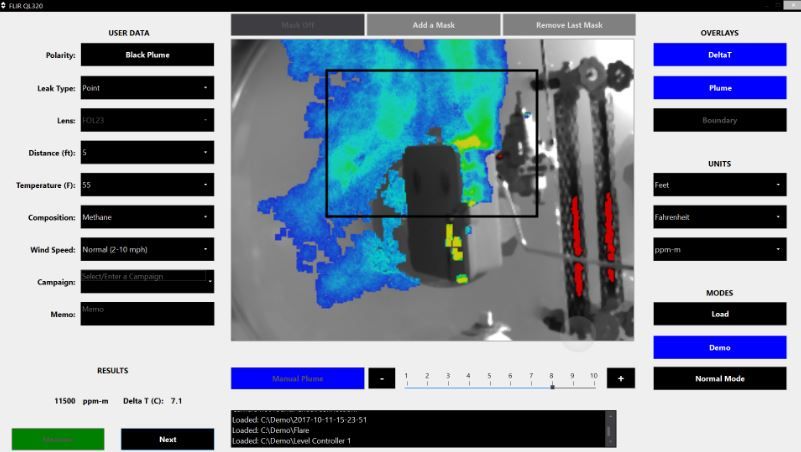
FLIR's enhanced QL320 interface
10. HOW DOES THE PATH LENGTH CONCENTRATION READING (PPM-M) DIFFER FROM THE BASIC CONCENTRATION READING (PPM) OBTAINED WITH A SNIFFER?
The QL320 provides concentration reading as a "concentration over path length" or "parts per million (ppm)" over a path length of one meter. This path length assumes that the leak has a depth of one meter. In terms of X, Y, Z axis, the "meter" path length is the "Z" (depth) axis of the column and NOT the "X" or "Y" (horizontal or vertical) axes. By definition, the reading would assume that the observed leak is one meter deep (from the initial leak, directly from the chamber).
If the depth is known (or could be estimated), the average ppm at depth can be calculated by dividing the ppm-m value by the depth. For example, if the QL320 gives a reading of 1000 ppm-m and the column depth is estimated to be 10 cm, the average concentration in the 10 cm deep gas column is 10 000 ppm (1000 ppm-m/0.1 m).
A sniffer or other device that presents data in ppm takes a reading of a sample of air molecules at a single point and therefore does not require a path length reading. TVA devices are also limited in that they can measure a leak only if the device is pointed directly at the leak, which is more difficult since this technology does not visualize a gas leak.
CONCLUSIONS
Quantitative optical gas detection is efficient, accurate and practical. Its benefits are increasing and its technological capabilities are continually improving. In addition to its obvious safety advantages over alternative gas quantification methods, qOGI offers cost-effectiveness as a complement to existing OGI cameras and positions oil and gas operators to be at the forefront of environmental awareness in the communities where they operate.
FLIR's QL320 platform enables qOGI both in the field and potentially post-scan (post-process capability) with the Q-mode feature and tablet combination.
For more information on optical gas detection, please visit: https://www.apliter.com/camaras-termograficas-gases-ogi/.
Related

About the FLIR QL320
Quantitative optical gas detection system for GF620/GFx320/GF320 FLIR QL320 System for gas quantification The QL320 is an optical gas detection system for the quantitative detection of gases.

FLIR QL320 Training Videos
FLIR QL320 TRAINING VIDEOS Quantify Gas Leaks like an Expert Tablet Setup & Operation Getting Started https://youtu.be/42eA8bKjG-g Anchoring for

FLIR QL320 - Gas Leakage Quantification for GF620, GFx320, GF320
FLIR QL320 - Gas Leak Quantification for FLIR GF620, FLIR GFx320 and FLIR GF320 thermal imaging cameras FLIR QL320 is an optical gas leak detection system for FLIR GF620, FLIR GFx320 and FLIR GF320.