

How does a house work? Seems like a silly question. Houses are stationary objects, right? What else is there to know? This may seem so at first glance; however, the physical activities of a house are always in motion and constantly changing. Air is always flowing at rates that change with the weather and when mechanical systems are turned on and off. This influences our comfort level, the quality of the air we breathe, the amount of energy we consume and can even affect the lifespan of certain structural parts of the house.
Every mechanical system we install in a house comes with an operating manual, but what about the rest of the house? Have you ever seen a builder provide an instruction or owner's manual for the house itself? For such a large investment, you would think there would be a guide showing how each part of the house should work, how to troubleshoot problems, and how each component should be replaced at the end of its useful life or at least adjusted in case something changes. Unfortunately, they don't. And they probably never will. Houses are complex structures that don't have a complete operating manual. Fortunately, the physical behaviors of every house are governed by the same laws, and these laws allow behaviors to change throughout the year and in different climate zones. The purpose of this article is to show how a house works and where the source of many problems related to comfort, energy, durability and indoor air quality (IAQ) come from.
Wood-frame houses are the most common single-family buildings in the United States. They have a long history dating back to before the Revolutionary War. In the early days, these homes served as large boxes that kept us dry and safe. As new inventions, materials and processes advanced with technology, our houses have become more complex with many components that must work together to be effective and efficient, much like the human body (we'll come back to this later). Therefore, if we change one part of the home, it can impact another. Aside from safety and security, the main goal of a modern home is to provide comfort and indoor air quality at a reasonable operating cost. There are two main parts of the home that make optimal comfort and air quality possible: the building envelope and the mechanical equipment. It is imperative that these two systems work together to avoid problems such as high humidity, poor air quality, uncomfortable rooms, mold, rot, dust and warped wood floors.
The mechanical system
Let's cover the obvious first. The heating, ventilation and air conditioning (HVAC) system and its many components have the important task of providing year-round thermal comfort. However, systems must be properly sized and designed to deliver maximum performance. To determine proper sizing, an ACCA Manual J load calculation must be performed. And to improve Manual J accuracy, a blower door test should be performed to determine the amount of outside air infiltration (more on this later). Unfortunately, a large percentage of new systems are installed without employing this process. Equipment sizing is often calculated based solely on the square footage of the home, typically 46 square meters per ton. This method can oversize the system and cause short cycling, which means that the thermostat set point is reached too quickly. This can shorten the life of the equipment and prevent the HVAC system from dehumidifying the home due to the shorter run times.
A key component that is often omitted in U.S. homes in the "V" in HVAC, which stands for ventilation. We will discuss later how ventilation is one way the mechanical system can work with the building envelope. Having well-designed ventilation is critical to providing cleaner indoor air. When we don't bring in outside air, we circulate the same air through the house over and over again. Over time, that air accumulates volatile organic compounds (VOCs) given off by building materials and appliances, along with other pollutants we breathe. This makes good filtration another key component in improving air quality. Proper ventilation and filtration work well together to provide a healthier living space.
There are many options available for residential ventilation. Energy and heat recovery ventilators (ERVs and HRVs) provide balanced ventilation by pulling in outdoor air and exhausting stale indoor air at the same rate. Air cyclers are another option. This is a duct connected to the return side of the system from outside the home. There is a motorized damper in the duct that opens on a set schedule to allow the air conditioner to bring in filtered outside air. Ventilation control options are now available that operate the ventilation based on readings provided by an air quality monitor. Ventilation dehumidifiers are another option that can provide dehumidification and filtered outdoor air at the same time for homes in humid climates. Air cyclers and ventilation dehumidifiers apply a slight positive pressure to the building envelope, which can sometimes prevent moisture and other contaminants from infiltrating as easily.
The building envelope
The building envelope serves as a container for the product that HVAC contractors provide to their customers. This outer skin of the building contains all the conditioned air that keeps us comfortable. So wouldn't we want to know if the building envelope is doing its job? Another way to look at it is this: Let's say our job is to keep water in a bucket - wouldn't we first want to know if that bucket has any cracks or holes in it? As conditioned air escapes from a leaky building envelope, it also infiltrates unwanted outside air into the interior, which is cold in the winter and warm in the summer. This causes some rooms to have an undesirable temperature, making it difficult to fully control comfort inside the home. The more permeable the envelope, the less control we have to maintain a comfortable living space.
An airtight enclosure is essential for optimum comfort and air quality. The myth that "a house has to breathe" is a misconception that our industry has struggled with for decades. Before the building industry began to focus on airtight enclosures, we relied on air leakage to serve as ventilation. As we mentioned earlier, it is true that we need air coming in from outside to maintain a healthy living environment. However, relying on cracks and gaps in the envelope is not an ideal source of "fresh" air. This is a practice from an earlier era, before we, as an industry, knew about measuring air tightness and its impact on comfort, energy, air quality and durability. We now have sophisticated tools and software to evaluate building enclosures and duct systems quickly and efficiently. We also have the capability and design of mechanical ventilation systems that provide cleaner air without compromising the integrity of the envelope. This is one of the ways the HVAC system and the building envelope work together.
There is a big difference between infiltration and ventilation. Ventilation is when outside air is carefully quantified, filtered and often preconditioned before it enters the living space. Infiltration is when unplanned outdoor air enters your home, carrying everything from heat and humidity on hot summer days to contaminants in attics, basements and wall cavities. If the home has enough leaks, various types of pests can make their way in and leave behind undesirable substances that can become airborne and enter the living space with the infiltrating air. As you can imagine, this is a major tax on air quality. Pollen and other air pollutants can travel into the leakage pathways from outside as well.
Treating the source, not the symptom: the physician's approach
Earlier, we mentioned how the various components of the building envelope and HVAC system can have an impact on each other similar to the functionality of the human body. For example, if a medication is taken for one symptom, it could have a side effect on another part of the body. Homes and HVAC systems work in a similar way. It is important that we, as diagnosticians, understand how each part of the house can impact another.
When we visit the doctor for a symptom we have, we are asked a series of questions along with some tests to identify the source of our discomfort. Technicians can follow a similar process by asking themselves some questions: What needs to be changed to make the customer happy? Could it be an equipment problem? A ductwork problem? An envelope problem? A mix? What tests make sense to find the source of the discomfort?
Diagnosis of the building envelope
To fully understand whether the building envelope is contributing to comfort and indoor air quality symptoms, there are three things we need to clarify. We will need to:
Determine the amount of leakage in the building envelope. Does it appear to have more leakage than it should?
Determine how leaks are distributed throughout the house. Are there areas that are more severe than others? Do these areas coincide with customer complaints?
Determine how the home's mechanical systems interact with envelope leakage. Do room pressures change when the HVAC system is on or off? Does the overall house pressure change when the HVAC system(s) or exhaust fans are running?
These steps are usually performed in this order. In this section, we will discuss a number of methods that can be used to locate problems in the building envelope. And to reference our comparison with medical professionals, sometimes it is best to employ more than one method to see if they match each other. This can increase confidence in our findings as we work to reduce the source of occupant discomfort.

To begin our process, we need to determine the degree of leakage of the building envelope. To do this, we use a blower door: the most important tool when it comes to analyzing the performance of a home. Imagine being an orthopedist without an X-ray machine... that's how important a blower door is.
Envelope testing and diagnostic procedures are a very complicated subject, and there are many free resources available to learn all about these topics in great detail. To quickly summarize, we use the blower door to pressurize or depressurize the housing envelope to a known and controlled pressure with respect (WRT) to the outside, typically +/-50 pascals. This allows for a stable research environment, as this induced pressure is sufficient to nullify any stack effects and wind induced pressures.
With some additional tools, the blower door can also show us where the leaks are. There are multiple ways to do this, and the best method for a particular house on a particular day may depend on weather conditions and/or type of construction. This detailed guide on residential air pressure and leaks is a great reference for a deeper dive into the subject.

Thermal imaging and smoke tracers
Once we have measured the total air leakage through the envelope, we will need to have an idea of how the leakage is distributed throughout the house. In many cases, the blower door test may seem acceptable, but we may later discover that most of the leakage is concentrated in one area. Air leaks can be difficult to locate, especially since we cannot see what is happening with the naked eye. Any way to make leaks visible helps us quickly locate sources of discomfort. A good thermal imaging camera can be one of the best ways to do this, as it allows us to photograph leaks that we might not otherwise be able to see. After all, seeing is believing.
Thermal imaging can quickly reveal heat flow patterns through wall cavities and/or envelope leaks. However, there needs to be a sufficient temperature difference between the inside and outside for a leak to be readily visible. Typically, 10 degrees or more of temperature difference is sufficient.
Smoke tracers or blowers are another great visual tool. This is not actual smoke. Instead, it is a fog produced from a glycol solution like you see in theater fog machines. By pressurizing the building with the door fan, the fog moves with the air currents generated by the fan and carries us to the problem areas.
Zonal Pressure Diagnosis (ZPD)
The ZPD is an excellent way to quickly assess how leakage is distributed throughout the house by determining the extent of roof, floor or attached garage leakage. Unfortunately, over years of poor practice, it has become a process for "estimating" interior room leaks. While this practice surely helps the sales side of home performance testing, it may have very little technical legitimacy. However, when used correctly, the ZPD can give us a lot of information about the distribution of leakage in the envelope. The high-resolution pressure gauge that comes with the blower door system can be used to perform this type of testing.
This series explains in more detail how the ZPD works.
The effect of the air-conditioning system on the envelope (HVAC)
A negative house is bad
In many parts of the United States, duct systems are often located outside the building envelope, either in whole or in part. This location may be a ventilated attic, a ventilated crawl space, an unconditioned basement, or some other ventilated outdoor enclosure. For duct systems located outside the building envelope, ducts that leak more on the supply side than on the return side will lower the house pressure. This makes the house negative with respect to the outside of the house. When the HVAC system operates, it draws air from inside the house and exhausts it out of the conditioned space through the supply duct leakage. This allows the return to draw more air out of the house than the supply distributes back into the house, making the house negative.
For example, if the supply is leaking 100 CFM more than the return, this amount of conditioned air is being lost every minute the HVAC system operates. At the same time, unwanted and untreated infiltration air from outside is being pulled inside through envelope leakage. Some parts of the year will be more extreme than others. Depending on the climate and/or time of year, this outdoor air can be either very humid or very dry. Therefore, a variety of IAQ, comfort, durability and energy consumption issues can result from this specific problem.

A positive house is also bad
Sometimes the opposite can occur, with the return side having most of the duct leakage. This makes the house positive with respect to the outside. If a leaky return duct passes through an unconditioned space, it will draw air from outside the envelope and deliver it to the living space. This problem is exacerbated when the air filters mounted in the return grilles become dirty, as more air is forced through the duct leaks. In some cases, comfort problems are alleviated when air filters are replaced with less restrictive ones.
When it comes to indoor air quality, nothing positive can come out of a positively pressurized home through return duct leakage. Where is this air coming from, the attic? The crawl space? Depending on the climate zone, both locations have the potential for high humidity, mold and dust. Air quality, humidity control and overall comfort are greatly affected by this condition.

Therefore, if the ducts are airtight, we don't have to worry, right?
This is not the case. There are other nuances that interact in the envelope/HVAC relationship that will affect the pressurization of the house and, by default, indoor comfort.
For each room that can be isolated by a door and has a supply air path (e.g., a bedroom), there must be an adequate and equivalent return air path. With the door closed, each CFM of supply air delivered to a room must have a return path to the HVAC system. This pathway can be an active return duct or a passive return air pathway, such as a transfer grille, skip duct, Tamarack door vent, etc. When the room pressure is equal to the main body of the house while the HVAC system is in operation, it is considered "pressure balanced". This pressure balance test should be performed with a high-resolution pressure gauge, such as the one that comes with a blower door or duct check kit. The pressures we will be measuring will be in units of pascals, so the typical HVAC pressure gauge will not be sufficient. High-resolution pressure gauges are accurate to within a small fraction of a pascal.

The pressure measurement for each room can be made in conjunction with airflow measurements for each supply and return. These airflow measurements are usually made with a flow hood. The correct flow rate for each supply and return is generated by performing a room-by-room load calculation. The installed system must be entered into the software to provide realistic flow rate targets. Each supply and return duct should have an adjustable damper to balance the room. The best way to adjust this is to use the high resolution manometer and flow hood together. This goes back to the medical approach to doing things: having multiple tests that agree with each other increases our confidence as we identify the source of comfort problems. Typically, we want flows to be within 10% of target. By the way, the most accurate flow hoods use their own calibrated fan and a high-resolution manometer to take readings.
If a room has sufficient supply air but an insufficient return air path to the equipment, the pressure profile in the home can become erratic. Using a room-by-room load calculation, let's say we have determined that a given bedroom needs 150 CFM of conditioned air. We will also say that the supply duct layout is adequate to provide that amount of air. But as we see in many scenarios, the return air path only allows 100 of that 150 CFM back to the fan. This happens when no steps are taken to ensure the room is balanced. This is a common problem in many homes, as is the lack of verification after installation of systems. If the bedroom door is usually open, who cares? But what happens when the door is closed? In a room with this type of insufficient return path, the room is pressurized to 5-10 pascals (sometimes much more) with the door closed. In this case, a loss of at least 10-20% of the supply air flow rate is to be expected.
In our hypothetical bedroom, with the door open, we have 150 CFM of supply flow. But once the door is closed, the supply flow can drop to 125 CFM, and only 100 CFM reaches the blower. This leaves 25 CFM that is expelled through duct leakage, so it never reaches the room. Again, the other 25 CFM is pushed out through the envelope leaks. This amount may not seem like a big deal, but again, this is just one room. If we have a 4 room house with each room behaving the same way, that's 100 CFM of air being lost to the outside every minute the system is running. And remember what happens when we have more leakage on the supply than on the return? If this is the case, the rest of the house goes negative, thus exacerbating infiltration pathways in other areas of the house.

Another thing to note is that air leakage may behave differently in a leaky duct system installed outside the building envelope than the leakage modeled in the load calculation. When a blower door number is entered into a load calculation, it is converted to ACHn (natural air changes). This is the amount of outside air that will infiltrate under normal operating conditions. It is great that the software does this for us, however, the pressures driven by the HVAC system will overcome the natural forces pushing and pulling on the skin of the house. Therefore, the ACHn value calculated from the blower door number may be a gross under-representation of the actual infiltration load. This issue can be explored here in more detail. Understanding envelope leakage alone using a blower door is a big step forward. But if significant duct leakage is suspected, it is important to measure its impact and make recommendations for remediation.
When HVAC technicians fail to measure, locate and quantify the effects of envelope leakage in a home, frustration can mount for both the technician and the customer. The source of the comfort complaint is overlooked, resulting in multiple visits to the home to address the same complaint over and over again. With each visit, superheat, subcooling and static pressure can reach acceptable levels. It is worthwhile to offer a deeper dive into the home to evaluate the building envelope and see how the HVAC system is affecting it.
There may not be a manual, but there is a process.
The unfortunate truth is that there is no physical manual or troubleshooting guide for each individual home for technicians to consult when problems arise. But you can use the steps presented in this article to pave the way toward locating the sources of your customer's discomfort. Once you are certain of your findings, you can develop a plan for remediation. If all else fails in your normal troubleshooting procedures, make sure you are not overlooking the envelope. Remember the three things to investigate:
Determine the amount of leakage in the building envelope. Does it appear to be leaking more than it should?
Determine how leaks are distributed throughout the house. Are there areas that are more severe than others? Do these areas coincide with customer complaints?
Determine how the home's mechanical systems interact with envelope leakage. Do room pressures change when the HVAC system is on or off? Does the overall house pressure change when the HVAC system or exhaust fans are running?
Once you start applying these practices in your comfort and air quality consultations, your confidence in your diagnostic ability will continue to grow. So, even if the home does not have a reference manual, you will have your own to apply to every home you visit.
Do you have any doubts about how to apply Blower Door systems in homes?
Contact our technical experts in these systems.
Mail: [email protected]
Phone: 91 159 39 78 / 93 706 36 79.
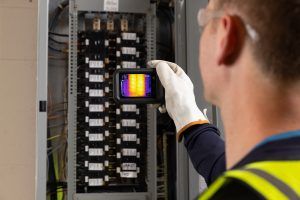
FLIR thermal imaging cameras manufactured in Europe: precision and resolution in every inspection
FLIR thermal imaging cameras manufactured in Europe: resolution, temperature, and accuracy in every inspection. Official FLIR distributor in Spain: Apliter.

FLIR Premium Handheld Bundle Promotion: More Than Just a Thermal Camera
Register your FLIR Exx or Txxx Series and get access to an extended warranty, professional software license, and ITC course. See conditions and included models.
Industrial Maintenance: From Cost to Strategic Investment
For decades, industrial maintenance has been perceived as a necessary evil. An activity primarily aimed at complying with regulatory requirements, avoiding penalties, and responding to