
It is clear that companies are struggling to cope with the exponential growth in energy costs and bills. Faced with skyrocketing prices and a lack of certainty, companies around the world are looking for ways to reduce consumption and cut costs wherever possible.
In this increasingly unaffordable new reality, acoustic imaging offers manufacturers a crucial lifeline by helping energy-intensive industries keep their lines running while reducing operating costs and cutting maintenance expenses.
You have probably heard the expression "lossless sound". Well, acoustic imaging takes this concept literally.
Detecting air leaks that remain undiscovered can tackle a very costly problem
For the UK and much of the EU, the cost of energy has almost doubled from the same time in 2021, with a current price of GBP 0.34/kWh compared to just GBP 0.189/kWh in 2021. That is an increase of 179%. In fact, gas prices have increased in 23 of the 24 EU Member States for which data is available, with the largest increases after the UK occurring in Estonia (+154%), Lithuania (+110%) and Bulgaria (+108%). All this begs the question: how can energy-intensive sectors survive in this context? Considering that large-scale industrial processes are largely driven by compressors and vacuum pumps to operate machines and transport goods, this is a crucial question.
The answer is, of course, by analyzing consumption and considering real, tangible ways to reduce expenditure at the shop floor level. An increasingly popular strategy among manufacturers across the EU involves the use of acoustic imaging.
No equipment, no matter how state-of-the-art, is immune to the problem of breakdowns and wear and tear. Machines that are not performing optimally are costing you money in very real terms. That, at the front line of condition monitoring, is where acoustic imaging comes in. They promise to achieve savings by detecting air leaks in real time.
While isolated incidents may seem minimal, it is easy for the cost of wasted energy to quickly spiral out of control from a minor nuisance to a serious problem. Consider that, in a typical compressor system, approximately 80% of the energy is lost as a result of heat dissipation, so only 20% becomes usable on the factory floor. From there, up to a third of this usable energy is lost as a result of leakage. Energy for which you are paying more and more.
Any questions?
Request information
Why are air leaks so expensive?
Let's frame on a measurable scale this problem, which can vary substantially from application to application. To do this, operators must first calculate exactly how much a leak affects the cost of their production.
Consider, for example, a compressed air leak through a small hole of only 1.5 millimeters in a network at seven bar pressure. Two years ago, at a price of €0.07/kWh, it would have already cost a company around €1,500 if we assume an average operating time of 6,000 hours per year.
Of course, the energy situation has now worsened, which means that costs can be three, four or even five times higher in some cases, costing up to €8500/year for failing to identify a small hole in a vital line component.
Considering the scale of industrial production and the number of leaks that can go unnoticed, it is worrying that such a comparatively small orifice can trigger such a large problem.
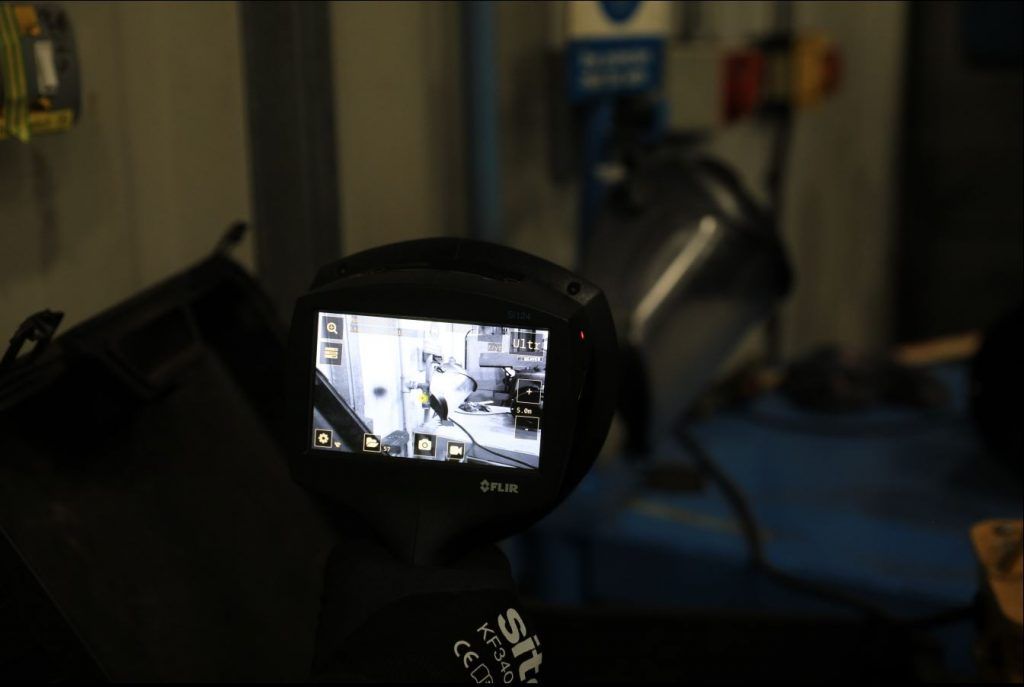
Reducing energy costs with the FLIR Si124 range
New models of acoustic imaging cameras, such as the FLIR Si124, which boasts an optimal bandwidth between 2 and 65 kHz, use a series of high-precision microphones that pick up sound in the audible and ultrasonic range to detect air leaks as soon as they appear. This range provides unparalleled detection capability to identify even the tiniest leak.
The technology also offers operators the ability to identify, photograph or videotape the location of an air leak up to ten times faster, resulting in minimal facility downtime and immediate repair or replacement of the faulty component. In addition, it also detects partial discharges, floating discharges and corona discharges, helping to reduce both life-threatening events and general maintenance problems.
Operators enjoy much faster identification of problem parts and even have the ability to see detected leaks as soon as they appear. This is because AI functions overlay the image of the sound to generate a visual representation of where the leak is located and indicate both its severity and recommended actions to resolve it.
In the case of the FLIR Si124 model, projective algorithms even calculate how much the leak will cost by assessing the air lost in real time, calculating the cost per kWh and displaying the estimated savings in one year (or other specified time frame). This provides inspectors with the evidence needed to troubleshoot problems and justify repair costs incurred on the production line.
If you are a manufacturer trying to keep rising energy costs under control, explore the new Si124 range now range to radically improve inspections in your plant.
Related entries

IRISS Infrared Windows: Safer Thermography for Electrical Equipment
In industrial facilities, periodic thermographic inspections are key to maintaining the reliability and safety of electrical equipment. However, inspecting live switchboards

Biogas detection with OGI cameras for gas detection.
A few years ago, most biogas installations in Europe were experiencing biogas leakage, as evidenced by measurements taken in recent years.

Avoiding heat loss for energy efficient homes
https://youtu.be/KYhm5K6n3FM Vídeo FLIR C5 – Hogares energéticamente eficientes Cámara termográfica compacta FLIR C5: La herramienta contra la perdida de calor para hogares energéticamente eficientes Desafío