
A fugitive emission, according to the standard "EN 15446:2008 - Fugitive and diffuse emissions of common interest for industrial sectors - Measurement of fugitive emissions of vapors generated by leaking equipment and piping", is any emission to the atmosphere caused by the loss of tightness of a device that is designed to be airtight.
This standard applies to the measurement of fugitive volatile organic compound (VOC) emissions from process equipment. Sources of leakage include, but are not limited to:
- Valves.
- Flanges and other connections.
- Pressure relief devices.
- Process sinks.
- Open end valves.
- Pump and compressor sealing systems.
- Stirrer seals.
- Access door seals.
Does not apply to instrument tube connections.
The standard follows the guidelines of the EPA methodology, which in its Method 21 determines the methods for the detection of fugitive emissions of VOCs.
Gas visualization cameras, Optical Gas imaging (OGI) technology.
The detectors traditionally used internationally as LDAR or Leak Detection And Repair techniques are those listed in EPA Method 21 and can be referred to as "sniffers":
- Flame Ionization (FID). It is the most widely used detector.
- Photoionization (PID).
Currently, one of the detectors that are beginning to consolidate as the best available technique (BAT) are the detectors or methods for obtaining optical images of gases. For some years now it has been included as a method of detection of fugitive emissions by the EPA. See EPA 0000a certificate
The rise of this technology is mainly due to three factors:
- Worker safety. A camera to detect gas leaks gives instant results through the image viewer. It should be taken into account that whether it is a small leak or a large one, inspections can always be performed from several meters away, so we will significantly improve the safety of operators in case of any mishap.
- Improved efficiency. Working with aspiration detectors or "sniffers" can mean spending a lot of time inspecting the installations. On the other hand, when using a thermal camera to detect gas leaks, we will be able to analyze larger areas quickly and thus discarding all those areas that do not require any maintenance or repair action, focusing on inspecting those that do show any anomaly. Thanks to a thermal camera to detect gas leaks we will save a lot of working time and improve the efficiency of our operators.
- Comply with environmental regulations. Having a thermal camera to detect gas leaks will allow our company to comply with the new industrial regulations and procedures established by the IED (Industrial Emissions Directive), such as Best Available Techniques (BAT or BREFs), related to integrated pollution prevention and control in the European Union.
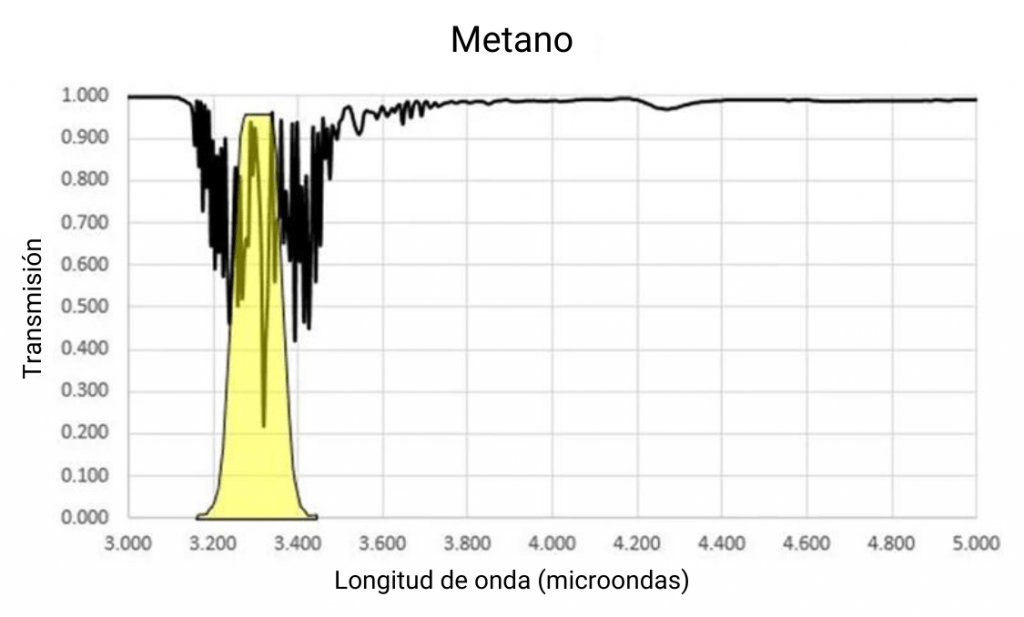
OGI cameras take advantage of the absorbing nature of specific molecules to image them in their native environments. The focal plane arrays (FPA) and camera optics are specifically tuned to very narrow spectral ranges, on the order of hundreds of nanometers, and are therefore ultra-selective. Only absorbing gases in the infrared region that is bounded by a narrow bandpass filter can be detected. Infrared absorption characteristics are wavelength dependent for most compounds. Noble gases such as hydrogen, oxygen and nitrogen cannot be imaged directly.
The yellow region in Figure 1 shows a spectral filter designed to correspond to the wavelength range in which most of the background infrared energy would be absorbed by methane.1
You can find more information about refrigerated and non-refrigerated chambers, in this post: https://www.apliter.com/blog/camaras-ogi-refrigeradas-y-no-refrigeradas/
Fugitive Gas Emission Inspections by APLITER
Due to the needs of our customers, in APLITER we offer the possibility of a rental with operator for the detection of different types of gases. An expert in this technology will come to your facilities and perform an inspection of all the components of your installation.
We currently have two models of gas visualization chamber available:
An OGI thermal imaging inspection with the FLIR Gx620 is up to nine times faster than with traditional tools such as sniffers, and is safer since it can be performed at a distance from the components. In addition, the sensitivity of the FLIR Gx620 camera meets the detection requirements of the US EPA-NSPS OOOOa standard.
The FLIR Gx620 gas detection FLIR thermal imaging camera is the first OGI camera with intrinsic safety certification for use in potentially explosive environments. The FLIR Gx620 OGI camera is FLIR's latest offering for volatile hydrocarbon leak detection in refineries and the petrochemical industry. The intrinsically safe designation means that technicians can use the thermal imaging camera within ATEX classified zones. The FLIR Gx620 OGI camera is the safest way to detect methane and VOC leaks.
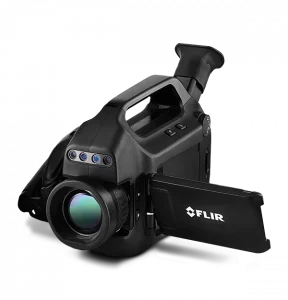
The FLIR GF77 thermal camera is an innovative uncooled optical gas detection camera with interchangeable lens options that detect methane, sulfur hexafluoride (SF6), ethylene, ammonia and other gas emissions.
The FLIR GF77 IR camera, which is capable of both gas detection and radiometric temperature measurements for thermal inspections, is ideal for power utilities, oil and natural gas operations, chemical manufacturing facilities, food and agriculture, and emergency services.

Do not hesitate to ask for an estimate and consult with one of our technical specialists to find the best option for you.
Links of interest:
Best Available Techniques, European IPPC Bureau: https://eippcb.jrc.ec.europa.eu/es/reference
EPA. Method 21: https://www.epa.gov/emc/method-21-volatile-organic-compound-leaks
Standard UNE-EN 15446:2008. https://en.tienda.aenor.com/norma-une-en-15446-2008-n0041467
Related entries


