
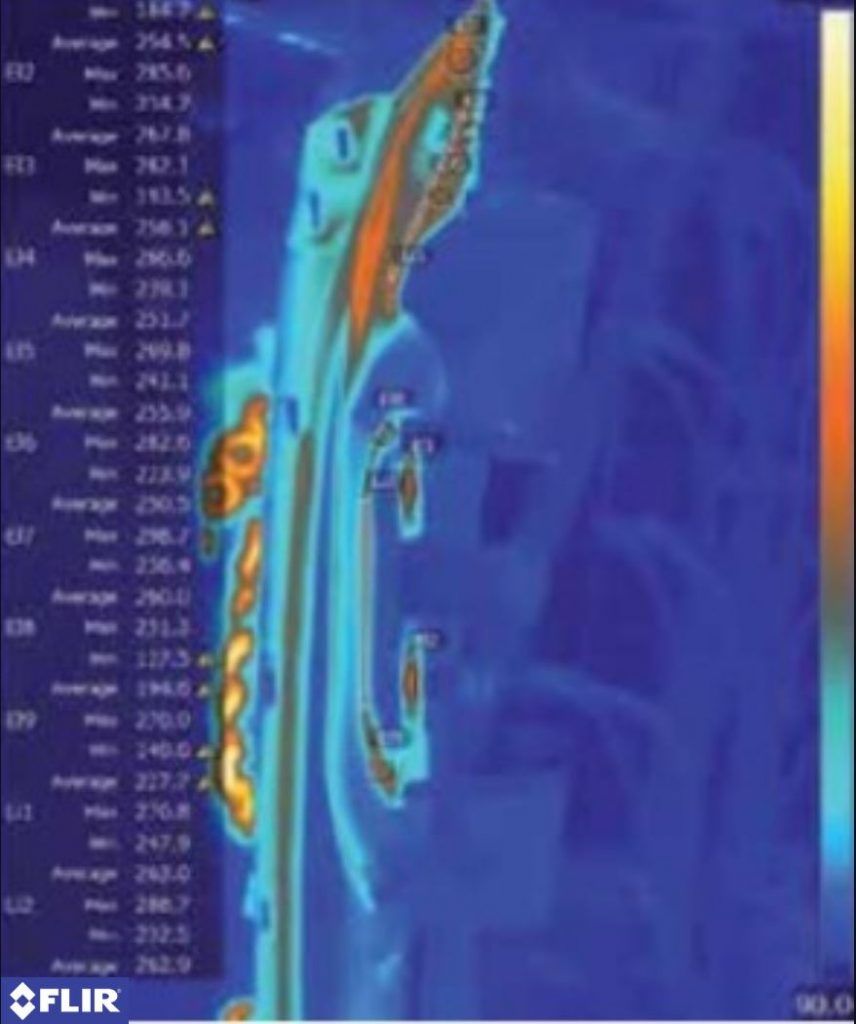
The use of plastic for parts such as instrument panels and defrost grills is common in the automotive industry because these lightweight materials not only make vehicles more fuel efficient, but also allow great design freedom and flexibility. These components are joined using infrared (IR) welding. While IR welding creates a strong bond, it is critical for manufacturers to ensure that the welds reach the correct temperature and heat evenly. Otherwise, the weld could fail, resulting in costly recalls.

IR welding for plastics
Infrared welding creates a high-strength hermetic seal by using an infrared-emitting plate to melt the mating surfaces. The plate is then removed and the part halves are actuated together and allowed to resolidify under pressure. Unfortunately, there is no visual way of knowing if the weld was successful without stopping production for an inspection.
The solution to this process and quality control problem is the use of thermal imaging cameras.


IR weld process control with thermal imaging allows fabricators to capture welds that fall outside the upper or lower temperature control limits.
A fixed infrared camera, placed along the production line, repeatedly and accurately illustrates the thermal patterns and gradients needed to identify IR weld failures. A thermal image can also show an incomplete shape, a non-uniform temperature profile or variable gradients. Temperature data collected from a thermal camera can help quality control engineers find and correct errors on the production line to prevent defective products from being released.

FLIR fixed-mount thermal systems, such as the A50/A70 advanced imaging cameras, can transmit linear or compressed radiometric temperature data via communication protocols such as GigE Vision and RTSP. These cameras offer accuracy of up to ±2 °C (±3.6 °F) within temperature ranges from -20 °C to 1000 °C (-40 °F to 3632 °F), ensuring that they provide correct and actionable data for quality control analysis. The A50/A70 series offers two pixel resolutions (464 × 348 or 640 × 480) and a range of fields of view (29°, 51° or 95°) on fixed manual focus lenses for consistent viewing. Thanks to their unique compressed radiometric output, these cameras avoid processor overload. When paired with the optional integrated visual camera, the A50/A70 can produce FLIR's patented MSX® images that can be easily interpreted.
Click to learn more about FLIR A50-A70 Imaging Transmission Cameras or contact one of our experts for more information.

Thermal leakage monitoring to prevent fires in electric vehicle battery modules
The customer challenge Most EV battery pack and module manufacturers use battery cells with a certain level of charge.

Preventing factory fires and reducing downtime: how thermography protects international production lines
According to the International Energy Agency, in the race to reach ambitious global net-zero emissions targets, by 2050, additional

Maximum performance: thermography to automate ski grinding in an industry-first facility
Ski grinding RELISTE is a machine vision integrator based in Austria. For more than 50 years, it has been specialized in the sale of