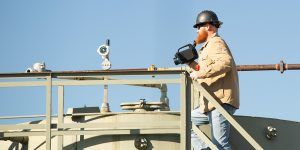
A few years ago, most biogas installations in Europe were experiencing biogas leakage, as evidenced by measurements taken in recent years. Since then, the use of gas detection camera technology to visualize leaks easily has increased among biogas operators. Biogas leaks not only generate losses with regard to system efficiency, but also pose potential health and environmental risks. Safety aspects also emerge when gases from explosive mixtures escape and put people and facilities at risk.
The mission of economic efficiency in relation to biogas damage, environment and acceptance
Biogas (methane) is one of the gases that can escape as a result of leaks in biogas installations at various locations and have a considerable impact on the safety and economic operation of the plant. A German company specializing in in-process analysis and detection of gas leaks in biogas facilities chose the FLIR Gx620 camera for leak detection to provide its customers with the highest level of gas efficiency and the lowest possible risk of downtime. "If left undetected, even the smallest gas leaks can cause serious financial damage over time," says one of the company's managing directors. The engineer has been using the FLIR Gx620 OGI camera for two years to examine leaks at biogas facilities and has inspected more than 150 biogas plants to date. Gas leaks must also be prevented for environmental reasons and in relation to popular acceptance.
The company learned about the use of thermography to detect organic gas leaks, especially biogas, at a trade show. "We then contacted a FLIR representative who is also a specialist consultant and user, and who demonstrated the technology at one of our customers' facilities."

Large installations require flexible gas tracing systems
Especially in the biogas field, maximum flexibility and compactness are required, and the FLIR Gx620 fits perfectly. The main problem of gas detection in the biogas field is the enormous size of many installations and the large volume of the components involved. On the other hand, the difficult access when trying to locate leaks, for example in fermenter ceilings, prevents fast and effective detection of gas leaks with conventional means. The main focus prior to purchase was to find a reliable and error-prone technology with sufficient resolution to detect even the smallest leaks at a distance. The size and mobility of the system were also important in order to be able to inspect even hard-to-reach components in biogas facilities with the camera. "The camera is so compact that it can be easily transported even when using ladders," explains the leak location expert.
Conventional biogas detection methods are time-consuming and prone to malfunctions
Prior to the use of sophisticated technology, gas detection devices and leak detection sprays were used to discover leaks in biogas facilities. However, the reliability of these methods is limited because these tools only work when all system components are directly accessible. In the area where the tank meets the roof, the inner gas membrane, the slots of submersible mixers or holes in the tank walls, the use of leak detection sensors and sprays is especially difficult and sometimes almost impossible. Inspecting an entire biogas installation with these tools is time-consuming, which also leads to a corresponding cost for the customer. FLIR's Gx620 solves this problem almost completely, because even hard-to-reach components can be examined from the ground.

Gas leak detected with an OGI camera.
Biogas detection requires experience
Gas leaks are shown in a grayscale video, in which the gas stands out as a cloud in the background. Thanks to the change of location and appropriate display times, small gas leaks do not go unnoticed. With the patented, integrated image analysis software (HSM), gas leaks are especially easy to detect in moving images, whereas black-and-white JPEG images of gas leaks require certain interpretive skills. "Some experience in image interpretation is necessary to carry out reliable leak location and assessment." The special FLIR software for subsequent documentation also proved to be very practical. The advantage of the software is mainly the sophisticated documentation it provides for the examined biogas installations and the ease of use, which only requires a short training period. Detected leaks can be marked directly on the image and also recorded as a video sequence with the camera software. Therefore, the customer can repair the damaged areas afterwards and the success of the measurements can be verified without much effort at a follow-up appointment.
The camera has no real competition in terms of compactness and possibility of mobile use. "The light weight of the gas detection camera allows ergonomic work in any position, and the ease of use completes its design." Last but not least, in addition to detecting methane, gas mixtures can also be detected, a fact that is especially useful when inspecting another system component such as combined heat and power (CHP). With FLIR's OGI gas detection camera, gasoline or diesel fumes can be visualized and, for example, exhaust leaks in the turbocharger can be specifically detected. Thanks to its compact and protected design, the camera can be used together with an explosimeter in explosive environments.
FLIR Gx620 enables maximum mobility

Added value for users and customers
The use of the gas detection chamber has brought considerable added value to customers using this technology. In addition to ensuring optimized operation through in-process analysis, the use of the gas detection camera can help operators of biogas facilities to quickly and reliably detect smaller gas leaks and thereby increase system efficiency in many cases. The camera's patented technology provides safety while eliminating the need for manual color marking by modifying computer parameters.
APLITER Gas Inspection Service
Apliter, in addition to selling this type of cameras for the detection of biogas and other gases, we also perform inspections with specific cameras for different gases and a qualified operator for this type of work in hazardous environments, able to find the source of gas leaks in petrochemical and industrial plants. Learn more about this gas leak inspection service.