
Different technologies, different sectors
FLIR Systems has been manufacturing infrared cameras to visualize gas leaks of different types for more than a decade. These optical gas detection (OGI) cameras are developed to "see" different gases, such as hydrocarbons, carbon dioxide, sulfur hexafluoride, refrigerants, carbon monoxide, ammonia, etc. These imagers are used for many applications in different industries, including decreasing emissions, increasing production efficiency and ensuring safe working environments. A major advantage of OGI cameras, compared to other inspection technologies, is the speed with which the technology can locate component leaks without interrupting the industrial process.
Historically, OGI cameras have been designed with cooled IR detectors that offer several advantages over uncooled detectors, but are typically more expensive. Advances in uncooled detector technology have enabled OGI camera manufacturers such as FLIR to design and develop more affordable OGI solutions for these industries. Although lower in cost, cameras with uncooled detectors show some limitations compared to those with cooled detectors.
The science behind optical gas detection
Before addressing the question of whether an OGI camera should have a cooled or uncooled detector, we can explain the theory behind this technology. Optical gas detection can be understood as something like looking with a normal video camera, but the operator sees a gas column as if it were smoke. Without an OGI camera, it would be completely invisible to the human eye. In order for the gas column to be seen, the OGI camera uses a unique method of spectral filtering (which is wavelength dependent) that allows it to detect a specific gaseous compound. In a cooled detector, the filter restricts the wavelengths of radiation that can pass through the detector to a very narrow band called the bandpass. This technique is known as spectral matching.

Any questions?
Request information
OGI cameras take advantage of the absorbing nature of specific molecules to image them in their native environments. The focal plane arrays (FPA) and camera optics are specifically tuned to very narrow spectral ranges, on the order of hundreds of nanometers, and are therefore ultra-selective. Only absorbing gases in the infrared region that is bounded by a narrow bandpass filter can be detected. Infrared absorption characteristics are wavelength dependent for most compounds. Noble gases such as hydrogen, oxygen and nitrogen cannot be imaged directly.
The yellow region in Figure 2 shows a spectral filter designed to correspond to the wavelength range in which most of the background infrared energy would be absorbed by the methane.

If the camera is aimed at a scene where there is no gas leakage, the objects in the field of view will emit and reflect infrared radiation through the camera lens and filter. If there is a gas cloud between the objects and the camera, and the gas absorbs radiation in the bandpass range of the filter, the amount of radiation passing through the cloud to the detector will be reduced. To see the cloud relative to the background, there must be a radiating contrast between the cloud and the background.
In summary, the keys to making the cloud visible are: the gas must absorb infrared radiation in the waveband seen by the camera, the gas must have radiant contrast with the background, and the apparent temperature of the cloud must be different from that of the background. In addition, motion makes the cloud easier to visualize.
Wavelengths related to optical gas detection
To address the challenge of differentiating between "cooled and uncooled" optical gas detection chambers, you must understand the wavelengths associated with optical gas detection and the detectors used in these chambers. The two wavelengths of OGI chambers are often referred to as mid-wave, 3-5 micrometers (μm) and long-wave, 7-12 μm. In the world of optical gas detection, they may also be known as the "functional region" and the "fingerprint region," respectively. More single-category gases can be seen in the functional region with a camera, while many individual gases have specific absorption characteristics in the fingerprint region. For example, almost all hydrocarbon gases absorb energy in the filtered region of the GF320 (highlighted in yellow) but have varying absorption characteristics in the longwave fingerprint region (highlighted in blue).

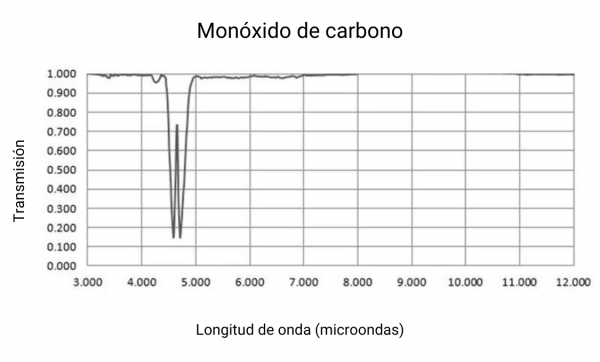
Although many gases have absorption characteristics in both the mid-wave and long-wave regions, there are also gases that emit only in one IR band. Some gases emit in the mid-wave spectrum and not in the long-wave spectrum (such as carbon monoxide/CO) and there are others that emit only in the long-wave spectrum (such as sulfur hexafluoride/SF6). These gases would not fall into the fingerprint and functional fingerprint regions, which usually correspond to hydrocarbon gases. Below you can see plots of IR spectra for CO and SF6 gases.

Refrigerated vs. non-refrigerated detectors
Refrigerated OGI chambers use quantum detectors that require cooling to cryogenic temperatures (around 77 K or -321 °C) and can be either medium-wave or long-wave detectors. Medium-wave chambers that detect hydrocarbon gases in the functional region, such as methane, typically operate in the 3 to 5 μm range, and use an indium antimonide (InSb) detector. Long-wave cooled cameras that detect gases such as SF6 typically operate in the 8 to 12 μm range and may use a quantum well infrared photodetector (QWIP).
A cooled OGI camera has an integrated imaging sensor with a cryogenic cooler that reduces the sensor temperature to cryogenic temperatures. This reduction in sensor temperature is necessary to reduce noise to a level below that of the scene signal being imaged. Cryogenic coolers are moving parts manufactured to extremely tight mechanical tolerances that wear out over time. In addition, helium gas gradually leaks out of the gas seal gaskets. Finally, cryocooler replacement is required after 10,000 to 13,000 operating hours.
OGI cameras with cooled detectors have a filter that is connected to the detector. The design prevents any exchange of stray radiation between the filter and the detector, allowing for better image sensitivity. The increased image sensitivity could cause the imager to image certain gases more efficiently and even allow the OGI camera to meet regulatory standards such as EPA OOOOa or other requirements.

Images of a handprint on a wall taken with a cooled thermographic camera and again after two minutes.
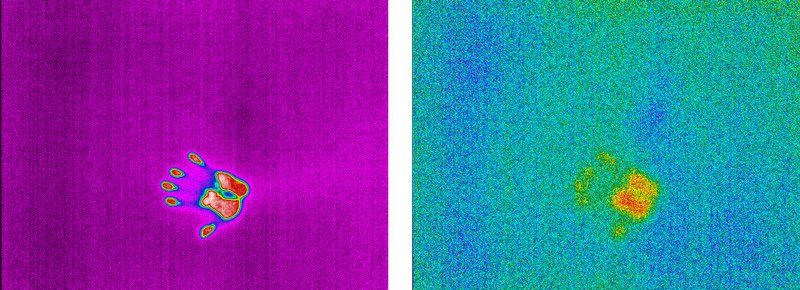
Images of a handprint on a wall taken with an uncooled thermographic camera and again after two minutes.
Uncooled OGI chambers use a microbolometer detector that does not require the additional parts necessary to cool a detector. They are usually made of vanadium oxide (VOx) or amorphous silicon (a-Si) and respond in the 7-14 μm range. They are much easier to manufacture than refrigerated chambers, but do not have the same sensitivity or noise equivalent temperature difference (NETD), making them more difficult to visualize smaller gas leaks. NETD is a figure of merit that represents the minimum temperature difference a camera can resolve. The images from the refrigerated thermal imager show the effects of sensitivity for refrigerated and uncooled detectors. By having a better NETD, a cooled OGI camera will detect gas at least five times better than an uncooled one. A similar standard is used to determine the detection capability of a chamber: the noise equivalent concentration length (NECL), which determines how much gas can be detected in a defined path. For example, the NECL of a FLIR GF320 cooled OGI camera (3-5 μm detector) for methane detection is less than 20 ppm*m, while the NECL of an uncooled solution (7-14 μm detector) is more than 100 ppm*m.
Another factor to consider with uncooled OGI chambers is the filter. Some cameras have no filter for longwave spectra, which means they are simply an open detector that uses unique analytics to visualize a gas. FLIR's patented High Sensitivity Mode (HSM) is an example of a camera that uses software and analysis to enhance gas visualization. Some cameras have more specific filters built into the camera system. They may be associated with the lens, be between the camera and the lens, or with different types of engineering.
With uncooled filtering, thermal sensitivity is lost due to the limitation of radiation reaching the camera detector. This would result in a higher NETD, but may provide a better image in terms of gas detection. As the width of the spectral filter is restricted to focus on specific gases, the radiation from the scene is reduced, while the detector noise remains the same and the reflected radiation from the filter increases. This results in a much higher quality image in terms of gas detection, but reduces the thermal sensitivity of the camera for temperature measurement (radiometry). When a cold filter is available, as in a cooled OGI chamber, this phenomenon is avoided because the amounts of radiation from reflections are very small.
Can all gases be seen with the thermal technology of OGI cameras?
Since OGI cameras image the gas as an absence of infrared energy, if a gas does not absorb infrared radiation in the bandpass, it cannot be imaged directly with an optical gas detection camera. For example, noble gases such as hydrogen, oxygen and nitrogen cannot be imaged directly. And even if a camera can image a specific gas, hydrocarbon gases for example, it will not image another gas that has radically different infrared absorption properties such as SF6. That is why FLIR has a range of OGI cameras for the detection of different gases.
How to choose a refrigerated or non-refrigerated OGI chamber
When choosing the camera that fits your OGI needs, the first factor to consider is whether the camera in question can visualize your gas. Once you have done so, the decision is not always straightforward and should not be based on price alone.
Although they may have a higher price tag, they offer considerable advantages over uncooled OGI chambers. As mentioned above, these units fall within the hydrocarbon gas functional region, which means that only one camera would be needed to image a wide variety of gases. In some cases, multiple cameras would be needed in the fingerprint region to achieve the same results. Another unique advantage of a medium-wave camera is the absence of interference from water vapors. As seen in the uncooled OGI camera images, water vapor has a large absorption in the longwave or fingerprint region, which could cause image wavering when using a camera.
Higher sensitivity and higher image quality are important factors to consider when choosing an OGI camera. Not only do they affect the ability to visualize small leaks, but they can be important factors in meeting regulatory standards.
There are other considerations when choosing a camera why a refrigerated OGI camera is preferable. The only handheld OGI cameras certified for hazardous locations are refrigerated detector cameras. If you need or want the ability to quantify your gas leak, you can only do so with a mid-wave spectrum camera, such as the GF320, and the proprietary software found in Providence Photonics' QL320 quantitative solution.
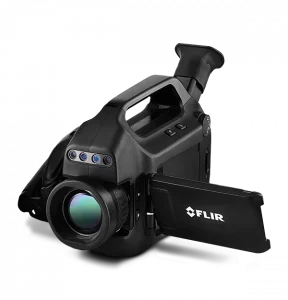
FLIR GF620 refrigerated OGI camera

Uncooled OGI camera FLIR GF77
With the introduction of uncooled OGI chambers to the market, this new technology offers several advantages. First and foremost, the manufacturing cost of an uncooled chamber is significantly lower, resulting in a lower market price. They are also cheaper to maintain due to the simplicity of the design, which does not require a cooler, making them possibly more suitable for continuous, uninterrupted operation applications.
Whether you're looking to save money, meet regulatory standards, increase worker safety or are simply concerned about the environment, you have more options than ever before, which can sometimes make the process confusing. Aside from price, there are many factors to consider when choosing an OGI camera. FLIR offers the widest range of OGI cameras on the market and can help you during the selection process.
Related articles:

FLIR ADGILE, the ideal complement for methane detection
In industries such as oil and gas, where safety and environmental standards are critical, methane leaks pose significant risks and must be identified and managed immediately.

European Union Regulation 2024/1787 on methane emission reductions: Maintaining compliance requires quantitative optical gas imaging
MAINTAINING COMPLIANCE REQUIRES QUANTITATIVE OPTICAL IMAGING OF GASES

Biogas detection with OGI cameras for gas detection.
A few years ago, most biogas installations in Europe were experiencing biogas leakage, as evidenced by measurements taken in recent years.