
In industries such as oil and gas, where safety and environmental standards are critical, methane leaks pose significant risks and must be identified and managed immediately. Monitoring and detection of methane leaks is not only a regulatory requirement, but is vital for operational safety and environmental management. The use of continuous, stand-alone optical gas imaging (OGI) is an efficient method to meet these objectives.
Introducing the FLIR ADGiLE system, featuring FLIR's uncooled GF77a optical gas imager, designed for continuous, stand-alone methane leak detection. By integrating FLIR's decade-long expertise in optical gas imaging (OGI) technology and analysis, the system provides accurate alarm capabilities for methane gas emissions, helping operators meet today's rigorous industry demands and prepare for future regulatory changes.
Anticipate methane leaks with FLIR ADGiLE
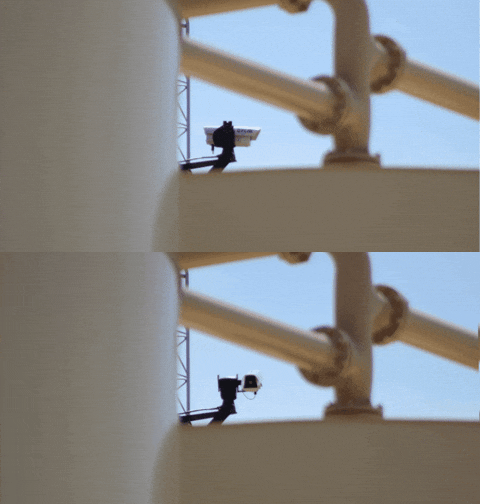
ADGiLE installation example


Detect accurately and act with confidence with FLIR ADGiLE
Dive into the future of gas leak monitoring with FLIR ADGiLE. This is not just a system, it is your smartest ally in the ongoing battle against methane emissions. Crafted with the finesse of advanced optical gas imaging (OGI) technology and the intelligence of real-time analytics, ADGiLE transforms the complex task of leak detection into a seamless and nearly effortless task. Get ready to experience unparalleled operational information and safety.
Continuous operation, at any time
Monitor methane emissions continuously, with robust analysis that detects and differentiates leaks in any operating condition.
Designed to operate day and night, it guarantees 24-hour security and compliance.
Ensuring asset integrity and security
Advanced detection capabilities enable immediate action, maintaining system integrity and preventing hazardous conditions.
Keeps personnel safe by providing early warnings and visual evidence of leak locations, reducing the need for manual hazard inspections.
Improved situational awareness
Ability to monitor a complete installation by means of panoramic and inclined tours to ensure inspection of all components.
Real-time video display of gas columns with alerts and event recording for detailed analysis. Helps operators to quickly understand the nature of the emission, in order to distinguish between leaks and routine venting.
Decision-making analysis software
FLIR Latitude UVMS enhances control and integration, giving operators the ability to set up automated actions upon detection and review historical data for comprehensive event analysis.
What does FLIR ADGiLE include?

GF77a camera in housing
The GF77a camera, housed in a ruggedized casing, offers flexible and comprehensive coverage, allowing operators to monitor large areas effectively.
Custom wiring connecting the camera to the panel
Customized cabling ensures secure and reliable connections between the GF77a camera and the environmental panel, facilitating the seamless integration of data and power required for continuous system operation.
Perimeter detection from tested analysis
ADGiLE has a perimeter PC running proven leak detection analysis that includes a custom-built environmental cabinet that provides robust data processing and real-time analysis capabilities.
FLIR Latitude UVMS Interface
The FLIR Latitude UVMS interface provides an advanced user interface for managing video data, integrating camera controls, and storing and retrieving video footage.
- IR resolution
- 320 × 240 pixels
- Thermal sensitivity/NETD
- <25 mK a 30 °C (86 °F)
- Spectral range
- Uncooled microbolometer: from 7 µm to 8.5 µm
Imaging and optics
- Field of view (FOV)
- 25° × 19°
- Field of View (FOV) - Focal Length
- 18 mm (0.71 inches)
- Minimum focal length
- Without MSX: 0.3 m (0.98 ft)
With MSX: 0.65 m (2.1 ft)
- Approach
- - Contrast of one shot
- motorized
- manual
- Image frequency
- 30 Hz
- Lens identification
- Automatic
- Number F
- 1,04
- Detector passage
- 25 µm
- Spectral range
- Uncooled microbolometer: from 7 µm to 8.5 µm
- IR resolution
- 320 × 240 pixels
- Spatial resolution (IFOV)
- 1.4 mrad/pixel
- Sensitivity to gases [NECL].
- CH4: <100 ppm × m
(ΔT = 10 °C, Distancia = 1 m)
- Thermal sensitivity/NETD
- <25 mK a 30 °C (86 °F)
Measurement and analysis
- Emissivity correction
- Variable from 0.01 to 1.0
- Reflected apparent temperature correction
- Based on the reflected temperature input.
- Atmospheric transmission correction
- Based on distance, atmospheric temperature and relative humidity data.
- Measurement corrections
- Global object parameters
- External optics and window correction
- Based on transmission input and temperature of the optics/window.
- Accuracy
- Range 1: -20 °C to 80 °C (-4 °F to 176 °F) ±3 °C (±5 °F)
Range 2: 0 °C to 250 °C (212 °F to 482 °F) / 0 °C to 100 °C (32 °F to 212 °F):±3 °C / 100 °C to 250 °C (212 °F to 482 °F):±3 %
Range 3: 100 °C to 500 °C (212 °F to 932 °F):±3 %.
- Object temperature range
- Range 1: From -20 °C to 80 °C (-4 °F to 176 °F)
Range 2: From 0 °C to 250 °C (212 °F to 482 °F)
Range 3: From 100 °C to 500 °C (212 °F to 932 °F)
General
- Including
- Thermal camera in protective housing
Additional cable insertion collars for auxiliary cables
Control cabinet (incl. Edge PC)
Adapter bracket
Screw kit
Power/communication cable
Ethernet cable, RJ45
Cardboard box and fixed environmental housing
Insert cardboard box and environmental housing
Printed documentation including user name and password to log into the camera web interface
- Housing material
- Aluminum
- Weight
- 5.90 kg (13.0 lb)
- Size [L. × W. × H.].
- Camera: 510 mm × 177 mm × 229 mm (20.1 in. × 6.97 in. × 9.02 in.)
Control unit (external): 700 mm × 530 mm × 265 mm (27.5 in. × 20.8 in. × 10.4 in.)
Mounting plate: 535 mm × 430 mm (21.06 in. × 16.9 in.)
Feeding
- Power consumption
- 21 W
- Operation with external power supply
- IEEE 802.3af, IEEE 802.3at/PoE Plus compliant
- External stress
- PoE Class 4 (25 W)
Environmental characteristics and certifications
- Lens transmission correction
- Automatic, based on internal sensor signals
- Corrosion
- Resistance to salt spray: ISO9227, up to 1000 hours
- EMC
- EN 55032:2015 Emission requirements
EN 55035:2017 Immunity requirements
FCC - Title 47 CFR Part 15:2019
ICES-001 Issue 4:2014
- Humidity (operating and storage)
- Relative humidity: 5 % to 95 %.
- Protection
- IP67
- Storage temperature range
- IEC 68-2-1 and IEC 68-2-2-2, -40 °C to 70 °C (-104 °F to 158 °F) for 16 hours
- Operating temperature range
- From -30 °°C to 50 °°C (-22 °°F to 122 °F)


