
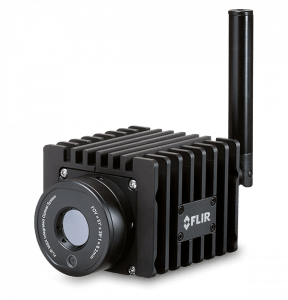
When decision makers are looking to integrate new hardware into their automation process, they often look at a few key areas such as ease of use, price, features, or the ability to use the hardware at multiple points in their system. FLIR's A50 and A70 thermal cameras are available in three options: Smart, Streaming, and Research & Development, to suit the needs of professionals in a variety of industries, from factory production, to utilities, to science. The new cameras offer improved accuracy of ±2°C or ±2% temperature measurement, compared to the previous accuracy of ±5°C, or ±5% temperature measurement. All cameras include an IP66 rating, along with a small and compact size with higher resolution options compared to previous versions.
With a thermal resolution of 464 × 348(A50) or 640 × 480(A70), professionals can deploy the cameras in a variety of capacities. These include monitoring programs to maximize uptime and minimize costs through planned maintenance, or when used in early fire detection applications to safeguard workers' lives and ensure business profitability by protecting materials and assets. With improved temperature measurement accuracy of ±2°C, professionals can rely on consistent readings over a period of time, or across varying environmental factors, taking any guesswork out of data analysis.
The IP66 rating of the FLIR A50 and A70 cameras provides protection against dust, oil and water, making the cameras ideal for demanding industrial environments. This ruggedness is especially useful when the camera is moved from one location to another for different applications. Whether the camera is fixed-mounted to inspect a production line or needed for measurements on a test bench, professionals benefit from its versatility.
Any questions?
Request information

A50 / A70 Smart
Designed for condition monitoring programs to reduce inspection times, improve production efficiency and increase product reliability, the Smart range cameras introduce intelligent "on camera / on edge" functionality. This means that temperature measurement and analysis can be performed on camera, easily and efficiently, without the need for a PC. These cameras allow automation system solution providers to start working with a camera that is easy to add, configure and use in HMI/SCADA systems (with REST API, MQTT and Modbus functionality).
Image transmission of the A50 / A70
Created for process and quality control, the A50/A70 image transmission cameras improve production time and the quality of what is produced, while reducing operating costs. Thanks to their compatibility with GigE Vision and GenICam, professionals can simply connect the camera to their PC and choose their preferred software. In most cases, the addition of the A50 or A70 image transmission cameras complements machine vision systems by detecting the temperature variation of the targets being analyzed.

A50 / A70 Research and Development Kit
Used primarily as a research and development solution, FLIR's R&D Kit provides an easy entry point into thermal imaging analysis for applications within academia, materials studies, and electronics and semiconductor research. The R&D Kit includes the Advanced Image Streaming versions of these A cameras and FLIR Research Studio software for camera control, live image viewing, recording, and post-processing for decision making. The A50 and A70 thermal cameras, with Smart, Streaming, or Research & Development options, offer professionals in different industries a manageable solution for inspecting and analyzing data efficiently and effectively, and help save time and money.
Summary of the advantages of the A50 / A70
In addition to their small, compact size, which makes it easy to mount these cameras inside machinery with tight spaces, the A50/A70 's IP66 rating is a must-have feature that eliminates the need to add a housing around the camera when deployed in harsh environments. Another added benefit is the ability to inspect and analyze data through the camera's Wi-Fi capability, eliminating the need for users to run cables through manufacturing facilities from a computer to the piece of equipment being inspected.
The release of these cameras provides new software capabilities that now allow dual functionality with two different spectra - thermal temperature monitoring and visual inspection - within the same camera. This adds an additional level of functionality to new and existing FLIR integrated systems. Users can combine thermal functionality, to check the sealing of packages, for example, with visual inspection of the package itself. This can now be completed with a single camera without the need for any additional hardware, just a simple software change.
FLIR A50/A70 thermal imaging cameras add value to industrial processes with their expanded communication capabilities allowing companies to do more with the camera data than ever before. The more data and the more ways customers have to access that data, the better. We can now take the same critical data that FLIR cameras have always provided and make it more available and therefore more useful to customers. Whether this means integration with security systems or with more plant control networks (DCS, PLC, SCADA), cameras are now able to multitask simultaneously and more efficiently.
If you have any questions, please call us at 93 706 36 79 or send us an email to apliter@apliter.com.
Our professionals will help you.
Related articles:

Benefits of thermography in automated production and industrial maintenance systems
In modern industry, the integration of advanced technologies has become essential to maintain competitiveness and optimize each stage of production. One of the most effective tools in this area is thermography, which allows real-time, non-contact temperature monitoring, facilitating early detection of faults and improving the quality of the final product.

Maximum performance: thermography to automate ski grinding in an industry-first facility
Ski grinding RELISTE is a machine vision integrator based in Austria. For more than 50 years, it has been specialized in the sale of

Preventing factory fires and reducing downtime: how thermography protects international production lines
According to the International Energy Agency, in the race to reach ambitious global net-zero emissions targets, by 2050, additional