
Reduce inspection time by up to 90%.
In most factories, compressed air systems are one of the biggest generators of electricity costs. That's why it's important to detect compressed air leaks and equipment inefficiencies as early as possible, and to repair them immediately. But finding air leaks is not easy using traditional inspection methods, such as time-consuming soap bubble tests.
Most leaks create turbulence, which in turn creates ultrasonic noise. An acoustic imaging camera, such as the FLIR Si124, pinpoints the source of that noise and superimposes that "hot spot" on a real-time visual camera image. By imaging the noise source, we can improve ultrasonic inspection time by approximately 90 percent. Inspectors can also quickly scan large areas with the camera from a safe distance, without touching machinery or stopping the line. The FLIR Si124 detects through background noise typically present in industrial environments to produce accurate images. By listening, recognizing and analyzing ultrasonic sounds and ultimately understanding what the different sounds mean, an acoustic camera allows operators to instantly and accurately identify the source of an air leak.

The FLIR Si124 is ideal for detecting leaks in difficult and hard-to-reach places.
Any questions?
Request information
Calculate the cost of a compressed air leak in your company.
By adopting acoustic imaging as part of a predictive maintenance routine, professionals can identify problems quickly, reduce excessive costs and keep manufacturing operations up and running.
Intelligent leakage quantification and cost analysis
Any typical ultrasonic microphone can locate air leaks if the sound pressure levels they emit are strong enough. But if the user is not trained in acoustics, using such devices without any analysis capabilities will not provide the results needed to make informed maintenance decisions. Historically, converting leak sound files into leak size and cost estimates involves the use of complicated tables or algorithms. The FLIR Si124 eliminates this problem by facilitating analysis with minimal training.

Fixing compressed air leaks detected by the FLIR Si124 can save manufacturers tens of thousands of dollars in electricity costs per year.
Filters background noise
Pressurized air leaks generate a broadband sound that ranges from sonic to ultrasonic frequencies. Industrial manufacturing facilities have various levels of background noise, making it nearly impossible to hear an air leak with the human ear alone. In general, background noise interferes less at high frequencies and air leaks are best detected over long distances at frequencies between 20 and 30 kHz. FLIR Si124's frequency range of 2 to 31 kHz is optimized to detect the smallest leaks at the longest distances or to detect even smaller leaks at close distances using frequencies up to 65 kHz.
When comparing standard ultrasonic detectors, the impression may be given that air leaks emit only a specific ultrasonic frequency sound and, in order to detect them, this frequency range must be used. However, this is not true: in some cases, it can be beneficial, but in others, it can damage the sensitivity of the detection. The most appropriate frequency to use for detection depends on several different factors. However, background noise can interfere. In these cases, the device must be able to differentiate sound sources that resemble a leak from other sources of sound interference. Most acoustic cameras on the market today require the user to manually filter out any sound interference using sliders to select a frequency range. This time-consuming trial-and-error approach significantly increases the risk that many problems will go undetected.
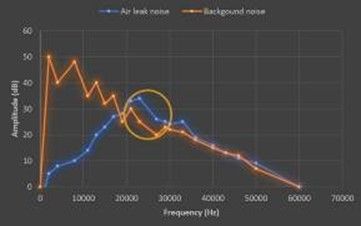
How to find the optimum frequency in a noisy environment.

Example of loss of detection range at different frequencies.
The FLIR Si124 takes a different approach: it automatically detects sound patterns that resemble air leaks and eliminates sound interference, both single and multiple sound sources, using advanced AI filters built into the camera. In other words, the camera recognizes if the sound resembles an air leak versus background noise, so the user doesn't have to.

The FLIR Si124 can detect any pressurized gas leak as long as there is sufficient pressure difference (a minimum psi is a good approximate value).
To detect very high frequency sound sources, the acoustic camera must have a large number of microphones, preferably quite close together. Otherwise, spatial aliasing problems will occur, leading to erroneous results and sound sources being displayed at invalid locations. It is tempting to include higher frequency support in the acoustic chamber for marketing purposes, as higher numbers often look better. The reality is that using too high frequencies will not provide any advantage and will instead worsen performance.
Precision with less effort
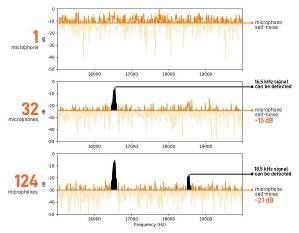
This figure shows how the number of microphones affects the ability to "see" problems. With 124 microphones, the Si124 allows the user to easily see two noise peaks generated by a leak versus 1 peak with a camera using only 32 microphones.
In acoustic imaging, the number of microphones in the camera plays a key role. In general, the greater the number of microphones, the better the acoustic performance. Acoustic cameras typically use MEMS (microelectromechanical systems) type microphones, as they provide high performance, stability, low power consumption and are small in size. MEMS microphones typically pick up loud noises [typically more than 120 dB(A)], but they also have a high automatic noise level, which means that a single microphone cannot pick up the quietest sound levels; however, this automatic noise can be eliminated by combining the signal from several microphones. A doubling of the number of microphones eliminates approximately 3 dB of noise. Therefore, the sensitivity to detect quiet sounds can be increased by maximizing the number of microphones.
The FLIR Si124 has 124 microphones (twice as many as competing acoustic cameras) to detect air leaks as low as 0.016 l/min under optimal conditions. This level of accuracy is made possible by the Si124 acoustic imaging camera's industry-leading flaw detection sensitivity, distance range, and unprecedented number of built-in microphones.
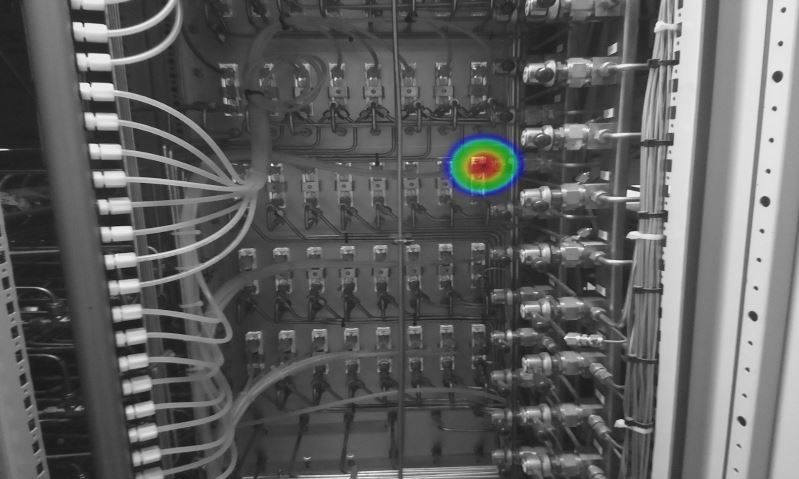
Facilities can reduce compressed air and vacuum leak inspection time by up to 90 percent without extensive training with the FLIR Si124.
FLIR is a trusted provider of decision support solutions.
Manufacturing professionals rely on FLIR to provide reliable, quality solutions that make their jobs easier so they have more time to focus on other priorities. FLIR added acoustic imaging to the company's suite of thermal products to enable facilities to get their work done faster, safer and more efficiently. The Si124 also features a simple but robust reporting tool to help customers identify problems and prioritize what needs more attention.
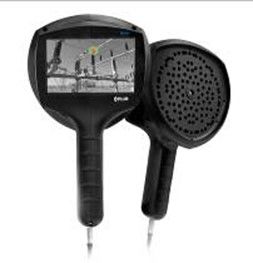
For more information on acoustic chambers or how to detect compressed air leaks, visit this page.
You can also contact us to solve your doubts by e-mail or by phone at 91 159 39 78 | 93 706 36 79.
Related articles


