
As building codes and owner expectations evolve, more buildings are being designed to meet standards that reduce air leakage through the building envelope. The CTE (Technical Building Code) has test standards written specifically for building airtightness testing, providing certified professionals with the ability to perform Blower Door testing. The presence of a more airtight building envelope allows for reduced utility bills, provides the ability to correctly size mechanisms, improves indoor air quality and reduces problems due to moisture.
Basic concepts of building science
When performing a leak test on a building envelope, it is important to know some basic concepts of building science. It is the study of how heat, air and moisture move in buildings. Air leakage can affect these elements by allowing air at an unwanted temperature into the enclosure. This can cause drafts in certain rooms and cause moisture to enter. When the relative humidity is too high, it can cause condensation, mold and comfort problems.
Air can enter, exit and pass through buildings in three ways: wind, fans and the natural stack effect of the building. Wind can have the greatest impact on buildings that are particularly permeable, causing drafts and pressure changes in various areas of the building. Fans also manipulate the air pressure in buildings, whether it is a fan from the heating system, ventilation, etc. The stack effect is an air pressure factor that few people take into account and that has a major impact on energy use and comfort. It is due to warm, buoyant air moving up and escaping from the top of the building, which draws in outside air at the bottom. This occurs without wind or fans moving the air. Not all leaks have the same impact on a building. Roof and floor leaks have the greatest impact, as these are the areas where air is most likely to infiltrate or escape.

Stack effect in a building
Equipment overview
To accurately test for air leakage in a building enclosure and comply with the CTE building enclosure test standards, it will be necessary to use a Blower Door system. Blower Door systems consist of a calibrated blower that is installed in an exterior door using an adjustable frame and a fabric or rigid panel with a hole into which the blower fits.
A digital pressure gauge is connected to the fan and reads the fan pressure with respect to the outside pressure and the inside pressure of the building. The pressure gauge operates by reading the fan pressure and converting it to flow rate. The fan door can be set to various orifice sizes on the inlet side of the fan that can be changed as needed to maintain pressure.

Typical configuration of a blower door.
Since the meter knows each inlet orifice size to which the fan can be set, it can calculate the flow once it reads a pressure. The flow is read as cubic meters per hour at 75 Pa pressure induced by the door fan (CFM75). The leakage target is usually a percentage of the total envelope area. Retrotec manufactures a commercial grade fan that uses an independent variable frequency drive and creates more flow.

Watertightness tests in buildings.
In some cases, particularly in commercial buildings, more than one fan will be required to achieve a test pressure of +/-75Pa. To run multiple fans at the same time, the fan controls will need to be linked so that all fans are running at the same speed. If the commercial model is being used with the VFD, the controls are linked there instead of the top of the fan shown in the diagram. If the fans are not linked together and run independently, the system will not operate efficiently and they may "fight" each other instead of working together to achieve a desired pressure. Also note that each fan will need to be on a separate circuit to avoid tripping circuit breakers.
In a multi-fan test scenario, digital meters are connected to an ethernet hub and fed to a router that connects to a laptop computer where everything is controlled using the Blower Door manufacturer's software.
Planning and site preparation
As a building tester, it is important to meet with the construction project manager or general contractor several times throughout the project to ensure the testing goes smoothly in the end. It is best to participate in the pre-construction meeting to understand the scope of the project. Why are the enclosure tests necessary? Is it for code or quality control? Is the tester just going to test and report the results or is he or she going to locate leaks in the event of failure? It is also helpful to know the materials of air barriers and vapor retarders. For example, fluid-applied air barriers and vapor retarders will, in most cases, be more effective in preventing air leaks.
Approximately one month before the test date, it is advisable to meet again with the general contractor and the HVAC contractor to ensure that the building will be empty of occupants and workers during the Blower Door test, so that no one will open the doors or step on the pipes during the test. It is also necessary to prepare the building prior to testing. Some items, such as vents and make-up air, will need to be taped off. Before the test is conducted, it will be necessary to determine who will be responsible for preparing the building.
Another item to consider is the number of fans that will be needed for the test. Retrotec has a calculator available for download that can help determine the number of fans needed for any specific project. Aspects of the building, such as conditioned length, width and height, along with airflow requirements and fan models used, can be entered to see how many fans will be needed.
It is also important to be familiar with the plans to define the location of the air barrier. The air barrier of a building is the exact point on a wall, floor and ceiling that separates the inside from the outside. This is also a good opportunity to plan how and where fans, pipes, meters and the laptop will be placed. For larger buildings with multiple floors, it will be necessary to place reference tubing from the gauges to multiple floors or zones to ensure that the entire building reaches the desired test pressure (i.e., +/-75Pa). Other considerations are pinch points in the building that may restrict airflow, such as elevator cabs and stairwell doors.

Arrangement of pipes in a multi-storey building. Reference of each floor (blue pipe) and outside pressure (red pipe). Linking the pressure gauges to the laptop (yellow ethernet cable).
Diagnosis: Location of leaks

The dark coloration represents the outside air infiltrating into the warm interior space at the corner of the building.
Once the test is completed, it will be necessary to determine if the number of leaks meets code standards, a third-party building standard, or the owner's expectations; whatever standard the building was designed to meet. If the building fails the Blower Door test, the leaks will need to be located and sealed. This can be done in a number of ways. One of the most effective and popular methods of locating leaks is thermal imaging using an infrared (IR) camera. This works especially well when combined with the Blower Door.
If there is a sufficient temperature difference between the inside and outside of the building (7 °C or more is recommended), the Blower Door can be operated to create a small pressure differential to amplify leaks that can be easily seen on the thermal imaging camera display.
Smoke testing with a Blower Door system can also help locate leaks in the building envelope. Vapor emitters, such as a hand-held fog machine, can make air leaks visible in vulnerable leakage areas, such as floor-to-wall connections, around windows and doors, roof penetrations, or anywhere two dissimilar materials meet that create a gap or crack in the air barrier.
Adding building enclosure testing to increase service offerings
In closing, this type of work is necessary to determine if a new building has passed inspection for code or other standards, as well as to troubleshoot problems within existing buildings to determine the causes of high energy bills, comfort issues or moisture problems. Learning how building envelopes behave with regard to air leakage and heat and moisture transfer can also be helpful when diagnosing problems with mechanical systems. Not all comfort problems are directly related to the mechanical system; sometimes they have to do with the performance of the enclosure, either due to air leakage or lack of insulation. The combined knowledge of how a building envelope and its mechanical systems work can set professionals apart.
Do you have any doubts about how to apply Blower Door systems in homes?
Contact our technical experts in these systems.
Mail: [email protected]
Phone: 91 159 39 78 / 93 706 36 79.
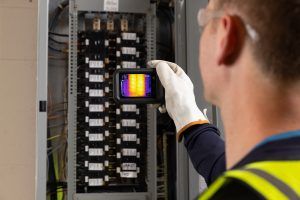
FLIR thermal imaging cameras manufactured in Europe: precision and resolution in every inspection
FLIR thermal imaging cameras manufactured in Europe: resolution, temperature, and accuracy in every inspection. Official FLIR distributor in Spain: Apliter.

FLIR Premium Handheld Bundle Promotion: More Than Just a Thermal Camera
Register your FLIR Exx or Txxx Series and get access to an extended warranty, professional software license, and ITC course. See conditions and included models.
Industrial Maintenance: From Cost to Strategic Investment
For decades, industrial maintenance has been perceived as a necessary evil. An activity primarily aimed at complying with regulatory requirements, avoiding penalties, and responding to