
Pulp and paper mills are major industrial facilities that rely on compressed air throughout the entire process. Compressed air is used to separate and clean raw pulp fiber, power pneumatic tools and even control valves. However, compressed air leaks can lead to wasted energy, reduced productivity and increased operating costs. One of the most effective ways to detect compressed air leaks in pulp and paper mills is through the use of acoustic imaging cameras. In this article we will explain how these cameras work and how they help pulp and paper mills detect compressed air leaks more effectively.
Table of Contents
Challenges of the paper industry in a changing marketplace

In 2021, global paper and board consumption reached 408 million tons. Today, the trend is shifting from traditional paper to more sophisticated products such as high-end packaging solutions and specialty papers. To keep pace with this growing demand, pulp and paper mills need a constant supply of compressed air to maintain a near-continuous production rate.
One of the biggest challenges in keeping pace with demand is the efficient use of resources to ensure continued success in the midst of an ongoing energy crisis. Energy costs, especially in compressed air systems, account for a significant portion of total production costs in the pulp, paper and paperboard industry, so it is crucial to address these challenges promptly.
The importance of compressed air in pulp and paper production
Compressed air is a critical component of pulp and paper production, used to run a wide range of equipment and tools. Compressed air systems often operate continuously in manufacturing plants and contribute substantially to total energy costs. In the pulp and paper industry, energy consumption can account for up to 20% of total manufacturing costs.
The role of compressed air in pulp and paper production

Request for information
Complete the form and a product expert will contact you shortly.
Compressed air is used in several stages of the paper production process, including:
Pasta preparation
To create paper, the process begins with the preparation of pulp, which can come from a variety of sources such as wood, cotton, rice or wheat straw. The pulp is then mixed with water and chemicals to create a slurry that will eventually become the paper. Compressed air is used to mix and agitate the pulp to ensure a homogeneous mixture.
Sheet creation
The pulp is then fed into a paper machine where it undergoes a series of processes to form the paper web. During this stage, compressed air is used to drive various pneumatic equipment, such as pumps and valves, which are necessary to regulate the flow of liquids and gases throughout the paper machine.
Water removal
After the paper manufacturing process, large volumes of water are used, which must be removed. This is achieved through pressing and drying techniques. Compressed air is used to drive the pressing process to remove excess water from the paper web and facilitate the drying process, which helps to remove any remaining moisture from the paper and dry it effectively.
Pressing
Once the paper web is formed, it undergoes a pressing process to remove excess water and flatten the sheet. This process can also add texture to the paper, depending on the pressing method used. Compressed air is used to drive the pressing equipment, which helps to remove moisture from the paper web and flatten it to the desired thickness.
Coating and treatment
Finally, coatings or treatments are added to the paper to improve its performance or appearance. This may include the addition of finishes such as gloss or matte, coatings that make the paper water resistant or durable, or treatments that improve the print quality of the paper. Compressed air is used to power the equipment that applies these coatings and treatments to the paper.
It should be noted that the papermaking process is highly technical and requires specialized knowledge and equipment to ensure the quality and consistency of paper products. In a typical paper mill, a reliable and constant supply of clean, dry compressed air is crucial to maintain a near-constant production rate and ensure high-quality paper products. In addition, the paper industry has made strides in recent years to become more environmentally sustainable, with many mills implementing green practices such as using recycled materials, reducing waste and utilizing renewable energy sources.
The importance of detecting compressed air leaks in pulp and paper mills
The costs of compressed air leakage in pulp and paper mills
Compressed air leaks can be a major source of wasted energy and lost productivity in pulp and paper mills. Unfortunately, leakage is a common problem in these systems, with compressed air systems typically losing 25-30% of their air to leakage. In some cases, these losses can even exceed 80%.
These losses have significant economic consequences, such as a 25-30% increase in energy costs, additional expenditures on compressor equipment to meet compressed air tooling requirements, a 30% reduction in compressor life leading to higher replacement costs, and additional maintenance costs for the additional equipment.
How much do compressed air leaks cost your paper mill?

So what exactly does that mean for real-currency costs? The cost of compressed air leaks in pulp and paper mills can range from $720 to $55,333 per year (depending on leak size and total psig).
Plant Service Magazine describes the cost of leaks based on their cumulative size. Based on 24/7 operation and 8 cents per kWh, we can expect a poorly maintained compressed air system to cost a company many tens of thousands of dollars each year.
The costs of compressed air leaks go beyond the economic consequences. Loss of pressure can cause pneumatic tools to work less efficiently, which can have an impact on the quality of the end product.
In addition, compressed air leaks can pose a safety hazard in the factory. If a leak is not detected and repaired, it can release compressed air at high velocity, which can cause injury or damage equipment.
The challenges of compressed air leak detection in pulp and paper mills
Pulp and paper mills are typically complex facilities that often operate 24 hours a day, 7 days a week, with several stages of the paper production process running simultaneously. This creates a challenging environment for leak detection, as there are numerous areas where leaks can occur. In addition, the equipment used in the mills can produce high noise levels, which can make it difficult to detect compressed air leaks using natural hearing alone.
Limitations of traditional air leak detection methods
Traditional leak detection methods, such as sniffers and leak sprays, may also have limited effectiveness in detecting compressed air leaks in pulp and paper mills.
Sniffers are tools that use a probe or detector rod to detect leaks in a unit filled with a tracer gas. The probe moves over the part and detects the leak as it passes over it. The sensitivity of the probe, the speed of movement and the distance to the part determine the accuracy of the leak detection. Sniffer techniques can locate leaks in a part and can detect leaks as small as 10-7 mbar - l/s, depending on the tracer gas used. However, they are operator-dependent and can miss leaks, making them unsuitable for high-volume production environments.
Spraying for leaks involves applying a soapy solution to the suspected area of the leak and looking for bubbles but, again, this method may miss small leaks or leaks in hard-to-reach areas.
The most popular method of identifying air compressor leaks is a single transducer ultrasonic acoustic detector. This electronic device can detect high frequency sounds that indicate air leaks. However, the traditional method of using a single-transducer ultrasonic system is like using a point temperature sensor for thermographic inspections: it is functional, but can be time-consuming, and maintenance teams must use them often during scheduled shutdowns. Moreover, to be effective, operators need extensive training and months of practice.
Where to look for compressed air leaks in pulp and paper mills

Compressed Air Systems have the potential for many leaks because they are complex, with many connections. Possible sources of leaks in compressed air systems:
- Couplings
- Hoses
- Pipelines
- Accessories
- Pipe joints
- Quick couplings
- Filter/regulator/lubricator units (FRL)
- Condensate traps
- Valves
- Flanges
- Gaskets
- Thread sealants
- Point-of-use devices
- Open condensate traps
- Open shut-off valves
The diagram above shows the typical components of a compressed air system. Each of these blue boxes represents a potential source of leakage.
The importance of acoustic imaging cameras for detecting compressed air leaks in pulp and paper mills

Given the limitations of traditional leak detection methods, acoustic imaging cameras have emerged as a powerful and effective tool for identifying compressed air leaks in pulp and paper mills.
Using acoustic imaging cameras, operators can quickly and accurately identify the source of a leak with minimal training, even in noisy and complex environments. This enables factories to take corrective action quickly, reducing energy waste, minimizing the risk of safety hazards and optimizing the performance of their equipment.
What are acoustic images?
Acoustic imaging is a non-destructive testing method that uses sound waves to create images of the internal structure of an object or environment. It is used in a wide range of industries, such as aerospace, automotive and manufacturing, to identify defects, locate faults and monitor the condition of equipment.
How acoustic imaging cameras detect compressed air leaks
Acoustic imaging cameras detect compressed air leaks by analyzing the sound waves generated by the escaping air. As the air escapes from the leak, it creates a unique sound signature that is captured by the camera. The camera then creates a visual representation of the sound waves, allowing operators to quickly identify the location and size of the leak.
Accuracy and precision of acoustic imaging cameras
Acoustic imaging cameras can accurately locate and measure compressed air leaks. They can pinpoint the exact location of pinhole-sized leaks, enabling operations to quickly locate and repair leaks to minimize energy waste and reduce safety risks. They can also measure leaks as small as 0.004 L/min so users can prioritize repairs.
Advantages of using acoustic imaging cameras in pulp and paper mills
Acoustic imaging cameras offer several advantages for detecting compressed air leaks in pulp and paper mills. These advantages include
Increased energy efficiency
Compressed air leaks can be a major source of energy waste in pulp and paper mills. By quickly identifying and repairing leaks using acoustic imaging cameras, mills can improve their energy efficiency and reduce their energy consumption. This translates into reduced operating costs and carbon footprint.
Improved productivity
Compressed air leaks can also affect the productivity of pulp and paper mills by reducing the efficiency of pneumatic equipment. By identifying and repairing leaks quickly, mills can improve equipment performance and increase productivity.
Cost savings
The detection and repair of compressed air leaks using acoustic imaging cameras can also bring significant cost savings to pulp and paper mills. By reducing their energy consumption and improving the performance of their equipment, mills can reduce their operating costs and increase their profitability.
To better visualize the total cost savings offered by an acoustic imaging camera, such as the FLIR Si124, FLIR provides a free return on investment (ROI) calculator. This online tool allows the pulp and paper industry to estimate the potential energy savings from detecting and repairing air leaks, relative to the cost of the camera itself.
Increased safety
The presence of compressed air leaks in pulp and paper mills poses a significant safety risk, especially when they are not detected and repaired promptly. As Nex Flow points out, the danger associated with leaking hoses or fittings cannot be underestimated. In the case of a damaged, pressurized hose, an outward "burst" can cause serious injury. This sudden release of pressure can trigger the connection or disconnection of a machine, endangering both the operator and people nearby.
Acoustic imaging cameras enable factories to quickly identify and repair leaks, reducing the risk of hazards and improving the overall safety of their operations.
In summary, the benefits of using acoustic imaging cameras in pulp and paper mills include increased energy efficiency, higher productivity, cost savings and improved safety. By investing in acoustic imaging technology, mills can optimize the performance and safety of their operations while reducing their environmental impact and operating costs.
Locating compressed air leaks in a paper mill using an acoustic imaging camera
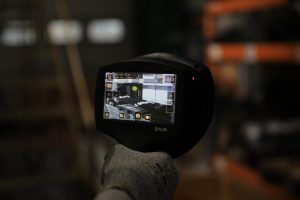
Unlike traditional methods such as sniffers and leak sprays, the FLIR Si124 ultrasonic air leak detector offers a much safer and faster alternative for maintenance personnel. Its advanced technology makes it possible to accurately identify compressed air leaks from a distance, eliminating the need to get close to suspected leak areas and heavy machinery, thus reducing the risk of occupational hazards and promoting a safe working environment.
With 124 microphones, the FLIR Si124 offers fast and accurate leak detection, as well as size and associated cost estimation in real time using artificial intelligence-based analysis. Its one-handed operation makes it easy to use and compatible with any stage of a factory's maintenance cycle, including and not limited to the inspection of dry pipe sprinkler systems, steam systems and vacuum systems. Its large-scale inspection capability allows inspections to be performed without interrupting production, further reducing costs.

FLIR Si124 detecting a compressed air leakage
The FLIR Si124 software sets it apart from other acoustic imaging cameras. FLIR Thermal Studio Suite desktop software offers an added advantage for the pulp and paper industry by integrating thermal and acoustic imaging into a single report. This dual functionality improves maintenance decision making while eliminating the need to learn multiple software platforms.
In addition, using the free FLIR Acoustic Camera Viewer cloud service, image captures are quickly uploaded via Wi-Fi and analyzed in depth, making it easy to quantify compressed air leaks, including the estimated cost of the leak. This feature enables maintenance departments to prioritize repairs and makes it easier for maintenance managers to demonstrate the impact of their equipment on a company's bottom line.
In addition, the FLIR Si124 is extremely easy to use and requires minimal training. By integrating it into regular maintenance routines, professionals can quickly identify problems and ensure continuity of power and manufacturing operations.
Recommended practices for the use of acoustic imaging cameras in pulp and paper mills
To maximize the effectiveness of acoustic imaging cameras in detecting compressed air leaks in pulp and paper mills, it is important to follow best practices in their use. These practices include:
Performing periodic leak detection inspections
To ensure that compressed air leaks are identified and repaired in a timely manner, plants should conduct periodic leak detection inspections with acoustic imaging cameras. The frequency of these inspections may vary depending on the size and complexity of the plant, as well as the age and condition of the compressed air system. However, it is recommended that plants perform inspections at least once a year to ensure that leaks are detected and repaired in a timely manner.
Proper placement of the camera
The effectiveness of acoustic imaging cameras in detecting compressed air leaks can be affected by their placement. To ensure accurate and reliable leak detection, acoustic imaging cameras must have a line of sight to areas where leaks are most likely to occur, such as at pipe joints or in hard-to-reach areas.
Seven benefits of using an acoustic imaging camera for air leak detection in pulp and paper mills
- Saving money and ensuring operational continuity and consistent quality by locating hidden compressed air leaks in time.
- Scanning large areas quickly and locating critical problems accurately to save time, energy and costs.
- It requires minimal training and is easy to incorporate into maintenance cycles.
- Provide real-time results and actionable data for maintenance and repair plans through machine learning-based analytics.
- It allows professionals to complete their inspections 10 times faster than with traditional methods.
- Advanced analytics separates the sound signature of the leak from the background noise, making it possible to detect air leaks even in noisy environments.
- It enables condition-based maintenance in pulp and paper mills to be carried out efficiently and without stopping operation, as the non-contact camera operates from an operating distance of 0.3 m up to 130 m.
Conclusion
Compressed air leaks can be a major source of wasted energy, lost productivity and increased operating costs in pulp and paper mills. However, by using acoustic imaging cameras to detect and repair leaks, mills can achieve significant cost savings, energy efficiency improvements and safety improvements. By following best practices for the use of acoustic imaging cameras, mills can ensure that their compressed air systems are running at maximum efficiency, maximizing the productivity and profitability of their operations.
Frequently Asked Questions
Compressed air is used for various purposes in pulp and paper mills, such as operating pneumatic tools, controlling valves and conveying materials.
Compressed air leaks can lead to wasted energy, reduced productivity and increased operating costs.
Acoustic imaging is a non-destructive imaging technology that uses sound waves to create images.
Acoustic imaging cameras detect compressed air leaks by listening for the sound of air escaping from a leak, which can be distinguished from background industrial noise.
The use of acoustic imaging cameras can increase energy efficiency, improve productivity, save costs and enhance safety.
Acoustic imaging cameras are more effective than traditional leak detection methods, such as single transducer ultrasonic inspections and visual inspections, because they can detect leaks that are difficult to locate with other methods.
Yes, acoustic imaging cameras can be used to detect compressed air and gas leaks in a wide range of industrial facilities, such as manufacturing plants, refineries and chemical processing facilities.
The amount of savings can vary depending on the size and complexity of the plant, but studies have shown that the use of acoustic imaging cameras can reduce compressed air consumption by up to 25%.
No, the use of acoustic imaging cameras in pulp and paper mills is safe and poses no additional risk to worker safety beyond those associated with the operation of the compressed air system.
The frequency of leak detection inspections may vary depending on the size and complexity of the factory, as well as the age and condition of the compressed air system. However, it is recommended that factories perform inspections at least once a year to ensure that leaks are detected and repaired in a timely manner.
If you need more information about utrasound acoustic imaging cameras, please contact our technicians by e-mail or by calling 91 159 39 78 | 93 706 36 79.
How to detect compressed air leaks faster with acoustic imaging
How to detect compressed air leaks faster with acoustic imaging

Reduce energy costs by finding leaks with the FLIR Si124
Save on energy costs with the FLIR Si124 ultrasound acoustic imaging camera.

Acoustic imaging with FLIR Si124
The FLIR Si124 industrial acoustic imaging camera produces an accurate acoustic image that is superimposed in real time on a digital camera image.