
Tire manufacturing is a critical industry that demands high levels of efficiency and safety. Compressed air is a crucial component in the tire manufacturing process. It is used for a wide range of applications, including feeding pneumatic tools, inflating tires and cleaning machinery. However, compressed air leaks can lead to significant inefficiencies, safety risks and quality issues in tire manufacturing.
Traditionally, manufacturers have relied on visual inspections and portable equipment to detect compressed air leaks. These methods are often time consuming, unreliable and difficult to perform on a large scale. However, recent developments in acoustic imaging camera technology have made it easier than ever to detect compressed air leaks in tire manufacturing. In this article, we will explore the importance of detecting compressed air leaks in tire manufacturing and how acoustic imaging cameras can help.
Table of Contents
Understanding compressed air leakage in tire production
Compressed air leaks are a common problem in tire manufacturing. They can occur for a number of reasons, including worn seals, damaged pipes and defective valves. Compressed air leaks can have a significant impact on the efficiency of the tire manufacturing process. They can cause machines to work harder than necessary, which can result in increased energy consumption and decreased productivity.
In addition to their impact on efficiency, compressed air leaks can also present safety risks in tire manufacturing. Compressed air leaks can create a risk of explosion, which can lead to serious injury or even death. It is critical to detect compressed air leaks as early as possible to minimize their impact on the manufacturing process and reduce safety risks.
The consequences of compressed air leaks in tire production
Compressed air leaks can have significant consequences for tire manufacturers. Some of the most notable consequences include:
- Reduced efficiency: compressed air leaks can cause machines to work harder than necessary, leading to higher energy consumption and reduced productivity.
- Higher costs: compressed air leaks can result in higher energy consumption, which can lead to higher energy bills for manufacturers.
- Quality issues: compressed air leaks can affect the quality of tires being manufactured, leading to defects and possible recalls.
If you need more information, please contact us so we can help you!
Traditional methods for detecting compressed air leaks in tire production
One of the most commonly used methods is the use of leak detectors, also known as sniffers. These devices can detect compressed air leaks by detecting changes in pressure and sound. Sniffers are typically used in conjunction with visual inspections to identify leaks in hard-to-reach areas or areas with poor visibility.
Another common method used to detect compressed air leaks is the use of leak spray. This method involves spraying a liquid solution over the area being tested and looking for bubbles. If bubbles appear, it indicates the presence of a compressed air leak. Leak spraying is often used in conjunction with visual inspections and can be an effective method of identifying leaks in piping, valves and other equipment.
Limitations of traditional leak detection methods in tire manufacturing
While these traditional methods can be effective, they also have several limitations. Visual inspections can be time-consuming and may not identify leaks in hard-to-reach areas or areas with poor visibility. Portable equipment, such as tracers, can also be affected by external noise and may not be sensitive enough to detect small leaks. Leak spraying can be messy and may not be effective in identifying leaks in certain types of equipment.
The advantages of acoustic imaging cameras for compressed air leak detection in tire production

Compressed air systems are used throughout the tire manufacturing process and require periodic inspections.
Acoustic imaging cameras provide a more reliable and efficient method of detecting compressed air leaks in tire manufacturing. They work by detecting the sound of air escaping from a leak and converting it into a visual image. This technology enables manufacturers to identify leaks quickly and accurately, even in hard-to-reach areas or noisy environments.
Compared to traditional methods, acoustic imaging cameras offer several advantages:
- Fast and accurate detection: acoustic imaging cameras can detect leaks quickly and accurately, reducing the time and effort required for leak detection.
- Non-invasive: acoustic imaging cameras do not require physical contact with the equipment, making them less intrusive and easier to use.
- Easy to use: acoustic imaging cameras are easy to operate and require minimal training to use effectively.
- Real-time data: Acoustic imaging cameras provide real-time data on leak detection, allowing manufacturers to identify and repair leaks quickly.
How acoustic imaging cameras work
Acoustic imaging cameras work by using an array of microphones to detect the sound of air escaping from a leak. The sound is then processed and converted into a visual image, which shows the location and size of the leak. This technology allows manufacturers to identify leaks quickly and accurately, even in noisy environments or hard-to-reach areas.
The images produced by acoustic imaging cameras can be analyzed in real time, allowing manufacturers to take immediate action to repair leaks. In addition, acoustic imaging cameras can be used to detect leaks in a wide range of equipment, including pipes, valves and pneumatic tools.
Choosing the right acoustic imaging camera for your needs

FLIR Si124 Acoustic Imaging Camera
When choosing an acoustic imaging camera for tire manufacturing, it is critical to consider several factors, including:
- Detection range: the detection range of the camera should be appropriate for the size of the equipment being monitored.
- Sensitivity: the camera must be sensitive enough to detect even small leaks.
- Noise reduction: the camera must be able to filter out external noise to ensure accurate leak detection.
- Portability: the camera should be easy to move and place in different areas of the manufacturing plant.
Localization of compressed air leakage in tire manufacturing using an acoustic imaging camera

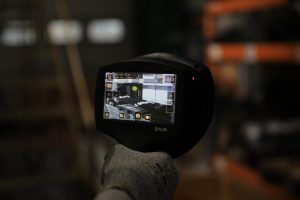
Compressed air leak detection with acoustic imaging camera FLIR Si124
TheFLIR Si124 acoustic imaging camera is an advanced ultrasonic solution for air leak detection. It is designed to find even the smallest leaks effortlessly and from a distance, making inspections safer and more efficient. Equipped with 124 microphones, the Si124 enables exceptional sensitivity and accuracy to find even small leaks in noisy industrial environments, such as tire manufacturing plants.
The acoustic camera works by producing a precise acoustic "hot spot" that is superimposed in real time on a digital camera image, allowing it to accurately identify the source of the sound.
The Si124 is lightweight and portable, making it easy to use with one hand. In addition, it provides real-time cost and leak size estimates through AI-driven analysis, taking the guesswork out of determining the urgency of repair actions.

FLIR Thermal Studio Suite with Si-Series add-on
Where the Si124 stands out from other acoustic imaging cameras is in terms of software. The ultrasonic air leak detection camera has the added advantage of FLIR Thermal Studio Suite desktop software . This intuitive software can help tire companies gain an additional advantage by integrating thermal and acoustic images into a single report. This dual functionality improves maintenance decision making and eliminates the need to learn multiple software platforms.
In addition, the free web-based FLIR Acoustic Camera Viewer software allows images to be quickly uploaded via Wi-Fi for immediate analysis. This service provides users with valuable information such as compressed air dimensions and energy costs, allowing maintenance departments to prioritize repairs.
Compressed air cost savings in tire manufacturing with FLIR Si124 acoustic imaging camera
FLIR Si124 can also save tire plants money. To estimate the potential energy a plant could save by detecting and repairing air leaks, relative to the cost of the camera itself, one can use the Si124-LD ROI calculator can be used.
Eight advantages of using an acoustic imaging camera to detect air leaks in tire manufacturing
- Automatically detects leaks by the sound they emit, even in noisy industrial environments.
- It allows leak detection in a wide field of view and from an extended range, thanks to its 124 microphones.
- Locates leaks up to 10 times faster than traditional methods.
- It analyzes leaks in real time, using the processing power of its built-in AI.
- Saves up to 20-40 % of all energy used for compressed air.
- Saves inspection time and costs.
- Provides safe and easy use in industrial environments.
- Provides ISO 50001-compliant reporting.
Conclusion
Acoustic imaging cameras for compressed air leaks are the way forward for tire manufacturing plants looking to increase efficiency and reduce costs. The FLIR Si124 acoustic camera offers a reliable solution to this problem, with its advanced ultrasonic technology, real-time analysis and cloud-based reporting system. With its ability to locate leaks quickly and accurately, FLIR Si124 can help tire manufacturers save money, improve productivity and ensure quality control.
To learn more about the FLIR Si124 acoustic camera and how it can benefit your tire manufacturing plant, visit this link.
Related articles

Pulp and paper mills: How acoustic imaging cameras help detect compressed air leaks
Pulp and paper mills are important industrial facilities that rely on compressed air throughout the entire process. Compressed air
How to detect compressed air leaks faster with acoustic imaging
How to detect compressed air leaks faster with acoustic imaging

Reduce energy costs by finding leaks with the FLIR Si124
Save on energy costs with the FLIR Si124 ultrasound acoustic imaging camera.