
In the food industry, it is essential to carefully control the temperature of perishable products in the production, transportation, storage and sales process. Constant warnings about illnesses due to spoiled and improperly cooked food highlight the need for tighter process control. Since this almost always involves a human factor, food processors require tools that automate critical operations in a way that minimizes human error while keeping costs down.
These tools would be thermal imaging cameras. Using FLIR's thermal imaging cameras it is possible to perform automated non-contact temperature measurements in many food processing applications. Analog video outputs can be viewed on video monitors, while digital temperature data, including MPEG4 video outputs, can be routed to a computer via Ethernet.

Thermography in the food industry - Operation
The main elements responsible for non-contact temperature measurements in the food processing industry are a thermal imaging camera and associated software, which act as "smart" non-contact sensors to perform complete inspections and temperature measurements of equipment, refrigerated products and food at the end of the cooking process.
Thermal imaging cameras are simple, small in size and can be installed almost anywhere we need them. In addition, they can be used to inspect package sealing, as well as to improve the efficiency of other food processing operations.
FLIR thermal imaging cameras have firmware and communication interfaces that enable their use in automated process control. Third-party software makes it easy to incorporate these tools into automated vision systems without the need for extensive customizable control code.
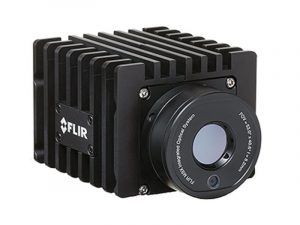
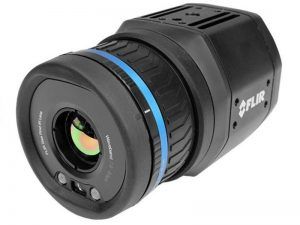
The use of thermal imaging cameras in food processing is increasing in applications such as:
- Food baking
- Microwave cooking of meats
- Microwave drying of parboiled rice and other grains
- Inspection of furnaces for correct temperature
- Correct packaging of frozen foods
- Checking the integrity of cellophane seals on microwaveable foods
- Inspection of the glue of the film wrapping lids
- Monitoring of refrigerator and freezer compartments
Thermography for product quality and safety control
Thermography is first and foremost a quality control tool. Controlling the quality and wholesomeness of cooked meat products is an excellent use of this technology. A fixed thermographic camera can record, for example, the temperature of chicken fryers as they leave a continuous conveyor oven.
The objective is to ensure that they cook properly without burning or drying out. The reduced moisture content also represents a loss of yield in relation to their weight. Thermal imaging cameras can also be used to inspect microwave precooking lines. In addition to improving product quality and safety, the overall yield can also be increased. A further benefit is that energy costs can be reduced.


Equipment monitoring
In addition to inspecting cooked food, thermal imaging cameras can also monitor conveyorized ovens. They can even provide information for oven temperature control.
Another use of thermal imaging cameras in conveyorized ovens is temperature monitoring to control temperature uniformity along the entire conveyor belt. If a heating element in an electric oven fails, or if uneven heat is observed in a high-impact air oven, one side of the product may be cooler, something that can be quickly detected with thermal imaging cameras.
With conventional contact temperature sensors, it is much more difficult to perform this type of inspection. Thermal imaging cameras can therefore help to correct variability and improve the quality of a product before it is discarded.
Packaging inspections
Available software enables thermal imaging cameras to locate objects and patterns in the captured images. One application for pattern matching is in frozen food production. Thermal vision can use pattern recognition software to check the correct packaging of food in trays.
A related application is the fully automated inspection of the cellophane cover that thermally seals microwaveable foods. A thermal imaging camera is able to capture the heat radiating from the edge of the package where the cellophane seal is formed. Using thermal imaging and machine vision software it is possible to check the temperature of the entire perimeter of the package. This type of program matches the geometric pattern of the image and its temperature with the temperatures of a pattern stored in the memory of a computer. Another function of this system would be laser marking when the sealing of the package is defective, so that it can be removed at the inspection station.
A problem that indirectly affects product safety is the integrity of the cardboard lids that wrap and protect food containers. One of the most economical ways to seal them is to apply hot melt adhesive in the form of dots on the flaps. In the past, bond integrity was determined by periodic testing in which several sample boxes were taken and destroyed. This process was time consuming and costly.
Because the glue is hot, a thermal imaging camera is able to "see" through the cardboard to check the pattern and size of the adhesive dots that have been applied. The camera can be installed in such a way that it captures images of predefined areas of the flaps where glue should have been applied, while checking the sizes and temperatures of the dots.
The digital data collected is used to accept or reject individual cartons, so that unfit cartons can be immediately removed from the production line. The data is automatically fed into the quality control system and trended, so that if the number of unfit cartons is excessive, a warning signal is generated.


Automated measurements
The application software currently available for thermal imaging cameras includes a wide variety of functions compatible with food processing applications. This software complements and works in conjunction with the firmware integrated in the thermal imaging cameras. The tools and image libraries in these packages are both hardware and language independent, making it easy for food processing engineers to quickly implement thermal monitoring and control systems.
The thermal imaging cameras themselves offer the user different operating modes that support correct temperature measurements under various conditions. Two of the most common functions in these cameras are spot measurements and area measurements.
The spot meter measures the temperature of a specific point. The area function isolates a particular area of an object or scene and typically provides the maximum, minimum and average temperatures within that area. Normally, the temperature measurement range is user selectable. In addition to selecting the temperature range, most cameras allow the user to set a color or gray scale to enhance the images.
In the case of local monitoring, a digital IR camera input or output can be used to directly trigger an alarm device without the need for any additional software. However, food processing often takes advantage of the higher-level analysis offered by third-party software installed on the PC.
These external solutions do not require writing any application source code. By complying with the most widely used vision interface standards, such as GigE Vision® and GenICam™, this software supports a wide variety of functions.
A simplified block diagram of conveyor belt monitoring is shown. A single thermal imaging camera is suitable for a large number of applications, or it can be combined with a visible light camera to record other object attributes, such as color.
Contact us to solve your doubts!
Related entries

Benefits of thermography in automated production and industrial maintenance systems
In modern industry, the integration of advanced technologies has become essential to maintain competitiveness and optimize each stage of production. One of the most effective tools in this area is thermography, which allows real-time, non-contact temperature monitoring, facilitating early detection of faults and improving the quality of the final product.

Maximum performance: thermography to automate ski grinding in an industry-first facility
Ski grinding RELISTE is a machine vision integrator based in Austria. For more than 50 years, it has been specialized in the sale of

Preventing factory fires and reducing downtime: how thermography protects international production lines
According to the International Energy Agency, in the race to reach ambitious global net-zero emissions targets, by 2050, additional