
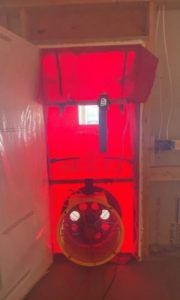
With codes and high-performance building programs requiring airtightness testing, a small but growing group of homebuilders have purchased their own blower doors. They are discovering that the value of this tool goes beyond mere regulatory compliance.
One of them is Arrow Building, whose owner, Jake Bruton, says he builds "durable, energy-efficient, aesthetically pleasing homes." Most of its projects meet Passive House standards, which specify a maximum air leakage of 0.6 air changes per hour at a test pressure of 50 pascals (0.6 ACH 50).
Purchased its first unit in 2014 before committing to those standards. He heard rumors that air tightness testing would eventually become part of the code. No other builder in his market seemed to have one, so he thought being first would give him a competitive advantage.

Improved driving with Blower Door
Bruton says the blower door proved its usefulness immediately. "We started testing everything for information," he recalls. Although his new homes met 3ACH 50 code, he wanted to do better.
So he began searching the Internet for air barrier best practices. "We found architects who had done several passive houses and started calling and asking how they did it," he says. Test results quickly came back down to 1 ACH 50 or better.
To maintain those figures, he now performs three separate tests on each new house, as follows:
Test No. 1: Coating
Coating. The first test concerns the overall airtightness of the envelope. Arrow homes are designed with a hybrid air barrier that includes the exterior sheathing and the roof under the attic. Both are installed and taped prior to this first test.
Builders still don't trim the window openings: instead, they just trim the door opening where the vent door will be installed. And instead of the standard 50 pascal test procedure, they depressurize the house to 100 pascals and then spray the exterior with a hose to see if water is coming in through seams and unsealed holes.
Test No. 2: Windows and Doors
Once the first test is completed, the teams install all windows and doors, after which Bruton performs a second test. Since the envelope has already been tested to be airtight, this test can detect any problems in the installation of windows and doors.
Bruton also sometimes performs another test, which is basically #2A. It is performed before drywall is put up, for example, after spray foam insulation is installed or after machinery is installed. It depends on the house and the complexity of the details.

Exhibit No. 3: The rest of the construction
The final test is performed after drywall installation at the standard 50 pascal pressure, during which a fog machine is used to identify specific leaks that might have been added after installation of the windows and doors, typically from electrical and mechanical penetrations.
The local jurisdiction also requires third-party testing, so this final in-house test warrants a passing grade.
The Retrotec Model 5000C Blower Door that Arrow uses has proven to be a great investment. "The testing we do ensures a much better home for our customers, and we couldn't afford to do it if we didn't have our own Blower Door," he says.
The unit works with Retrotec's GaugeRemote app, which allows the operator to control the fan speed from a phone or tablet, which geolocates the home, adjusts to local weather conditions, runs the test and generates a report that can be saved, shared or printed. Thanks to these apps, the operator no longer has to take notes and can control the fan remotely while moving around the house focusing on finding those leaks.
Related entries

AirTracer: Retrotec's new portable smoke generator
This portable smoke generator has been designed with convenience and accuracy in mind, providing an effective solution for leak location in a wide variety of applications, from construction to critical space ventilation systems.

SOLO, the new pressure gauge from Retrotec
With the aim of improving energy efficiency and accuracy in airtightness testing in buildings, we introduce Retrotec's Solo manometer, a compact and advanced tool designed to facilitate the pressure evaluation process in the building envelope.

Blower door systems in clean rooms
Blower Door systems offer a number of benefits for cleanrooms