
A house must be sufficiently insulated to use a heat pump. To find out whether this is the case, an infrared thermographic camera is often used. But that is not enough, says Frans Dam, energy consultant and professor of thermography. According to him, additional techniques are needed to detect thermal bridges, find and see energy leaks.
Frans Dam sums up his work as "discovering (energy) leaks". Being an energy expert, he likes to talk about energy loss detection or about how to detect thermal bridges. "Infrared photos, where energy loss is made visible by color, are known to many people. But interpretation is very important. If you see a blue spot on a wall, indicating energy loss, there are fifteen possible causes. Is there a vent inlet nozzle directed at it? Is there moisture in the wall? Is there a piece of insulation missing? Is there a hole in the outside wall? Or a crack through which airflow is circulating along the wall? In short: if you see a color difference in a wall, you don't immediately know what the next step to take is."

Detecting thermal bridges with a thermal imaging camera
Cracks in walls and partitions
Dam gives as an example a house with walls insulated with polystyrene blocks. "People often think that this insulating material keeps the house warm. But if there are cracks in the walls and partitions, this is not the case. Warm air tends to rise and cold air enters from below through the cracks. This is not only ignored by consumers; sometimes it is also ignored by building professionals. You can also insulate the house, but if there is a leak, the cold will still get in."
The Blower Door creates an underpressure
According to Dam, a typical home insulation investigation begins with thermography. Images from infrared cameras can detect walls, floors or ceilings that are too cold. "But that doesn't say much about the ridge of an attic, for example. Because of the warm air that always rises, this place is usually relatively warm." According to Dam, this can be overcome by creating negative pressure in a home. This is possible with Blower Doors. This is done by using a fan that is placed in the frame of an otherwise closed door.
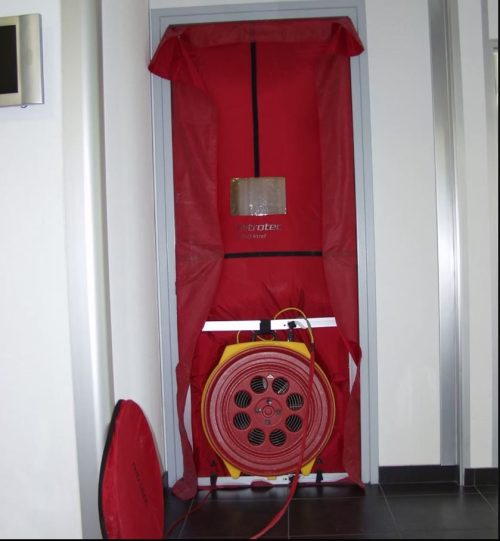
Detecting thermal bridges with Blower Door
Drafty window frames
"If there are cracks in the ridge, cold air will come in here because of the negative pressure. Then you see the IR image change from red (relatively warm) to blue (relatively cold)." The edges of the drafts on the frames and doors will also change color due to the negative pressure. The airflow created by the negative pressure can also be demonstrated with a small smoke machine. "The flow of the smoke indicates where the gasket is missing."
Reverse blowing direction
In a next step, an overpressure can be created. This can be done by reversing the blowing direction of the ventilation system. "By spreading the smoke inside a house, the outside will show where the leaks are." Dam shows a video of a thatched roof with smoke billowing everywhere during such a test. "The problem with thatched roofs is that a draft from the inside causes condensation on the reed layer, so the reeds never dry out and deteriorate faster."

Thermal bridges viewed with a thermal imaging camera from the exterior
Also useful for new homes
According to him, the three methods complement each other and cannot exist without each other. According to Dam, they are as useful for a historic house as they are for a row of newly completed homes. And for new homes as well? Dam: "Certainly, the question often arises as to whether they comply with the building code. The degree of air leakage at a certain pressure per square meter of floor area is standardized. On the basis of the measurement reports, additional activities can be carried out. Industrial buildings are eligible for an energy investment allowance through the BREEAM system. The method of calculating the subsidy includes a check mark as to whether thermography has been carried out, but the score obtained also influences the amount of the deduction."

Thermal vision of air leaks
Owner training
Homeowners need help to understand how their home works and what measures they can take. "It doesn't help that, in practice, energy advisors can only give limited advice. A professional structure would help, with consultants, people who can do measurements and building physicists. Then the consumer would get a good answer to the question 'where to start'."
Your own home as an example

Thermography to detect thermal bridges in a house
Dam concludes the interview with a tour of his own home and attached office. It is a historic farmhouse that was stripped down to the walls in 2016 and rebuilt. The attic is equipped with 45 cm thick insulation material, the walls are insulated with plastered polystyrene foam. Both buildings are heated jointly with an 11 kW heat pump. If the heating were switched off, the temperature would only drop by one degree per day in winter." On the upper floor, under the attic roof, there is not even active heating; only the ventilation air provided by the balanced ventilation provides some additional heat there. With passive cooling, everything can be kept cool throughout the house. "In short, it is quite possible, with a little attention, to get a super warm house with a heat pump."
Do you have any doubt about how to detect thermal bridges in homes?
Contact our Blower Door system experts.
Mail: apliter@apliter.com
Phone: 91 159 39 78 / 93 706 36 79.

FLIR Premium Handheld Bundle Promotion: More Than Just a Thermal Camera
Register your FLIR Exx or Txxx Series and get access to an extended warranty, professional software license, and ITC course. See conditions and included models.
Industrial maintenance, from cost to strategic investment
For decades, industrial maintenance has been perceived as a necessary evil. An activity primarily aimed at complying with regulatory requirements, avoiding penalties, and responding to

Infrared windows: the solution chosen by a leading American bottling company to improve electrical safety
In industrial installations, periodic thermal inspections are key to maintaining electrical reliability. But what happens when these inspections involve downtime,