
Regardless of when or where they occur, invisible gas leaks are difficult and time-consuming to detect, especially when using outdated inspection methods and when there are many components to inspect.
As we discussed in detail in our previous blog, there has been a major change in how the government will regulate emissions of methane and other greenhouse gases that contribute to global warming. Specifically, we cover the EPA's New Source Performance Standards (NSPS) "OOOOb" and Emissions Guidelines (EG) OOOOc. These updates are additions to the 2015 regulation known as "OOOOa," which first established optical gas imaging (OGI) as the best system for emissions reduction. The EPA legislation and guidelines are having a major impact on leak detection and the oil and gas (O&G) industry to protect the environment.
To adapt to the recent regulation, affected O&G organizations must ensure that they have the right personnel, training and tools to carry out the mission, especially portable gas detection tools capable of detecting and measuring leaks quickly.
With this in mind, it is appropriate to introduce FLIR's new G-Series optical gas imaging (OGI) cameras. FLIR G-Series introduces a family of high-tech, cooled-core OGI cameras that can help Leak Detection and Repair (LDAR) professionals seamlessly locate, quantify and document harmful gas emissions.
With their targeted approach and new features, FLIR's OGI cameras enable inspectors to detect leaks faster and locate the source immediately, resulting in quick repairs, reduced industrial emissions and increased regulatory compliance.
Importantly, FLIR G-Series now supports quantification analysis with integrated GPS that accurately measures the type and size of leaks, eliminating the need for a secondary device. This reduces time in the field and supports the documentation that is now required.
Integrated Delta T checks
One of the first elements of the revised legislation was the definition of Delta T and the ramifications of Appendix K. Delta T, short for the temperature difference between the background temperature of the scene imaged by the camera and the emitted temperature of the gas (assumed to be the ambient temperature), sets the severity criterion for the inspector. The delta must be adequate enough to effectively visualize the leak emission.
It is necessary to separate the Delta T at the pixel level and at the component level or the inspector could miss several leaks. FLIR has placed a quick and easy button on the camera, making the "delta t check" a push-button function. The camera then highlights each pixel that does not meet delta t, providing a complete image against a bounding box. Predecessor cameras, dating back to the previous decade, and even some of the newer cameras on the market can apply only a spot radiometer, measuring a large area (e.g., a 10'x10′ box) to compare the background to the ambient temperature. This process could give an operator false confidence that the Delta T function has performed accurately and then miss leaks, as it relies on a full scene averaging over a large area for the measurement rather than at the pixel level, allowing component-level assurance that the inspection is accurate.
Translation made with the free version of the translator DeepL.com
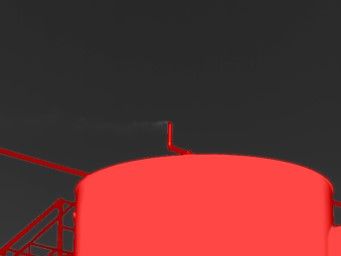
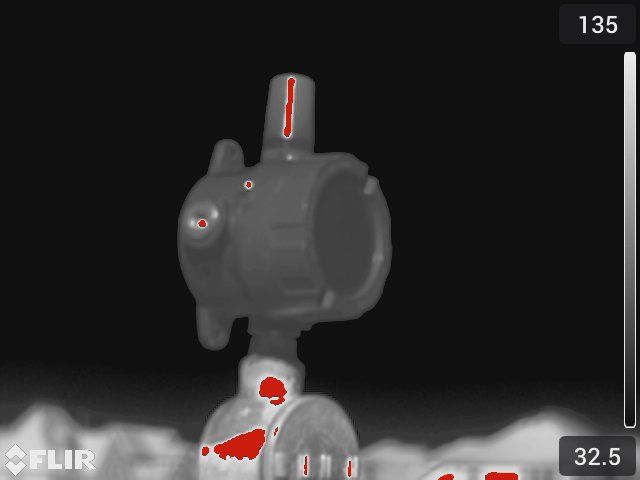
The image on the left shows a tank with large areas of Delta T challenges. If this leak were to move down (instead of right to left) from the vent line, it would not be detected by an OGI camera. The image on the right of a FLIR Gx320 camera shows how a true Delta T check should work, highlighting specific pixels that do not have sufficient Delta T and allowing an operator to ensure proper inspection of all components.
FLIR Route Creator
Designed for thermographers inspecting a large number of objects, FLIR Inspection Route software guides the user along a predefined route of inspection points created in FLIR Thermal Studio Pro using the Route Creator add-on. This helps inspectors follow a logical path to collect images and data in a structured way. It also speeds up post-processing and report generation. EPA regulations now require inspecting components for a specific number of seconds, and FLIR's Route Creator can help ensure that timing.
FLIR records GPS coordinates along the inspection route, providing a very detailed document for the EPA, showing exactly where the inspector has walked, all integrated into the camera. The route creator pops up and provides the operator with a guide to better understand how many components are in the inspection scene with predefined stops within the route. This is very practical as it ensures that all points and steps in the inspection plan are covered. When an inspector has a chain of components to observe, they can ensure that their inspection meets regulatory requirements.
Photographic evidence
The regulation also now requires a short video clip or photograph showing the leak and the associated component. Historically, it was difficult to easily depict where the leak was coming from without using a video. With FLIR's new infrared sketch feature, the inspector simply clicks to take an infrared image and can draw an arrow on top of an overlay with GPS date and time to satisfy the requirement. G-Series cameras have built-in GPS logging functions to show the exact route of the monitoring survey performed with the camera.
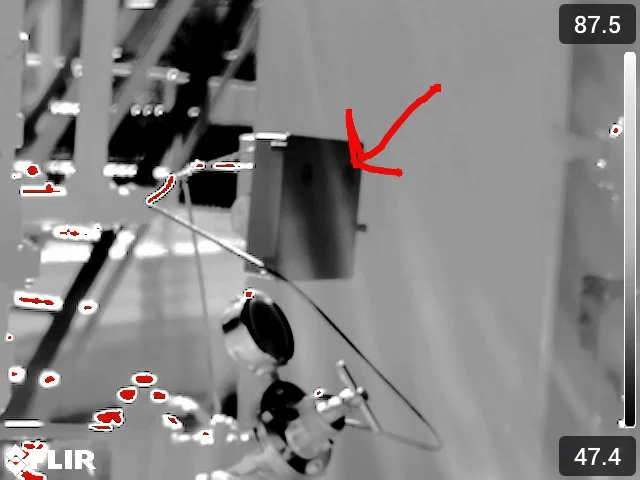
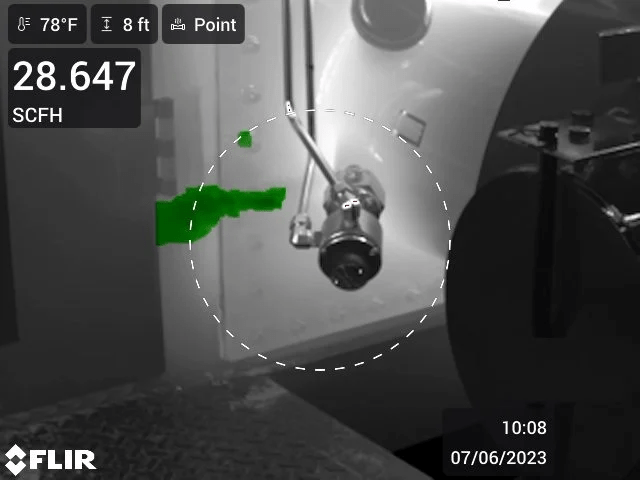
The image on the left shows that with FLIR's new Gx320 camera, an operator can take an IR image instead of video and use the LCD touch screen to draw an arrow to represent where the leaking component is faulty. The image on the right shows what in-camera quantification looks like with FLIR QOGI.
Quantification
Leakage quantification greatly helps to provide more accurate quantification metrics, as required in some parts of Subpart W, which is still in draft form. With FLIR, inspectors can see what is happening and have insight into the status of the emission down to the exact location where a repair technician must go to remedy it.
Although the new regulations do not specify QOGI as a quantification tool, operators have the opportunity to use it as a reference for some of the regulations. Specifically, getting ahead of the new Waste Emissions Charge (WEC) as part of the Inflation Reduction Act (IRA). The methane WEC applies to natural gas and oil facilities that emit more than 25,000 metric tons of CO2 equivalent per year, as declared in Subpart W of the Greenhouse Gas Reporting Program.
Conclusion
It is in the best interest of O&G professionals to soak up the latest EPA regulations and guidelines, as FLIR has detailed in its recent blogs. This is in addition to knowledge of the tools available, as the process of recording inspection activities must now be done with a higher level of detail and accuracy. In addition, recalling the test process and results down to details such as GPS coordinates for specific sets of components has become essential to the inspection lifecycle. Conversely, using outdated tools and cameras that lack the necessary controls, software and reliable wireless connectivity for proper reporting will likely result in serious productivity losses, aside from the organization being unaware of gas leaks that will prevent the organization from complying with the latest standards.


