
Before discussing what thermography is, it is essential to define what infrared is. Infrared light is halfway between the visible spectrum and the microwaves of the electromagnetic spectrum. The main source of infrared radiation is heat or thermal radiation, and any object with a temperature above absolute zero (-273.15°C or 0 Kelvin) emits radiation in the infrared region. Even the coldest objects we can imagine, such as a piece of ice, emit infrared rays.

What is thermography?
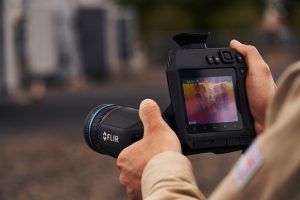
At this point we can talk about what thermography is and define it as the technique that allows measuring temperatures at a distance and without physical contact with the object under study, capturing the intensity of infrared radiation emitted by objects. This is done through thermal cameras, which convert the energy radiated by an object into a visible image formed from the surface temperature of the object captured.
Every day we are exposed to infrared rays. Heat from sunlight, fire or a radiator are forms of infrared. Although our eyes do not see them, the nerves in our skin perceive them as heat. The hotter an object is, the more infrared radiation it emits.

What are thermal imaging cameras?
If you have doubts about the applications of infrared thermography, enter this post, where we explain how thermal imaging cameras work, types of cameras and how to select them.
What is detected by thermography?
Thermography allows us to capture thermal patterns and trends that reflect valuable information for different technical applications, such as the revision of electrical systems, mechanical installations, gas leaks, or the detection of problems in buildings. Thanks to these patterns, we can even detect anomalies or risk areas before they physically manifest themselves, contributing to prevention and safe maintenance in multiple environments.
How is thermography performed?
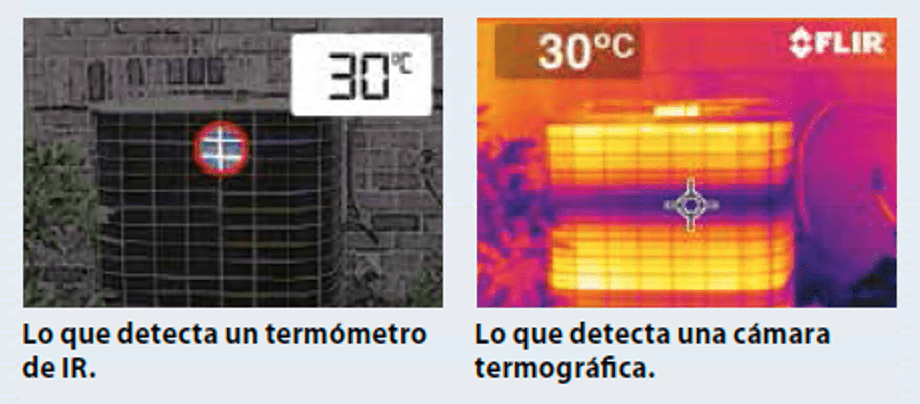
Thermography uses a thermal camera that records infrared radiation from an object and converts each pixel of the image into a temperature measurement. In this way, we obtain a visual representation of the different temperature points in the analyzed area, which allows us to identify specific areas more accurately than an infrared thermometer.
It is important to differentiate between a thermographic camera and an infrared thermometer: while the thermometer measures the temperature at a single point, the thermographic camera analyzes a given area, providing a unique temperature measurement at each pixel of the image.

Therefore, thermographic camera measurements have 4 major advantages:
1. Measures the temperature in real time:
If the temperature of an object changes, the camera detects it immediately.
Measurement without direct contact:
As it is a non-invasive technique, we do not manipulate or touch the object, but work remotely and safely.
3. Two-dimensional image:
Each pixel of the image contains information on the measured temperature, allowing several points to be analyzed at the same time.
4. Additional information on thermal patterns:
Beyond temperature, the thermal imaging camera shows thermal patterns that can reveal trends and possible areas of risk.
Since all objects above absolute zero emit infrared radiation, the applications of thermography are almost infinite: from the control of electrical and mechanical systems to medicine, rescue, fire detection and energy efficiency studies in buildings, among many others. Thermal imaging cameras are available on the market to cover a wide range of needs, from the monitoring of large petrochemical facilities to the analysis of specific points in domestic electrical installations.
Final tips on thermography
If you want to implement thermography in your company as a method of analysis and prevention, it is advisable to seek the advice of an expert to select the appropriate camera model. In addition, when considering an investment in thermography, do not forget aspects such as camera warranty, after-sales service, or the necessary training for optimal use of the tool.
To learn more about this topic, we suggest you review the following articles before making a decision:
- 6 words to know before buying a thermal imaging camera
- 6 things to consider when buying a thermal imaging camera
Remember that acquiring the camera alone is only part of the process. Make sure you find a reliable supplier who can accompany you and help you achieve your risk analysis and prevention goals.
Related entries

Industrial maintenance, from cost to strategic investment
For decades, industrial maintenance has been perceived as a necessary evil. An activity primarily aimed at complying with regulatory requirements, avoiding penalties, and responding to

Thermography applications in industry
All objects around us emit infrared radiation that can be captured and visualized with a thermographic camera. Thanks to this physical property that provides us with thermal information, we can apply infrared thermography to an infinite number of sectors. Discover examples of the most representative applications below.

Risk prevention in ATEX Zone 22 with FLIR Si2x
FLIR Si2x, the key to detect hazards before it's too late. In ATEX Zone 22 environments, where combustible dust can become a latent hazard, this innovative acoustic camera can locate air leaks and mechanical failures without stopping production, ensuring safety and operational efficiency.