
SK Energy, Korea's leading petrochemical oil refining corporation, uses FLIR's optical gas imaging(OGI) and thermal imaging cameras for safety inspections at the Ulsan CLX plant, one of its key refineries. For the Ulsan CLX inspection team, this FLIR technology is critical to maintaining safety throughout the plant. Given the sheer scale of the Ulsan CLX plant, its inspection team uses an impressive array of inspection equipment for a wide range of purposes: from handheld thermal cameras, such as FLIR's Exx-Series and T-Series, to FLIR's G320 and G346 OGI cameras. In particular, the FLIR G320 has become an integral part of the inspection process, and the Ulsan CLX plant has added more than ten cameras to its arsenal of inspection equipment.
The Ulsan Complex, or "Ulsan CLX", is an indispensable facility for SK Energy that develops and produces most of the company's petrochemical feedstocks and finished products. It also develops and refines crude oil, and produces petrochemicals, films, yarns and textiles. Ulsan CLX has a crude oil refining capacity of 840,000 barrels per day, making it the largest of its kind in Korea and the third largest in the world for a single petrochemical plant.
SK Energy central facilities
SK Energy goes to great lengths to ensure the safety of its huge Ulsan CLX plant and avoid unnecessary downtime by implementing stringent safety management protocols, preventive inspections and regular maintenance activities. The company employs a number of safety strategies, including daily safety measures, minor maintenance work performed every year and major maintenance projects every three to four years.
Any questions?
Request information

FLIR technology ensures operator safety and maintenance of facilities
During regular maintenance, SK Energy deactivates parts of its production line and dismantles equipment for detailed inspections and repairs. It also overhauls old equipment and replaces catalyst materials. With more than 46,000 kilometers of piping and equipment spread over 21 production processes, it is impossible to inspect the entire complex with regular inspections.
Therefore, SK Energy inspects the Ulsan CLX production processes on a rotating basis, monitoring eight to nine production processes at a time. These periodic inspections alone require hundreds of thousands of technicians and personnel for months at a time. Regular maintenance is key to managing facility safety and detecting potential failures before they cause a system breakdown.
This is not to say that regular maintenance can completely eliminate equipment failures or safety incidents. For example, in any regular maintenance session, tens of thousands of components are disassembled and reassembled, valves are closed and opened, and old parts are replaced with new ones. Because everything is done by hand, there is a small chance that workers will fail to secure a screw or valve, which can lead to abnormal heating or gas leaks.
Why refineries and petrochemical facilities need FLIR
When pipelines in an oil refinery or chemical plant leak, the escaping gas can be toxic. These toxic gases sometimes have no perceptible odor or color, so precautions must be taken to ensure the safety of workers.
Safety and equipment management are also extremely important. Refineries and chemical plants have numerous horizontally and vertically interconnected pipelines. These pipelines are often covered with insulation and refractories to protect the plant from extreme temperatures. However, when used for long periods of time, gaps can develop between the insulation and the pipes, leading to heat loss. Failure to identify and fix these problems in time can lead to costly downtime of the entire plant.
As Ulsan CLX inspection team deputy manager Bo-lim Lee explains, "FLIR's optical gas imaging cameras and thermal cameras ensure the safety of our workers from harmful gases that cannot be seen with the naked eye. They protect the entire facility and help protect the complex from hidden hazards."
Although the inspection team uses a range of FLIR products, its most highly rated device in terms of utility and reliability is the FLIR G320. First introduced at CLX Ulsan in 2012, this gas detection camera is used to scan the entire facility for hydrocarbon or VOC leaks at valve connections after major maintenance projects. Lee says the use of the OGI G320 camera to scan the entire facility after maintenance is considered virtually mandatory at Ulsan CLX.
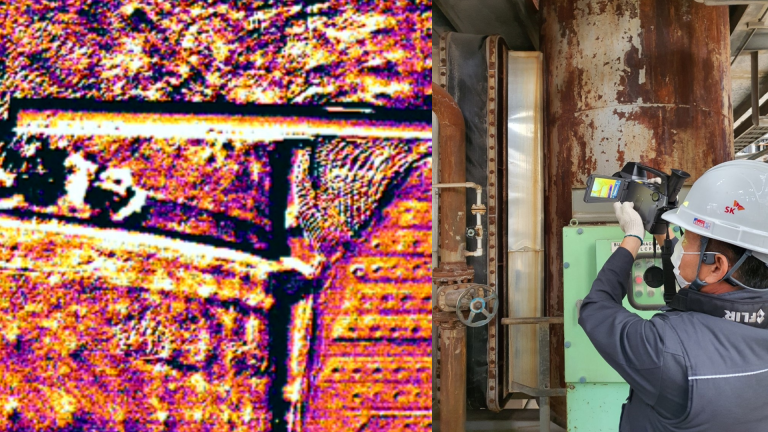
Using the FLIR G346 optical gas imaging (OGI) camera, SK Energy was able to accurately detect gas leaks in the welded parts of your carbon monoxide boiler inlet duct. From your carbon monoxide boiler.
Deployment of the FLIR G320
Previously, the Ulsan CLX used a gas detector to detect noxious gases. Although products such as sniffers (toxic vapor analyzers) can detect the presence or absence of noxious gases leaking into the air, they are not capable of identifying the specific location where the gas leak occurred. Sniffers also require the user to physically approach the inspection site, which greatly increases safety concerns.
Instead, the FLIR G320 can visualize harmful gas leaks and identify the location of the leak. Inspectors can sweep the camera across a target area from a distance-improving safety-and avoid any gas clouds when approaching for a closer look. Other advantages of the G320 include thermal imaging, stability against changes in the environment, durability and ease of use. Thanks to its utility and reliability, the FLIR G320 is a popular piece of equipment not only in Ulsan CLX's inspection team, but also in its production departments, which have purchased more than ten additional OGI cameras. Lee says, "We highly recommend the FLIR G320 to other oil refineries and chemical plants."
FLIR technology ensures operator safety and maintenance of facilities
In addition to the G320, SK Energy uses the FLIR G346 OGI camera, as well as FLIR T640 and E54 thermal cameras and the FLIR GF309 oven camera to ensure the safety of its facilities.
The FLIR GF309 is filtered at a special wavelength so that it can penetrate flames to inspect the inside of boilers and heaters. Using the GF309, SK Energy recently discovered coking damage while inspecting a heater tube at one of its subsidiaries. Inspectors monitored their equipment around the clock with the GF309 camera, analyzing which components showed temperature fluctuations. They quickly identified the faulty heater tube and were able to remove and clean it without having to shut down the facility. The Ulsan CLX inspection team uses a FLIR G346 OGI camera to detect leaks in its two carbon monoxide boilers.
Normally, SK Energy converts the toxic carbon monoxide gas into non-toxic carbon dioxide before discharging it into the air. But because both boilers are old, they tend to leak carbon monoxide from their welds. The FLIR G346 allows the inspection team to locate the source of the leaks and repair them before the carbon monoxide can cause any safety problems. As for the FLIR T640 and E54, these thermal imaging cameras are portable and convenient enough to be widely used in daily safety inspections. In particular, the T640 and E54 can easily detect heat loss in horizontal and vertical pipes that have gaps in the insulation.
"FLIR's cameras are excellent for visualizing invisible risk factors during facility safety inspections thanks to the easy-to-read thermal images they provide," says Lee. He adds, "We expect FLIR's range of optical gas imaging and thermal imaging cameras to play an important role in our safety inspections and worker protection."
All images and content of this post, rightfully belong to their owners SK Energy and Teledyne FLIR. Apliter Termografia uses these images as official distributor of Teledyne FLIR in Spain.
More articles about OGI cameras:


