
When people are first exposed to infrared (IR) or thermal imaging, they often have difficulty interpreting the camera images. People do not understand what they are seeing. Worse, those who buy thermal cameras do not get the most out of the investment.
This is not because thermography is too complex, but because it is a fundamentally different way of experiencing the world compared to what we see with our eyes. So, let's take some time to understand the similarities and differences of the typical visible light camera on a drone.

What is infrared?
The first thing to keep in mind is the fact that infrared cameras see a different type of energy than what you see with your eyes. Human eyes-and a typical drone camera-see visible light, while a thermal camera sees infrared energy.
Although both visible and infrared light are part of the electromagnetic spectrum, it is the respective wavelengths that differentiate them. Electromagnetic energy travels in waves, so the wavelength is the physical distance between the peak of one wave and the peak of the next.
In the infrared spectrum, these wavelengths are usually measured in micrometers, or one millionth of a meter. Visible light spans the 0.4-0.75 micrometer wavelength band (often abbreviated as "micron" and abbreviated as μm), while the infrared energy detected by most drone thermal cameras spans the 7.5 to 14 μm wavelength band.

These points provide the basis for the fundamental facts that people need to understand when delving into thermal imaging. First, a given detector is only sensitive to a certain wavelength range and can only see it. Human eyes and a typical drone camera are sensitive to visible light and thus can see it in the 0.4 to 0.75 μm wavelength band. The wavelengths of infrared energy are too long for our eyes to see; that is why thermal cameras can "see the invisible".
You will find more in-depth information about thermography and infrared by clicking here, and watching the following video.
Heat vs. temperature
The next thing that can confuse people is thermal energy with temperature. They are not the same thing. When something looks "hot" to a thermal camera, it just means it is giving off more heat energy; it may or may not have a higher temperature. So what is the difference?
All the molecules that make up everything on earth are oscillating. As thermal energy is added to a substance, its molecules will oscillate faster and create more friction between the molecules, thus increasing the temperature of the substance. What we see with a thermal camera is the amount of thermal energy being released from something, not its temperature.
Temperature can be considered as the result of having more or less thermal energy in a substance. If we add thermal energy, the temperature will increase. If we take energy away, the temperature will go down. Since our cameras detect thermal energy, we must remember that the temperature values we see in an infrared image are calculated, not detected. And those calculations are affected by a few very important variables that not only influence how hot something looks, but also how it is measured.
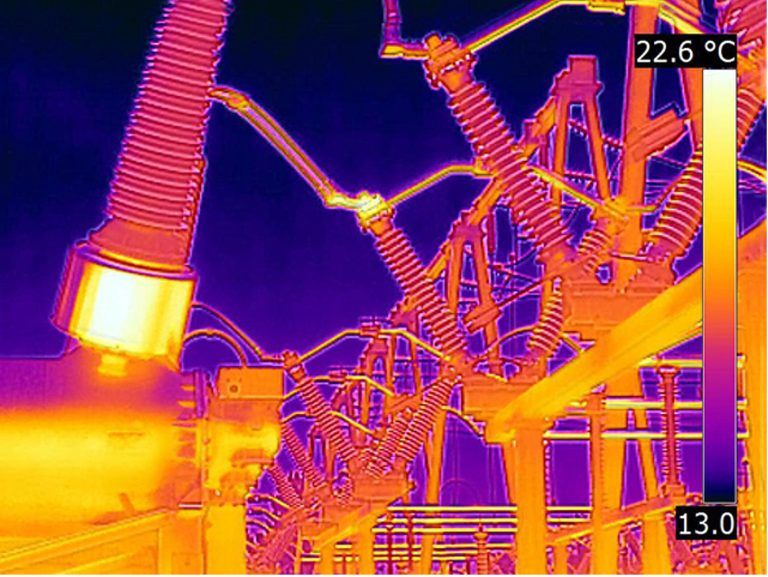
Infrared thermographic camera calculating the temperature
What makes things look hot or cold?
First, remember that the infrared energy we see coming from an object comes from the surface of the object; but that energy does not necessarily come from the object itself. It can come from the object, but it can also reflect off of it, pass through it, or be a combination of all three. To correctly interpret an image and measure the temperatures it contains, we must first understand where the energy we see is coming from. Everything we see in an infrared image is a combination of emitted, reflected and/or transmitted energy. We can show this relationship mathematically as follows: one represents 100% of the IR energy in the scene.
The good news is that relatively few things are significantly transmissive to infrared energy, so most things are a combination of emitted and reflected energy (E+R=1). The bad news is that the transmissivity of an object to infrared energy can be the exact opposite of what is expected based on human experience with visible light. For example, thin-film plastics, such as tarps and garbage bags, are highly transmissive to infrared, to the point that we can see through such objects with a thermal camera, but are opaque to visible light. In contrast, normal window panes are very transmissive to visible light (or they would not make good windows), but are almost totally opaque to infrared.
E + R + T = 1
Emission (E):
Energy that comes directly from an object is called emitted energy. It is the energy contained in the object and radiated from it.
Reflex (R):
Reflected energy is thermal energy that originates from something else, but bounces back to the object seen in the camera's viewfinder.
Transmission (T):
When energy from something behind the object passes through that object of interest, that material is said to be "transmissive". This means that the energy seen is transmitted from the object of interest, not emitted from it.
This is one of those things that makes it tricky for new operators: not only can you not see through the glass with an infrared camera, but you often see reflections on the glass in the infrared. To correctly interpret a thermal image, operators must know what they are looking at and its thermal properties, to understand whether the energy that appears to be coming from that object is actually coming from that object. This is equally true whether trying to understand what things are hot in an image ("qualitative" inspection), or to obtain actual temperature measurements ("quantitative" inspection).
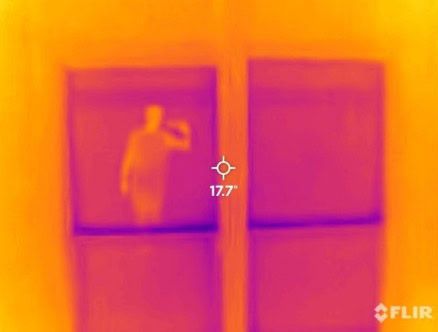
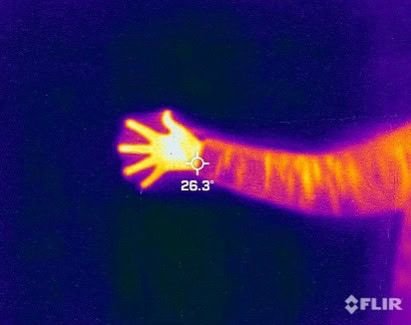
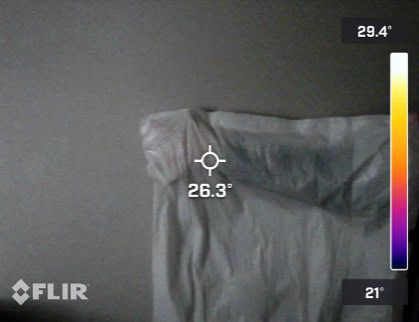
Thermal cameras can see reflections in the mirror and through the plastic coating.
How hot?
Earlier we talked about heat being the type of energy we see with a thermal camera, but temperature is the result of having more or less heat in the object. We have also explained that heat energy is either emitted from an object or reflected (bounced) from an object. All of these variables influence how hot an object is and how accurately it can be measured. The measure of how well an object radiates its heat is called emissivity. Emissivity is a ratio of the energy of an object to the amount of energy it emits, and these ratios are shown as values between 0 and 1.0. Thus, an object that is 90 percent emissive has an emissivity of 0.9. Remember that everything we see is a combination of emissivity and reflection, so if an object is 90 percent emissive, it is 10 percent reflective. The degree of emissivity or reflectance of an object will be determined by the following six things, in decreasing order of importance:
- Material - Emissivity is primarily a property of the material. The material the object is made of has the greatest influence on how effectively it emits its energy. Organic objects - earth, rocks, wood, animals (including people) are highly emissive, often with an emissivity above 0.95.
- Finish. The smoother and shinier an object is, the lower its emissivity and therefore the higher its reflectivity. For example, if we take a rough piece of wood and polish it smooth, it will lower its naturally high emissivity and increase its reflectance. Conversely, shiny metals are naturally highly reflective, but once they corrode, they become more emissive.
- Viewing angle - When high emissivity objects are viewed from too low an angle, they will become more reflective. This is especially important for drone operators because we can easily change the tilt angle of our thermal cameras. Be sure to look at the target at an angle as close to 90 degrees to the surface as possible to minimize reflections.
- Geometry - Objects with many holes and angles may appear hotter than they really are due to these changes in geometry.

Thermal imaging cameras measure both reflected and emitted thermal energy.
When measuring temperatures with a thermal camera for quantitative inspection, it is necessary to compensate for all of the above variables to generate what is called a true temperature.
We hope you found this article useful.
If you want to learn more about thermography and thermal imaging cameras, click on the button below.


