
Table of Contents
Clean, rust-free metal surfaces have a low emissivity. So low, that it is difficult to measure on them with a thermal imaging camera. In many industrial R&D applications, there are many low emissivity targets, especially in electrical applications. To get good measurements, the emissivity of these problematic targets needs to be increased.
The thermal imaging camera records the intensity of radiation in the infrared region of the electromagnetic spectrum and converts it into a visible image. The infrared energy radiated by an object is focused by the camera optics onto an infrared detector. The detector sends the data to the electronic sensor for image processing.
Finally, the sensor translates the data into an image compatible with the viewer or viewable on a standard video monitor or LCD screen. Infrared thermography is the art of transforming an infrared image into a radiometric image that allows temperature values to be read. Therefore, each pixel of the radiometric image is, in fact, a temperature measurement.
To interpret thermal images correctly, it is necessary to know the different materials and circumstances that influence the temperature readings of the thermal imaging camera. Emissivity is the efficiency with which an object emits infrared radiation compared to a perfect emitter (the so-called black body, which has an emissivity value of 1).
In fact, the targets we usually measure are not perfect radiators and have an emissivity value below 1. For these bodies, the measured temperature will be a combination of emitted, transmitted and reflected radiation. It is important to set the correct emissivity value in the thermal imaging camera, otherwise the temperature measurements will not be correct. FLIR Systems thermal imaging cameras have predefined emissivity settings for many materials. If you do not find one you can look it up in an emissivity table.

A perfect blackbody has an emissivity of 1. In other words, the target radiation is 100% emitted from the surface.

In reality, our targets are not perfect black bodies. The temperature measured on a target is the result of a combination of emitted, transmitted and reflected radiation.
The emissivity, reflectance and thermal conductivity values of a target will largely depend on the material properties. Most non-metals have emissivity values close to 0.9, which means that 90% of the measured radiation comes from the radiation emitted by the target. Most polished metals have emissivity values between 0.05 and 0.1. Tarnished, oxidized or corroded metals have emissivity values ranging from 0.3 to 0.9 depending on the amount of rust or corrosion. Without increasing the emissivity value one way or another, materials with emissivity below 0.7 are difficult to measure, those with emissivity below 0.2 are nearly impossible. Fortunately, there are cost-effective ways to compensate for low emissivity in targets. These methods reduce the reflectance of the target, thereby improving measurement accuracy.

If you look at the thermal image, you may think that the leaves are cooler than the surface of the cup. In reality, they are exactly the same temperature, the difference in the intensity of the infrared radiation is caused by a difference in emissivity.
Insulating tape to increase emissivity
Most high-quality insulating tapes have an emissivity of 0.95. It must be ensured, especially with medium wavelength cameras (3-5 μm), that the tape is opaque. Some vinyl tapes are too thin and have some infrared transmittance and are therefore not suitable as a coating to increase emissivity. Scotch™ brand black vinyl insulating tape 88, which has an emissivity of 0.96 in both the short wavelength (3-5 μm) and long wavelength (8-12 μm) regions, is recommended.
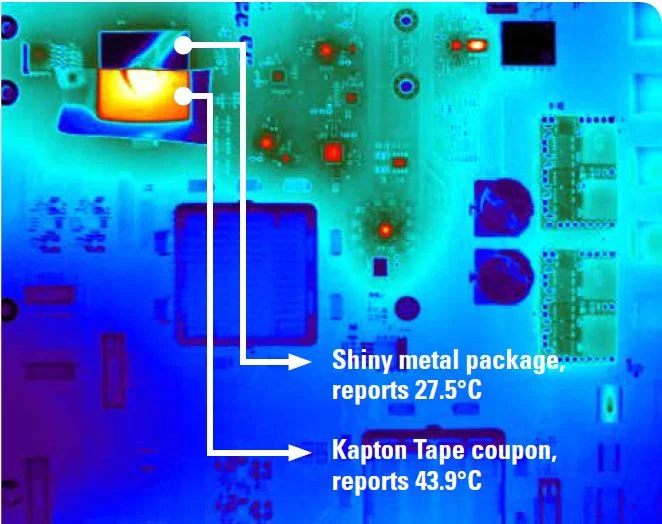
Temperature of a large ASIC with a shiny metal cover: without any finish, the ASIC indicated near room temperature. When a layer of high-emissivity Kapton tape was applied, the true temperature of 43.9 °C was indicated.
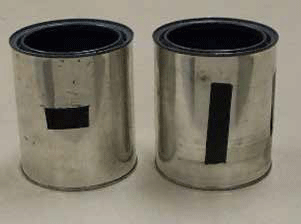

This example shows two cans with tape. The one on the left is filled with hot water, the other is at room temperature. In the hot can, the temperature obtained from the tape is 72.8 °C (163 °F), and in the can it is 23.5 °C (74.3 °F). The second reading is essentially room temperature, since the emissivity of the can is very low. This is a classic example of the need to use an application to increase emissivity on a low emissivity target.
Paints and coatings to increase emissivity
Most paints have an emissivity between 0.9 and 0.95. Metal-based paints are not recommended, as they have low emissivity. The color of the paint is not an important variable in its infrared emissivity. The uniformity of the paint is more important than its color. Uniform paints are preferable to glossy paints. The coating should also be thick enough to be opaque. Two coats are usually sufficient. Tape works for small areas. Paint works for larger areas, but is a permanent coating. For large area coatings but which have to be removed later, or where tapes are not appropriate, powders suspended in thick mixtures or sprayed on can be used. Two examples would be Dr. Scholl™ penetrating dye and talcum powder foot spray. The emissivity of these powders are within the 0.9 and 0.95 range, which shows that they are thick enough to be opaque.


Left: Printed circuit board (PCB) without emissivity enhancement paint. Right: with emissivity enhancement paint. The disadvantage of using paints can be the reduction of small details.
White correction fluid to increase emissivity
The use of liquid corrector is a good way to increase the emissivity of a surface. This method can be used with smaller electrical components as an alternative to tape, which would not stick to small surfaces. The liquid corrector can be cleaned using a small brush and alcohol. The emissivity of the liquid corrector is between 0.95 and 0.96 for a long wavelength camera.
Other recommendations to increase emissivity
Caution should always be exercised as these lenses often carry electrical current. This means that coating of the targets should only be done when they are de-energized and using an approved coating to ensure proper operation when transmitting power. Be sure to cover an area of sufficient size. Know the spot size ratio of your camera to take measurements and the minimum operating distance you can safely use. For example, a camera with a spot size ratio of 250:1 can measure a one-centimeter target to a maximum of 250 centimeters, or 2.5 m (or a one-inch target to a maximum of 250 inches, or 20.8 feet). For higher temperature applications, use paints designed for high temperatures, such as engine paints or charcoal grills. Tapes and powders are limited in the temperature range to which they can be applied. For electrical systems, if the tape melts, the problem is likely to be significant. Thus, you should not need high temperature material for this application.
Control emissivity values on PCBs
During fault-finding procedures, measuring the temperature of components on printed circuit boards (PCBs) can be a very useful and cost-effective technique, but it is difficult due to the different emissivity values of the components. Typically, PCBs have a variety of metal and plastic components made by different manufacturers who apply their own finishes to the components. When the boards are treated with a proven, concrete and known coating, the problem is usually simplified. After plating, the surfaces of the components have the same electronic value and relative temperatures can be determined using a thermogram.

To control the emissivity values, you can treat a PCB with a coating.
Determine emissivity
Knowing the emissivity value is necessary for a true evaluation of the measured radiation temperature. However, the values in the emissivity table should be used with caution. It is often not clear at which wavelength band the emissivity value is valid. And emissivity changes with wavelength. Also the condition, texture and shape of the surface play important roles in the emissivity of a material. Here is a way to understand the effect of emissivity variation on measurement accuracy: Suppose the emissivity variation of an object is ±0.05. For an emissivity of 0.95, this represents about 5 % error (0.05/0.95). For a material such as shiny copper, the emissivity is 0.05, this represents a 100 % error (0.05/0.05). These errors propagate into the temperature calculation, increasing the error in the temperature reading. Our recommendation is not to attempt to measure temperature with a target emissivity below 0.5 due to this effect. Coat the target with a high emissivity material before measuring.
Temporary | Permanent |
| Penetrating dye designer | 1/16″ liquid tape |
| Round paper stickers | Plasti-dip 1/32″ |
| White liquid corrector (long wave) | Smooth non-metallic paint |
| Adhesive tape | Scotch 70 silicone rubber |
| Scotch Black Vinyl Duct Tape 33 | Bulldog Rubber No. 8 (self-adhesive) |
| Candle soot (small targets) | W.H. Brady Labels (adhesive) |
| Adhesive paper | Friction tape (self-adhesive) |
Kapton Tape (polyimide film with silicone adhesive) | Porcelain touch-up enamel |
| Coating plastic for PCB 70 (RE) |
High emissivity coating materials
Source: https://www.flir.es/discover/rd-science/use-low-cost-materials-to-increase-target-emissivity/
Follow us on:
Suscríbete a nuestra Newsletter para estar informado >>> Click aquí<<<
Related articles:
Industrial Maintenance: From Cost to Strategic Investment
For decades, industrial maintenance has been perceived as a necessary evil. An activity primarily aimed at complying with regulatory requirements, avoiding penalties, and responding to

Thermography applications in industry
All objects around us emit infrared radiation that can be captured and visualized with a thermographic camera. Thanks to this physical property that provides us with thermal information, we can apply infrared thermography to an infinite number of sectors. Discover examples of the most representative applications below.

Risk prevention in ATEX Zone 22 with FLIR Si2x
FLIR Si2x, the key to detect hazards before it's too late. In ATEX Zone 22 environments, where combustible dust can become a latent hazard, this innovative acoustic camera can locate air leaks and mechanical failures without stopping production, ensuring safety and operational efficiency.