
Nowadays, the use of fossil fuels such as coal, gas or oil to create electricity is still the majority in most of the world, although, little by little, due to the fact that their reserves are limited and their price is higher every day, renewable energy sources are becoming more and more popular. This type of energy is obtained from virtually inexhaustible natural sources, such as solar or wind energy, among others.
Renewable energy sources, also known as green energy, do not emit polluting gases or radioactive waste, and therefore have a positive impact on the fight against climate change, reducing the environmental footprint andCO2 emissions released into the atmosphere.
To ensure that these renewable energy sources are efficient and generate an optimum return on investment, we must ensure that the plants where they are produced do not suffer any damage that prevents them from operating correctly at full capacity. To fulfill this purpose, thermography has proven to be the most effective tool for the maintenance of these facilities, since it is possible to carry out inspections of large surfaces in a short time, remotely and without having to shut down the production systems.
Next, we analyze the application of thermography in the maintenance of 2 of the most widely used renewable energy sources: solar energy and wind energy.
Solar energy and photovoltaic installations
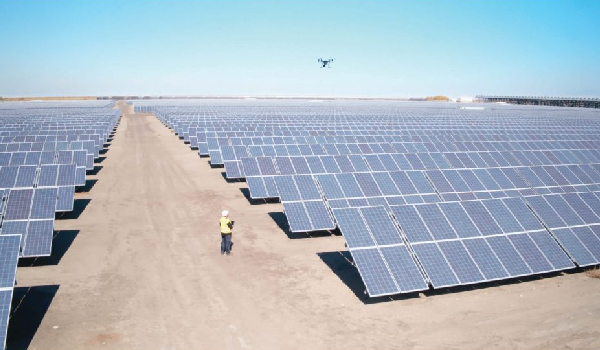
Solar energy is one of the main sources of renewable energy. Electricity is generated from solar panels made up of crystalline silicon cells, photovoltaic systems that capture sunlight and, through the photovoltaic effect, transform it into electrical energy. These solar panels are mostly installed in solar parks, large tracts of land with hundreds, or sometimes thousands, of them.
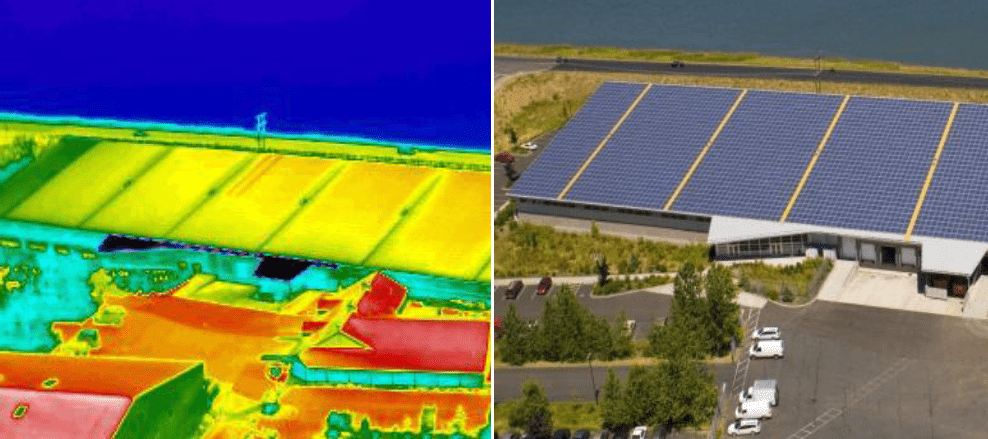
Due to the large number of panels that make up solar farms and the enormous extensions of land they occupy, the use of thermography has proven to be the best option for the maintenance of these installations. Thermal imaging cameras allow a quick and clear inspection of the photovoltaic panels, detecting those photovoltaic cells that are functioning abnormally and allowing them to be repaired or replaced quickly before they cause a major breakdown or shutdown of the installation. A thermal imaging camera will also be very useful for checking the rest of the installation, such as wiring, regulating systems and storage devices, among others.
It should be added that to optimize the use of thermography in the maintenance of photovoltaic installations, the thermal imaging camera can be mounted on a drone. In this way, large-scale inspections can be carried out covering large areas of land in an agile way and quickly detecting the plates that have any faults.
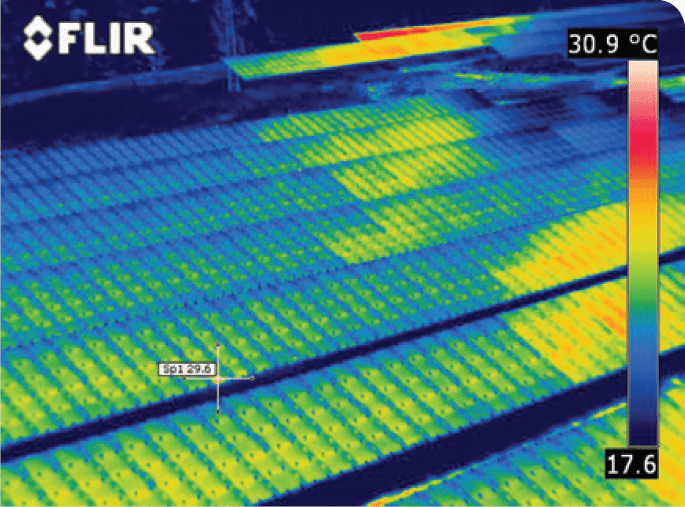
On the other hand, we can also increasingly find solar panels on buildings or private houses, where they generate enough energy to supply private consumption. In these cases, the use of thermography for maintenance inspections of photovoltaic panels will also be very effective and necessary. We must bear in mind that installing solar panels in a private home is a high cost for the owners, who may take up to 10 years to amortize the initial investment, so they must ensure that at all times their renewable energy sources are working at full capacity and without defects. Therefore, the use of thermography will also be very useful in these cases.
Wind energy and wind farms
Wind energy is another of today's most important renewable energy sources. Electricity is generated from the kinetic energy of the wind by wind turbines driven by large blades. These turbines, also known as wind turbines, are grouped in wind farms made up of dozens of them.
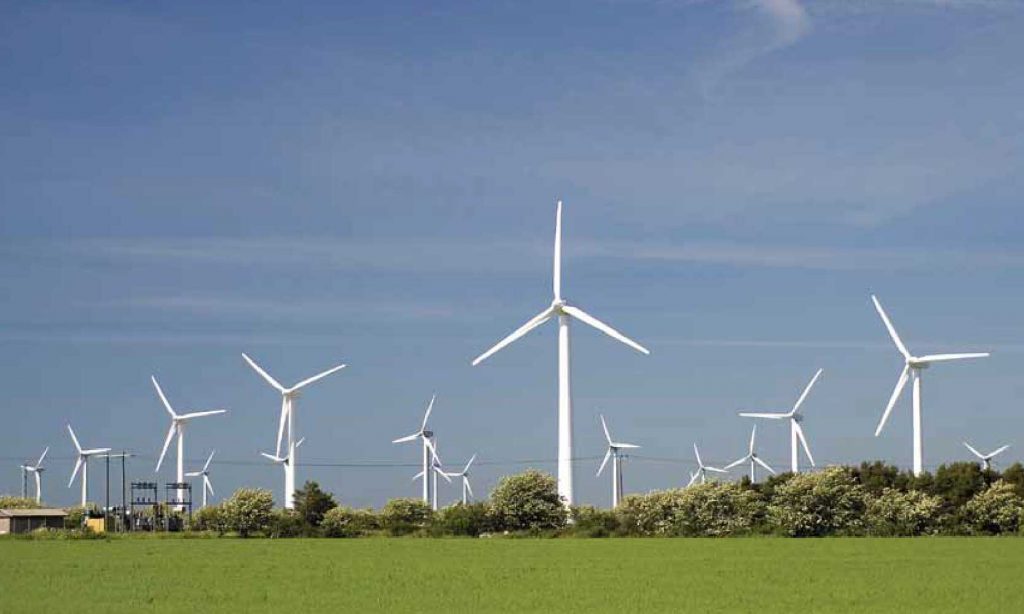
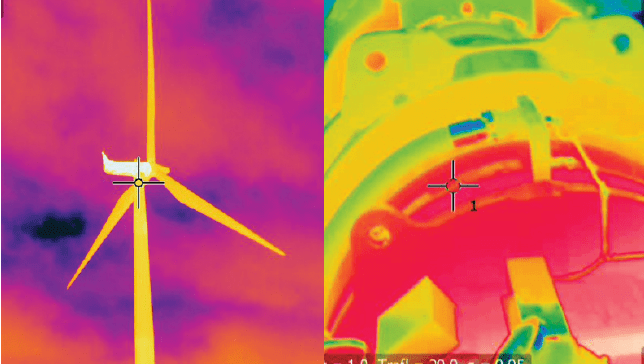
Wind turbines contain many mechanical and electrical components that can be easily inspected with a thermal imaging camera, such as shafts, gears, brakes or bearings, among others. Unlike other technologies that will only reveal if there is a problem in the system, with the use of a thermal imaging camera we will be able to see exactly which part is causing the problem. Therefore, thanks to the use of thermography in the maintenance inspections of wind turbines we can detect any failure of the machine and we can repair or replace it before it leads to a serious breakdown, ensuring that these renewable energy sources operate at full capacity for a long time.
As with photovoltaic systems, thermal imaging cameras are also useful for inspecting the electrical components associated with wind turbines, such as transformers, wiring and yaw motors. Thermal imaging is the only technology that will allow us to check all these system components remotely and without having to stop their operation.
A thermal imaging camera that meets the appropriate technical requirements
Once the effectiveness of thermography applied to the maintenance of these 2 renewable energy sources has been proven, we must emphasize that in order to carry out the inspections successfully we must have a thermographic camera that meets the appropriate technical aspects, such as a good resolution, the ideal thermal sensitivity or an appropriate optics for this type of work. In order to carry out thermal inspections in solar or wind farms it is also essential to have a good training in thermography applied to renewable energy sources and never neglect personal safety standards.
If you would like more information about thermographic cameras for inspections of photovoltaic panels or wind turbines, as well as specific training for this type of work, please contact one of our technical advisors. contact one of our technical advisors and we will help you find the device that best suits your needs.