
Data center maintenance teams have a big part to play in protecting the critical resource that customers and businesses depend on. Fortunately, they have a secret weapon that allows them to detect problems at an early stage before they become big problems: FLIR thermography.
The data center market has experienced massive growth in recent years. Driven by an increasing adoption of cloud, AI, IoT, 5G and big data technologies, new data centers are being built on every continent at a rapid pace. Whether they are in-house data centers for some of the largest and most influential companies, or created by specialized providers offering infrastructure services, data centers play a critical role in maintaining the continuity of a business. Data center downtime can have a huge economic impact and should be avoided at all costs. In addition to financial loss, reputational damage can have the same impact, especially when the data center supports customer-facing services.
Ensuring uptime has become increasingly complex for data centers. With so much mechanical, electrical and electronic infrastructure under one roof, overheating is a major concern, not only because the infrastructure does not use power efficiently, but also because overheating can lead to total server shutdowns, affecting users around the world, or even loss of data or equipment. One of the most reported incidents is the overheating in 2013 of a Microsoft data center that operates some of its cloud services, including Outlook, which resulted in the loss of services for 16 hours.

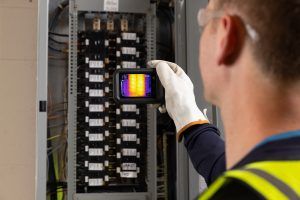
Detect problems in switchgear, motors, HVAC infrastructure, uninterruptible power supplies (UPS), power distribution units (PDU), batteries and generator equipment.
Any questions?
Request information
THERMAL IMAGING CAMERA MAINTENANCE INSPECTIONS
Maintaining a data center today involves much more than IT operations. Power distribution systems and cooling infrastructure are also essential to keep the data center up and running and to prevent mechanical or electrical failures and the resulting outages.
Many systems that are critical to data center operation heat up before they fail. Temperature is an important indicator of power consumption and equipment performance, which is why Infrared thermography (thermal image) is an ideal tool for inspecting power consumption, electrical installations, cooling equipment and computer hardware.
Periodic inspections with a thermal imaging camera have become indispensable in predictive and preventive maintenance programs.
Thermal cameras help maintenance personnel detect problems with electrical switchgear, motors, HVAC infrastructure, uninterruptible power supplies (UPS), power distribution units (PDUs), batteries and generator sets, and all electrical devices that power server systems before these problems become serious failures or downtime.
With cloud computing becoming the new normal, and as data centers grow in scale, so does the need for greater computing density and energy efficiency. Data center owners are looking for ways to increase capacity, but they also want to reduce costs and energy. Thermal imaging can provide them with important information on how to optimize power and space requirements without causing overheating.
In summary, periodic inspections with thermal imaging cameras can help maintenance personnel:
- Find and fix hidden problems before they become unplanned downtime.
- Reduce the possibility of component degradation going unnoticed due to overloaded circuits or loose connections.
- Prevent equipment failures
- Optimize power management and space allocation
Thermal imaging applications
Thermography is the perfect technology to address the wide range of maintenance and inspection work in data centers.
ELECTRICAL AND MECHANICAL SYSTEMS
Thermal imaging cameras can be used to inspect a variety of electrical or power generation related systems. Heat is an important indicator of defects in electrical installations. When current passes through a resistive element, it generates heat. Over time, the resistance of electrical connections can increase due to, for example, loosening and corrosion. The corresponding increase in temperature can cause components to fail, resulting in unplanned outages.
Electrical systems can also suffer from load imbalances and increases in impedance to current. Thermal inspections can quickly locate hot spots, determine the severity of the problem and help establish the time frame in which the equipment should be repaired.
Thermal imaging cameras will help you detect problems with:
- Overheated connections
- Overloaded or unbalanced circuits
- Damaged switches
- defective fuses
- Power supplies
- Battery systems
- Generator systems
- Uninterruptible Power Supplies (UPS)
- Transformers
- Electrical panels
- Resistive load banks
HVAC AND REFRIGERATION SYSTEMS
To operate smoothly and efficiently, data centers need perfectly air-cooled conditions. Data centers typically use a hot aisle/cold aisle design principle. Server racks are aligned in aisles with the front sides facing each other. The cold aisles get cold air directly from the computer room air conditioning (CRAC) unit from below the raised floor. The cold air cools the servers in the racks. Meanwhile, the back of the servers blows warm air into the hot aisle, which then returns to the CRAC unit.

Data centers typically use a hot aisle/cold aisle design principle.
Thermal imaging has become increasingly important to verify proper hot aisle/cold aisle operation, especially as today's data centers condense more servers in their racks. Thermal cameras will allow users to see problems such as misaligned ductwork and electrical faults, and then make decisions on corrective actions. HVAC inspection with a thermal imager can help:
- Monitor server rack temperature distribution patterns
- Locate misrouted and leaking ductwork
- See electrical or mechanical defects of the CRAC unit.
- Confirm source of energy losses
- Find the missing insulation
- Discover AC condensate leaks
- Find internal server fans that are not working or are damaged.
RENEWABLE ENERGY
Data center operators are increasingly improving their use of renewable energy sources, including solar and wind power. These renewable energy sources enable data centers to reduce their environmental impact while meeting long-term sustainability goals.
FIRE PROTECTION
Although fires in data centers are relatively rare, they can have a devastating impact. Data centers may be equipped with fire alarms and fire suppression systems, but once a fire starts, damage to assets is almost certain. Fixed thermal imaging cameras can identify hot spots before they ignite and provide an early warning response to prevent an outright destructive fire before assets are damaged or security is compromised.
PHYSICAL SECURITY
Thermal cameras not only detect hot spots or temperature differences. They also help protect a physical perimeter against intruders or unwanted intruders. Since data centers operate 24 hours a day, 7 days a week, they need effective solutions that help them monitor facilities and detect threats around the clock.
Thermal security cameras offering high contrast, high resolution and wide detection ranges are ideal for data center deployments. Unlike standard video cameras, thermal cameras can see in most adverse weather conditions, such as light rain, fog, smoke or total darkness.
When integrated with video analysis, thermal cameras can distinguish between a human or a vehicle. When combined with radar, customers gain redundancy and reduce the likelihood of a false positive. By combining thermal cameras with HD visible cameras, remote operators can review visible and thermal video footage of the scene to improve alarm verification and intruder identification.
Download the white paper for more information on thermal imaging for data centers.
Related entries
FLIR thermal imaging cameras manufactured in Europe: precision and resolution in every inspection
FLIR thermal imaging cameras manufactured in Europe: resolution, temperature, and accuracy in every inspection. Official FLIR distributor in Spain: Apliter.

FLIR Premium Handheld Bundle Promotion: More Than Just a Thermal Camera
Register your FLIR Exx or Txxx Series and get access to an extended warranty, professional software license, and ITC course. See conditions and included models.
Industrial Maintenance: From Cost to Strategic Investment
For decades, industrial maintenance has been perceived as a necessary evil. An activity primarily aimed at complying with regulatory requirements, avoiding penalties, and responding to