
Full awareness and failure prevention with FLIR Si124

SPI Inspections provides its clients with the best utility and infrastructure system inspections thanks to its extensive experience in these fields and advanced inspection technology. The team employs UAVs, FLIR thermal cameras and other high-tech equipment to provide competent inspection services, independent verification of construction standards and monitoring of energy systems.
Recently, the SPI Inspections team tested the new FLIR Si124 acoustic imaging camera. Designed with 124 microphones, the Si124 generates an accurate acoustic image that visually displays real-time ultrasonic information over a digital camera image. This allows the user to accurately determine the source of the sound.
The founders of SPI Inspections have more than 100 years of combined experience working with utility systems, from power line construction to substation inspection. "We already know the field well," says Elton Hunter, SPI's field manager. "Our expertise is basically power, from the facility where it's generated to where the meters are, both home and business."
Any questions?
Request information

"We've helped our customers a lot," Hunter says. "Our goal is to make their systems work better and make them safer and more reliable." The SPI Inspections team found the FLIR Si124 to be a valuable asset when it comes to detecting partial discharges, which can be a sign of impending failure in power infrastructures.
Inspection tools
Electricity's journey from the power plant to the light bulb in your home can fail at many points if the infrastructure is not properly maintained. SPI uses its extensive experience to know when maintenance is needed on an element with the help of advanced technology. "In our business, we use a lot of technology tools," Hunter says.
Among the tools in their arsenal is the FLIR GF77 gas detection camera, which allows them to detect sulfur hexafluoride (SF6) leaks in electrical installations, as well as hot spots. The GF77 is a multi-purpose camera that can detect different gases by simply changing lenses. When equipped with an HR lens, the camera can show sulfur hexafluoride emissions, while with an LR lens, the camera can see emissions of methane, ethylene, ammonia and other gases. In addition, it is calibrated for temperature, so it works like a standard thermal imaging camera to show different problems in the facility.
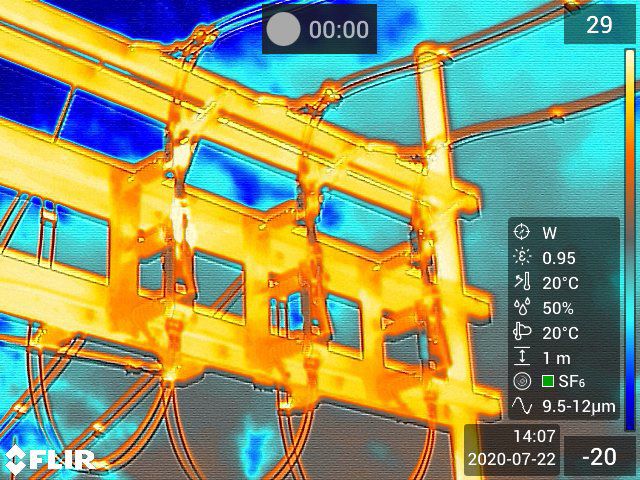
Having used FLIR's gas detection cameras previously in inspections, the SPI team was excited to get their hands on the FLIR Si124 and see what it was capable of. While acoustic imaging cameras are typically used to locate pressurized leaks in compressed air systems, the FLIR Si124 is also a very effective tool for detecting partial discharges in high voltage systems.
Partial discharge, caused by a break in electrical insulation, can be detected when the air surrounding the break becomes ionized, creating a phenomenon called a "corona". Corona can be detected quickly with acoustic imaging, which shows up as a "ball" of sound in the image. "For us, it's priceless," Hunter says.
The team had previously used ultraviolet technology to detect crowns and was pleased to find that the FLIR Si124 achieved the same results for one-fifth the price. "Basically, the FLIR Si124 does the same job and is very easy to use," explains Brett Fleming, corporate director of SPI Inspections.

Intuitive and accessible functions
Since much of their work is done in the field, it's very important to the SPI Inspections team that the tools are ready for the job. "It's very intuitive," Hunter says of the FLIR Si124. "Within about six hours, we were feeling very confident working with it."
"The camera gives us good clarity on the ground," Hunter continued. He said his team appreciated the quality of the images, the ease of downloading them to a laptop or the cloud, and the functionality of the user interface. "We're people who have been in construction for over 40 years, have arthritis and swollen hands from pounding with hammers and such. The user interfaces, such as the keys and touch panels, are very intuitive. We've found them very easy to work with."
The FLIR Si124 makes it easy to detect faults in the field. During testing with the camera, they found a fault on a power line about 60 meters above the ground, a difficult problem to detect. "With our drones we could, but we wouldn't have known where to look," says Hunter. "Thanks to our experience in the field we were able to pick it out and get close to it, then we knew there was a little problem up there."
"It's a $25 million failure on a line that's only five years old," he says. With the FLIR Si124 they were able to detect the problem at an early stage, before the cost of repair reached that figure.
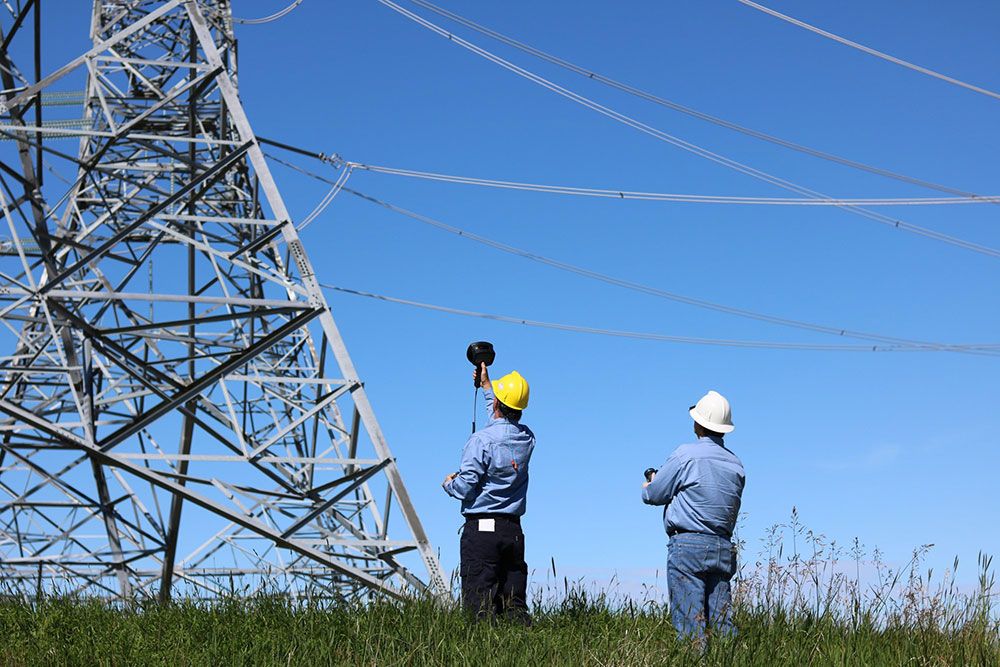
Detecting problems safely before they become catastrophes
Electrical substations and other utility infrastructure present different hazards to workers and inspectors. When the team faced a particularly hazardous area inside the substation, where a capacitor bank had fallen, they were required to stand outside the metal fence surrounding the area. At the time, they were glad that Si124 could look through the fence to assess the situation.
"We were able to get up close and look through the metal fence. Because of the 124 microphones on the front and the little camera," Hunter explains, "with that camera we were able to look through that five-by-five-centimeter square and keep our people safe, which is a big advantage for us on the ground."
SPI's goal during inspections is to detect problems before they become more serious. Early detection of partial discharges and corona with tools like the Si124 helps them anticipate problems and provide information to their customers. "It allows us to preemptively forecast what's happening on our power lines," Hunter says. "So instead of having to deal with a catastrophic failure, outage and repair, we can anticipate and go to the customer and say, 'You're going to have a problem with this if you don't fix it.'"
Unplanned outages can be avoided with regular inspections and repairs. "If we do our job right, no one has to know we're out there. The customer doesn't know we're out there. We come out, do our job, make recommendations, and then on planned outages or regular maintenance work, they can repair whatever it is."
SPI Inspections operates in Canada and China. Learn more about the services they offer at www.spiinspections.com/ and about the FLIR Si124 at www.apliter.com.
Related articles:
The improved bandwidth of the new Si124 range offers great savings to energy-intensive industries
The Si124 range of acoustic chambers now detects air leakage from 2 to 65 kHz, and this small change represents major operational improvements in the following areas

Reduce energy costs by finding leaks with the FLIR Si124
Save on energy costs with the FLIR Si124 ultrasound acoustic imaging camera.

Acoustic imaging with FLIR Si124
The FLIR Si124 industrial acoustic imaging camera produces an accurate acoustic image that is superimposed in real time on a digital camera image.