
The mining industry plays a vital role in extracting valuable resources from both the surface and subway layers of the earth. Mining operations require robust and reliable equipment to ensure the safe and accurate extraction of minerals and metals.
Among the crucial equipment in this industry are air compressors, which have become a critical component in every stage of the mining process, including powering various drilling methods, ventilation and the operation of a multitude of tools in both subway and open pit mines. However, compressed air systems often face challenges, such as leaks, which result in higher energy costs and reduced equipment efficiency, affecting overall productivity and safety. One of the most effective ways of detecting compressed air leaks in mining operations is through the use of acoustic imaging cameras .
Table of Contents
The Importance of Compressed Air Systems in the Mining Industry

Air compressors are an essential component of the entire mining process, and compressed air is widely used and helps at all levels of the process. The mining industry has identified many uses for air compressors, which has made mining safer and more efficient.
Compressed air is a preferred method for mining due to its adaptable and convenient nature. Air compressors work well in various mining processes and can withstand the hard wear and tear of mining. They are consistent, efficient and have relatively low parts replacement costs.
The role of compressed air in mining operations

The mining industry makes extensive use of air compressors to power equipment, supply clean air and provide ventilation to create safer and more efficient processes. Compressed air supports several functions in mining operations, including:
Blast-controlled explosives
are used in the mining industry to break rocks and other durable materials. Compressed air provides high velocity streams to help detonate explosives safely.
Cleaning
Compressed air is an effective way to remove particles from filters, keeping out unwanted particles. As a clean source of air, compressed air can help keep equipment and materials free of dirt and debris. This can improve efficiency, reduce downtime and keep everything in top condition for longer.
Drilling
Compressed air is used to power a rotary drill bit, penetrating firm ground and providing access to its minerals.
Material handling
Some materials, such as coal dust, are more manageable when mixed with compressed air by fluidization. It can also convey mining material for effortless movement.
Instruments and tools
Mining operations rely on pneumatic tools that need clean, dry air to function properly. Air compressors deliver this air to mining tools and devices, allowing them to work without electricity. Compressors can power wrenches, hacksaws and drills for consistent and safe subway mining.
Methane gas extraction
Methane gas buildup in a mine can be lethal, increasing the risk of static sparks and respiratory problems. With proper construction and safety design, air compressors can use vacuum pumps and blowers to help extract methane gas.
Smelting and refining
Smelting and refining heat and extract metal from ores to obtain the most usable metals from raw materials. Smelting and processing plants near the mining operation will use air compressors during this process. In addition, the refining process uses compressed air to reduce material waste by oxidizing unwanted elements.
Sprinklers
Compressed air is introduced into the tanks through the sprayers, which are pipes located at the bottom of the tanks. With small pores, the pipes distribute the bubbles evenly throughout the tank.
Ventilation systems
Miners need sufficient quantities of safe, breathable air while working underground. Compressed air can provide them with ventilation deep subway so they can breathe. In case of emergencies, compressors also deliver clean, safe air to refuge bays so miners can seek breathable shelter.
Drilling methods in subway and open-pit mines

Subway mining employs a variety of drilling methods, including Top-Hammer, DTH (or ITH) and simpler equipment such as jackleg drills, depending on the application, hole size and available space and equipment. DTH or ITH drilling is generally used for larger diameters and longer holes, such as for blasting and cutting holes or service holes such as ventilation or drainage holes that require significantly more compressed air.
Open pit mines, also known as open pit mines and quarries, rely on rock drilling for the production of building materials and metallic and non-metallic minerals. The size of the mine and the volume of production determine the pattern of shafts with specific diameters and depths that must be drilled and blasted to prepare the rock for crushing. Top-Hammer drilling rigs are generally used for smaller hole sizes (less than 3.5″) and shallower depths, while DTH (or ITH) drilling is more suitable for medium-sized holes (3.5″ to 8″), and larger diameters are drilled with rotary. drilling rigs
Drilling productivity is highly dependent on the compressed air system, which provides flushing for all three methods, as well as hammer operation in DTH drilling. Optimal upward velocity of air in the annulus around the drill string is critical to ensure that crushed cuttings can be removed from the borehole at their largest size, resulting in faster penetration rates and longer bit life. In addition, air pressure plays a vital role in DTH hammer operation and penetration rate, which accounts for the majority of total drilling costs in open-pit mining.
The importance of detecting compressed air leaks in the mining industry

Distribution station with valves for compressed air in the mine
Compressed air systems are prone to leaks, which can increase energy costs by making the compressor work harder. Leaks often occur at joints and weak points and cause fluctuations in pressure levels. This can reduce the efficiency of pneumatic tools and increase the time required to complete the job. Leaks also increase compressor run time and unnecessary compressor cycling, which shortens equipment life and increases maintenance costs.
Costs of compressed air leakage in mining operations
Compressed air systems typically lose 25-30% of their air to leaks. That means
- Energy costs by 25-30
- Cost of acquiring additional compressor equipment to meet compressed air tooling requirements
- Compressor life reduced by 30%, which means 30% higher replacement costs
- Additional cost of maintenance of additional equipment
How much do compressed air leaks cost your mine?

Compressed air leaks in mining operations
So how does this translate into real-world financial implications? The financial burden of compressed air leaks at mining sites can range from $720 to $55,333 per year, depending on the size of the leak and the total pressure per square inch gauge (psig).
Plant Service Magazine calculates the cost of compressed air leaks based on their combined magnitude. Taking into account continuous operation around the clock and a rate of 8 cents per kilowatt-hour (kWh), an improperly maintained compressed air system could cost a mining operation tens of thousands of dollars annually.
The importance of acoustic imaging cameras for detecting compressed air leaks in mining operations
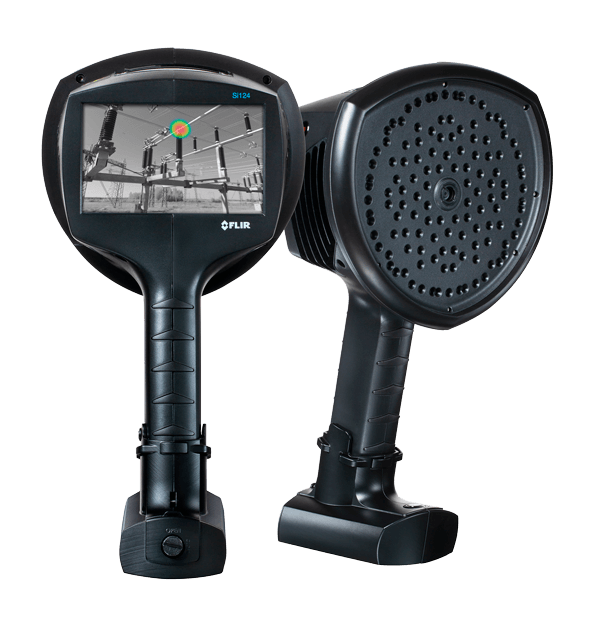
FLIR Si124 Acoustic Imaging Camera
Acoustic imaging cameras have become a valuable and effective resource for detecting compressed air leaks in mining operations. These cameras offer the advantage of quickly and accurately locating the source of a leak, requiring minimal operator training, even in environments with high noise levels and complexity. As a result, mines can quickly take corrective action to reduce energy waste, mitigate safety risks and optimize the performance of their equipment.
To meet the challenges of the mining industry, mining companies can turn to technology with a special emphasis on condition monitoring. The FLIR Si124 acoustic imaging camera offers a powerful solution for condition monitoring in mining and is specifically designed to discover compressed air leaks as well as partial discharges such as corona and arcing in medium and high voltage electrical systems.
Built with 124 microphones, the FLIR Si124 can detect and locate even very quiet noises at great distances, making it ideal for the harsh environment of mining operations. The sensitive microphones of the FLIR Si124 are also advantageous when inspecting high-voltage systems, which requires a safe distance from energized equipment.

FLIR Si124 acoustic imaging camera detecting compressed air leakage
The addition of FLIR Thermal Studio Suite desktop software provides an added benefit by integrating thermal and acoustic images into a single report. This dual functionality improves maintenance decision making while eliminating the need to learn multiple software platforms.
The companion FLIR Acoustic Camera Viewer is a web-based reporting software that enables fast upload of images via Wi-Fi for immediate analysis. This service provides users with valuable information such as waveform and energy costs of compressed air leaks, as well as classification, severity assessment and recommended corrective actions for partial discharges.

FLIR Si-Series Plugin for FLIR Thermal Studio
The FLIR Si124 acoustic imaging camera improves the operational continuity of mining facilities. The camera detects compressed air leaks at an early stage, reducing energy waste and economic losses. It also helps to avoid unplanned downtime caused by high-voltage component failures and helps to ensure a constant and uninterrupted power supply, which is necessary for mining and production.
The camera requires minimal training and is easy to incorporate into the maintenance cycle of mining facilities, even in the noisiest areas.
Advantages of the use of acoustic imaging cameras in mining operations
Increased energy efficiency
In the mining industry, compressed air leaks can contribute significantly to energy waste. However, by using acoustic imaging cameras to quickly detect and fix leaks, mining operations can improve their energy efficiency and reduce overall energy consumption. This, in turn, reduces operating costs and environmental impact.
Increased productivity
Compressed air leaks can negatively affect the productivity of mining operations by impeding the efficiency of pneumatic equipment. By quickly identifying and repairing these leaks, mining companies can optimize equipment performance and improve overall productivity.
Cost savings
The FLIR Si124 acoustic imaging camera can help ensure a constant and uninterrupted power supply, vital for mining and production. FLIR Si124 can also help save money for mining operations. To estimate the potential energy a plant could save by detecting and repairing air leaks, relative to the cost of the camera itself, the Si124-LD ROI calculator can be used.
Eight advantages of using an acoustic imaging camera to monitor the state of the mining industry
- Reduces energy waste and economic losses by locating compressed air leaks at an early stage.
- Avoids unplanned downtime caused by high voltage (HV) electrical component failures.
- Improved operational continuity and uninterrupted power supply.
- Helps prevent potentially dangerous accidents through early detection of partial discharges in medium and high voltage electrical transmission and distribution equipment.
- It enables condition-based maintenance over large areas safely and efficiently and without stopping operation, as the non-contact camera operates from an operating distance of 0.3 m up to 130 m (1 ft).
- It requires minimal training and is easy to incorporate into the maintenance cycle of mining facilities.
- It complements thermography equipment for better overall inspection of mining equipment assets.
- It allows professionals to complete their inspections 10 times faster than with traditional methods.
Conclusion
In conclusion, the use of air compressors in mining has revolutionized the industry, providing reliable and efficient equipment to ensure that miners can get the job done safely and efficiently. Compressed air is used in many different mining processes, from blasting and drilling to ventilation and cleaning. It is a versatile and convenient power source that can withstand the hard wear and tear of mining.
However, leaks in the compressed air system can be detrimental to the mining process by increasing energy costs, reducing tool efficiency and increasing maintenance requirements. The FLIR Si124 acoustic imaging camera offers a powerful solution for monitoring the condition of mining facilities, detecting compressed air leaks at an early stage and improving operational continuity.
Mining companies can benefit greatly from the use of air compressors and condition monitoring technology, ensuring maximum efficiency and safety in their operations.